Is There a Hantavirus Vaccine?
The Direct Answer
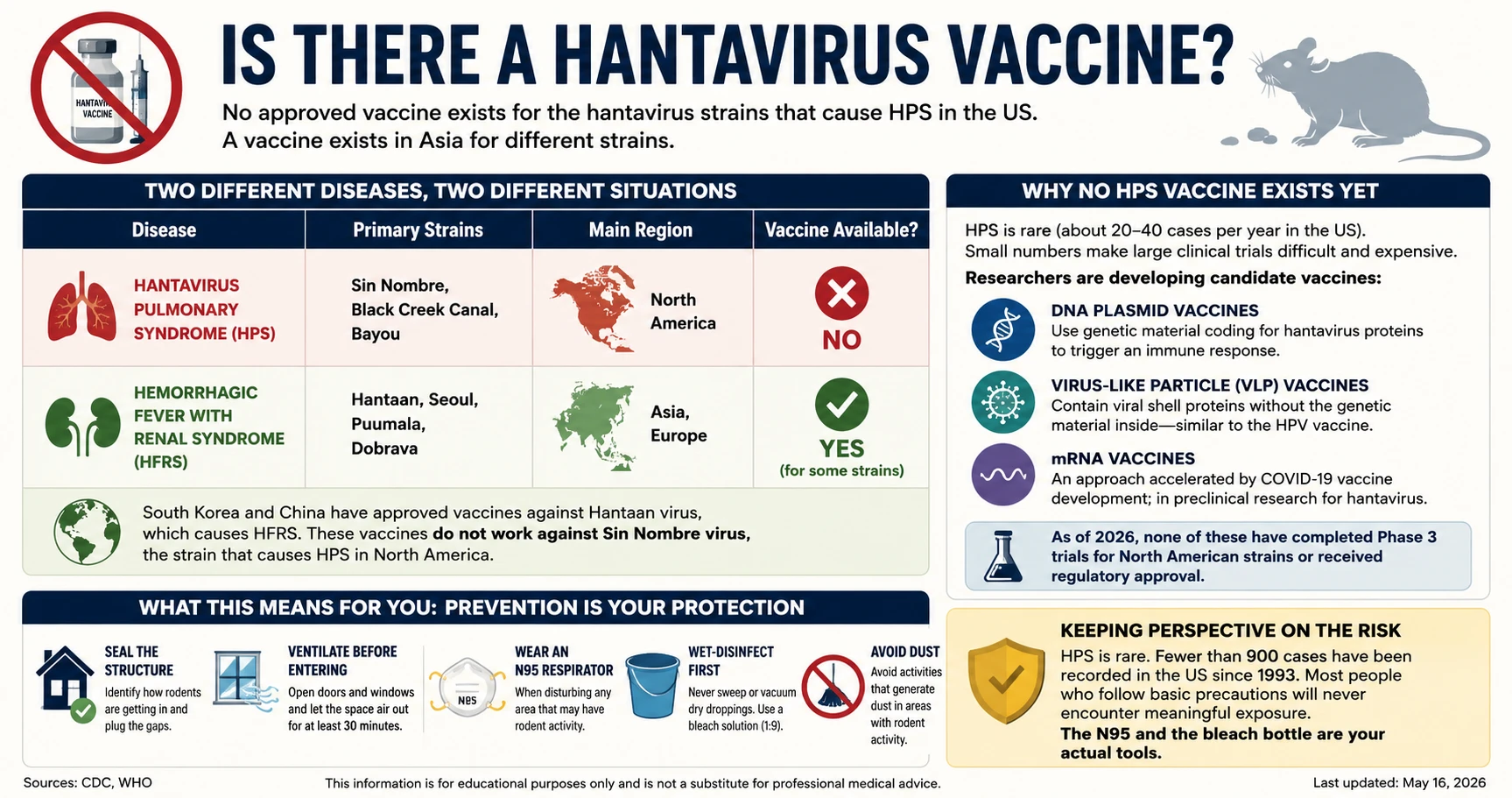
There is no vaccine for hantavirus in the United States. The strain that causes Hantavirus Pulmonary Syndrome — Sin Nombre virus, carried primarily by deer mice — has no approved vaccine for human use. If you are in an area with hantavirus risk, there is no shot you can get beforehand. Avoiding exposure is the only protection available.
Two Different Diseases, Two Different Situations
The word "hantavirus" covers a family of related viruses that cause two distinct diseases depending on the strain:
| Disease | Primary Strains | Main Region | Vaccine Available? |
|---|---|---|---|
| Hantavirus Pulmonary Syndrome (HPS) | Sin Nombre, Black Creek Canal, Bayou | North America | No |
| Hemorrhagic Fever with Renal Syndrome (HFRS) | Hantaan, Seoul, Puumala, Dobrava | Asia, Europe | Yes (for some strains) |
South Korea and China have approved vaccines against Hantaan virus, which causes a severe form of HFRS responsible for tens of thousands of cases annually in Asia. These vaccines work against the specific strains dominant in that region.
They don't work against Sin Nombre virus. The two strains are genetically and structurally different enough that the Asian vaccines provide no meaningful cross-protection for North American HPS.
Why No HPS Vaccine Exists Yet
Vaccine development follows a predictable logic: the investment is proportional to the disease burden. HPS, while severe, causes roughly 20–40 reported cases per year in the United States. That's a much smaller patient population than influenza or COVID-19, which makes large Phase 3 clinical trials — the gold standard for vaccine approval — difficult and expensive to run.
The situation isn't that scientists don't know how to approach it. Multiple candidate vaccines have shown promising results in animal models:
- DNA plasmid vaccines: injecting genetic material coding for hantavirus proteins, triggering an immune response. Several candidates reached early-phase human trials.
- Virus-like particle (VLP) vaccines: assembled viral shell proteins without the infectious genetic material inside — similar in concept to the HPV vaccine.
- mRNA vaccines: accelerated interest following the COVID-19 mRNA vaccine development; applied to hantavirus strains in preclinical research.
As of 2026, none of these have completed Phase 3 trials for North American strains and received regulatory approval.
What This Means for You
If you're going to spend time in a high-risk environment — rural western US, a cabin that's been closed for months, an RV, a barn — prevention is entirely behavioral and physical, not pharmaceutical.
The prevention measures that actually work:
- Seal the structure before arriving, or at least identify how rodents are getting in and plug the gaps
- Ventilate before entering — open doors and windows and let the space air out for at least 30 minutes before working inside
- Wear an N95 respirator when disturbing any area that may have rodent activity
- Never sweep or vacuum dry droppings — wet-disinfect first with a bleach solution (1 part bleach to 9 parts water)
- Avoid activities that generate dust in areas with known rodent activity
These steps work. The 2012 Yosemite outbreak was traced to inadequate rodent exclusion in tent cabins — a structural problem, not a behavior problem. Most HPS cases are preventable with correct exposure avoidance.
Keeping Perspective on the Risk
HPS is rare. Fewer than 900 cases have been recorded in the US in the 30+ years since the disease was identified in 1993. Most people who spend time in rural environments and follow basic precautions will never encounter meaningful exposure.
The absence of a vaccine is a gap worth knowing about — so you don't go into a high-risk situation assuming a shot protects you. It doesn't. The N95 and the bleach bottle are your actual tools.
Official Sources
- CDC Hantavirus: Prevention — exposure prevention guidance
- WHO Hantavirus Fact Sheet — global disease overview and vaccine status
Sources & References
- CDC — Centers for Disease Control and Prevention
Hantavirus: Prevention, Symptoms & Control
- WHO — World Health Organization
Hantavirus Disease: Fact Sheet
All health claims on this page are verified against the primary sources listed above. View our Editorial Policy
Frequently Asked Questions
Medical Disclaimer
The information on this page is for educational purposes only and is not medical advice. If you believe you may have been exposed to hantavirus or are experiencing symptoms, contact a qualified healthcare professional or local health authority immediately.