What Is Hantavirus? The Basics Before You Touch Anything
Most people don't think about hantavirus until they find mouse droppings somewhere in their home — an attic, a garage, a cabin that's been closed up all winter. Then suddenly the question matters.
So here's the plain-language version: what the virus actually is, where it comes from, and why it's treated so seriously. No textbook definitions. Just what you actually need to know before you touch anything.
What Is Hantavirus?
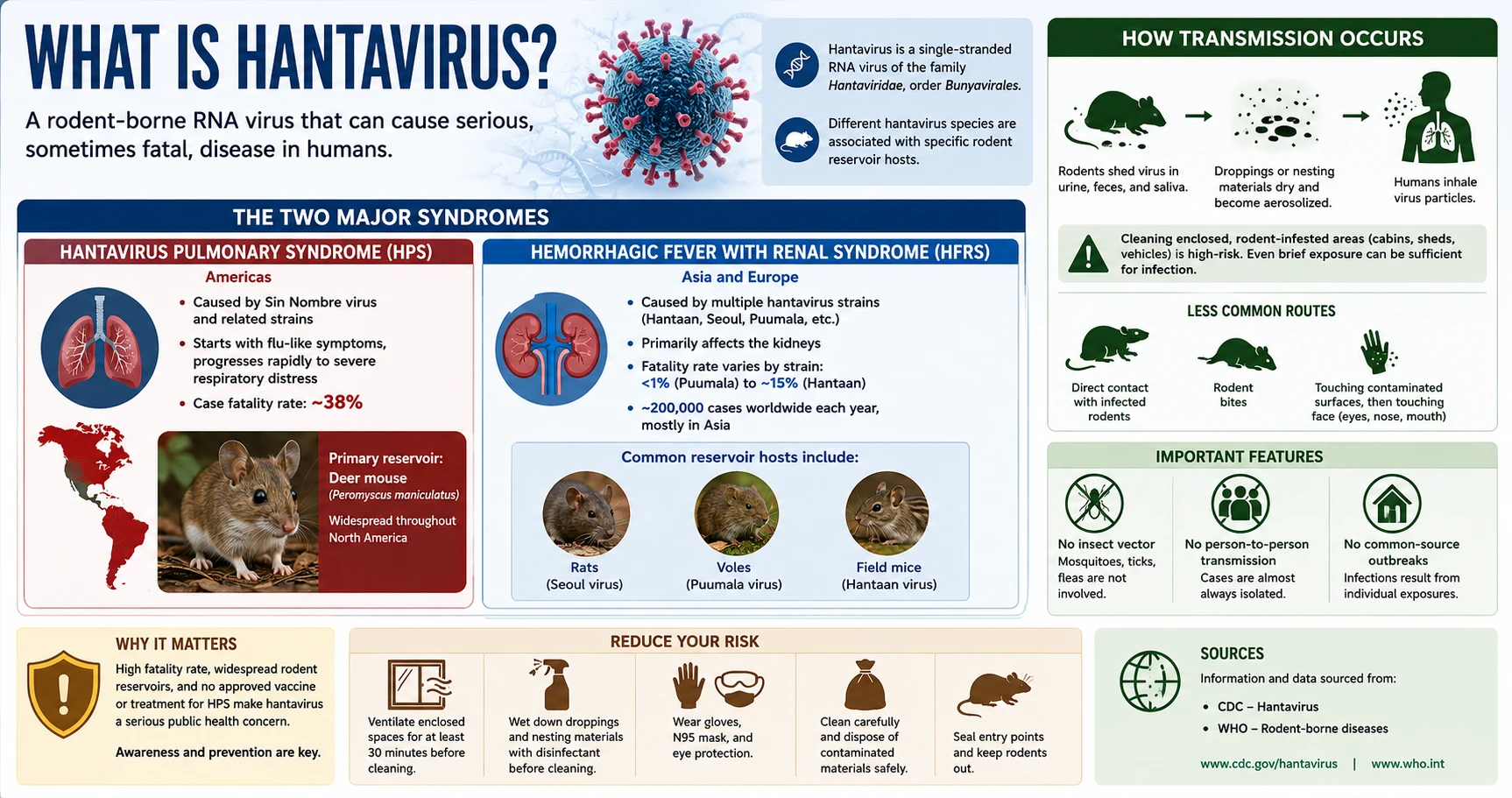
Hantavirus is a family of viruses carried silently by specific rodent species — the animals don't get sick, but the virus persists in their urine, droppings, and saliva. When a human disturbs that material and breathes in the dust, transmission can occur.
Researchers have identified dozens of distinct hantavirus strains across the globe, each associated with a particular rodent host. In North America, the one that matters is Sin Nombre virus, carried by the deer mouse.
The Two Major Syndromes
Not all hantavirus infections look the same. Where you are in the world largely determines which strain you might encounter and which disease it causes.
Hantavirus Pulmonary Syndrome (HPS)
HPS is the primary clinical concern in North and South America. It is caused by Sin Nombre virus and closely related strains. The disease begins with flu-like symptoms but progresses rapidly to severe respiratory distress as the lungs fill with fluid. The case fatality rate for HPS is approximately 38 percent, making it one of the most lethal rodent-borne diseases in the Western Hemisphere.
The deer mouse (Peromyscus maniculatus) is the primary reservoir host for Sin Nombre virus in the United States. This small, white-bellied mouse is found throughout most of the continental US, particularly in rural and wilderness areas. Because the deer mouse looks similar to the common house mouse to an untrained eye, correct identification matters.
Hemorrhagic Fever with Renal Syndrome (HFRS)
HFRS is the dominant hantavirus disease in Asia and Europe. It is caused by several different hantavirus strains, including Hantaan virus (Southeast Asia), Seoul virus (globally distributed via the common rat), and Puumala virus (Northern and Central Europe). HFRS primarily damages the kidneys rather than the lungs, and its fatality rate varies by strain, ranging from less than 1 percent for Puumala infections to around 15 percent for Hantaan infections.
Globally, HFRS accounts for an estimated 200,000 cases per year, the vast majority occurring in China and other parts of East Asia. By raw case count, HFRS is a far larger public health problem than HPS, even though HPS receives more attention in North American media.
How Transmission Occurs
The mechanism of infection is consistent across hantavirus strains. Rodents shed the virus in their urine, feces, and saliva. When dried rodent droppings or nesting material are disturbed, virus particles become airborne and can be breathed in by nearby humans. This is why cleaning out a long-unused cabin, shed, or vehicle is considered higher-risk than simply being outdoors in an area where deer mice are present.
Most people who encounter rodent droppings — even without proper precautions — do not develop hantavirus. But the disease is serious enough that the circumstances matter: an enclosed, poorly ventilated space with significant rodent activity carries real risk, and brief disturbance in that environment can be enough for exposure.
Less commonly, hantavirus can be transmitted through direct contact with infected rodents, through rodent bites, or through touching contaminated surfaces and then touching the mouth, nose, or eyes. However, breathing in airborne particles remains the dominant route of infection.
No Insect Vector, No Common-Source Outbreak
One important feature of hantavirus epidemiology is that there is no insect carrier transmitting the virus between people or between rodents and people. Mosquitoes, ticks, and fleas play no role. This means that hantavirus outbreaks do not spread across populations the way vector-borne diseases can. Cases are almost always isolated and linked to individual exposure events with infected rodents or their contaminated environment.
In North America, there is no documented person-to-person transmission of Sin Nombre virus. Each case reflects a direct exposure to rodent material.
What This Means If You Found Droppings
If you're reading this because you just found droppings in your garage, attic, cabin, or RV — the relevant facts are these: the risk is real but not automatic, the primary danger is disturbing dried material in an enclosed space without respiratory protection, and knowing the difference between deer mice and house mice matters because house mice are not a known carrier of hantavirus in the US.
There is no vaccine and no specific antiviral treatment for HPS. The only tools available are prevention, correct rodent identification, and safe cleanup. Those are the things worth understanding before you go back in.
Official Sources
- CDC Hantavirus — disease biology, transmission, and prevention
- WHO Hantavirus Fact Sheet — global strain distribution and disease burden
Sources & References
- CDC — Centers for Disease Control and Prevention
Hantavirus: Prevention, Symptoms & Control
- WHO — World Health Organization
Hantavirus Disease: Fact Sheet
All health claims on this page are verified against the primary sources listed above. View our Editorial Policy
Frequently Asked Questions
Medical Disclaimer
The information on this page is for educational purposes only and is not medical advice. If you believe you may have been exposed to hantavirus or are experiencing symptoms, contact a qualified healthcare professional or local health authority immediately.