How Long Does Hantavirus Survive Outside a Host?
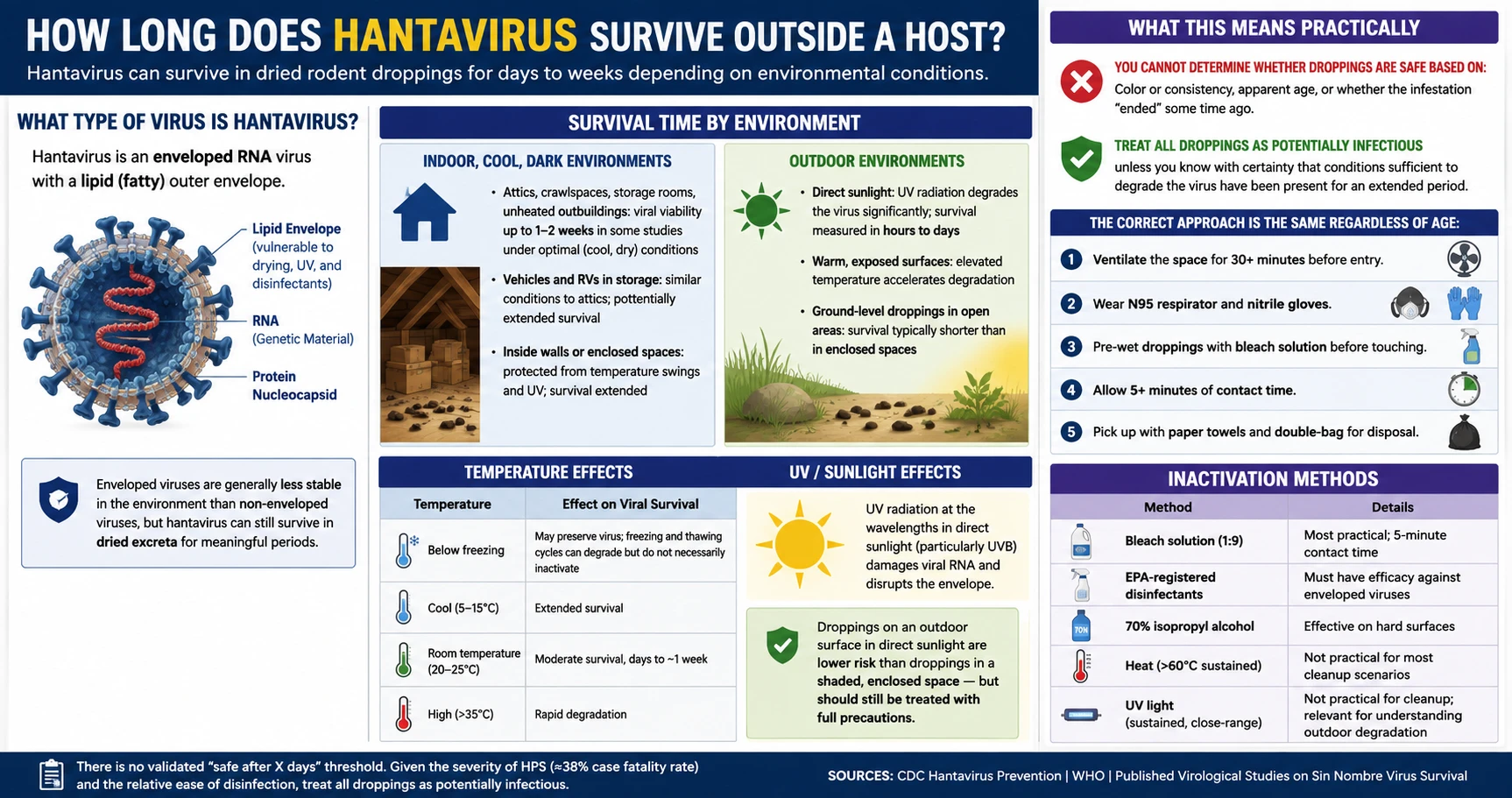
If you're asking because you found old droppings in a garage, attic, shed, or stored vehicle — the honest answer is: there's no precise expiration date, and conditions matter enormously. A sealed crawlspace in cool weather is very different from droppings left on an outdoor surface in direct summer sun.
Why Hantavirus Can Survive — and Why Bleach Works
Unlike some viruses, hantavirus has a lipid outer envelope — essentially a fatty membrane that encases the viral material. That envelope is its weakness: UV radiation, heat, and disinfectants that break down lipids (like bleach) can inactivate it.
But that vulnerability doesn't mean the virus dies quickly in all environments. In cool, dark, enclosed spaces — the exact conditions found in attics, stored RVs, closed cabins, and unheated garages — the envelope stays intact longer, and the virus can remain viable for days to weeks.
Survival Time by Environment
Indoor, Cool, Dark Environments
- Attics, crawlspaces, storage rooms, unheated outbuildings: Viral viability up to 1–2 weeks reported in some studies under optimal (cool, dry) conditions
- Vehicles and RVs in storage: Similar conditions to attics; potentially extended survival
- Inside walls or enclosed spaces: Protected from temperature swings and UV; survival extended
Outdoor Environments
- Direct sunlight: UV radiation degrades the virus significantly; survival measured in hours to days
- Warm, exposed surfaces: Elevated temperature accelerates degradation
- Ground-level droppings in open areas: Survival typically shorter than in enclosed spaces
Temperature Effects
| Temperature | Effect on Viral Survival |
|---|---|
| Below freezing | May preserve virus; freezing and thawing cycles can degrade but do not necessarily inactivate |
| Cool (5–15°C) | Extended survival |
| Room temperature (20–25°C) | Moderate survival, days to ~1 week |
| High (>35°C) | Rapid degradation |
UV / Sunlight Effects
UV radiation at the wavelengths in direct sunlight (particularly UVB) damages viral RNA and disrupts the envelope. Droppings on an outdoor surface in direct sunlight are lower risk than droppings in a shaded, enclosed space — but should still be treated with full precautions.
What This Means Practically
You cannot determine whether droppings are safe based on:
- Color or consistency
- Apparent age
- Whether the infestation "ended" some time ago
Treat all droppings as potentially infectious unless you know with certainty that conditions sufficient to degrade the virus have been present for an extended period. A few droppings on an outdoor surface that's been in direct summer sun for weeks is a genuinely lower-risk situation than a pile of accumulated droppings in a sealed attic or storage unit — but the cleanup protocol is the same either way.
The correct approach is the same regardless of age:
- Ventilate the space for 30+ minutes before entry
- Wear N95 respirator and nitrile gloves
- Pre-wet droppings with bleach solution before touching
- Allow 5+ minutes of contact time
- Pick up with paper towels and double-bag for disposal
How Long Until an Area Is Safe Without Disinfection?
This is a question the research cannot answer precisely. There is no validated "safe after X days" threshold. Variables include:
- Ambient temperature (often fluctuating)
- UV exposure (depends on window exposure, time of year)
- Humidity
- Viral load in original deposit
- Species of hantavirus
With a 38% case fatality rate and no approved antiviral treatment, the case for treating all droppings — regardless of age — is straightforward. Bleach solution costs almost nothing and takes five minutes. The alternative isn't worth it.
Inactivation Methods
The following reliably inactivate hantavirus:
| Method | Details |
|---|---|
| Bleach solution (1:9) | Most practical; 5-minute contact time |
| EPA-registered disinfectants | Must have efficacy against enveloped viruses |
| 70% isopropyl alcohol | Effective on hard surfaces |
| Heat (>60°C sustained) | Not practical for most cleanup scenarios |
| UV light (sustained, close-range) | Not practical for cleanup; relevant for understanding outdoor degradation |
Official Sources
- CDC Hantavirus — viral survival and environmental persistence data
- CDC: Cleaning Up After Rodents — disinfection guidance based on viral survival
Sources & References
- CDC — Centers for Disease Control and Prevention
Hantavirus: Prevention, Symptoms & Control
- WHO — World Health Organization
Hantavirus Disease: Fact Sheet
All health claims on this page are verified against the primary sources listed above. View our Editorial Policy
Frequently Asked Questions
Medical Disclaimer
The information on this page is for educational purposes only and is not medical advice. If you believe you may have been exposed to hantavirus or are experiencing symptoms, contact a qualified healthcare professional or local health authority immediately.