Can You Vacuum Mouse Droppings? Why You Should Never Do It
The Scenario
You found droppings in a kitchen drawer, along a baseboard in the garage, or scattered across the floor of an RV you just opened for the season. You want them gone. The vacuum is right there — it seems like the obvious tool.
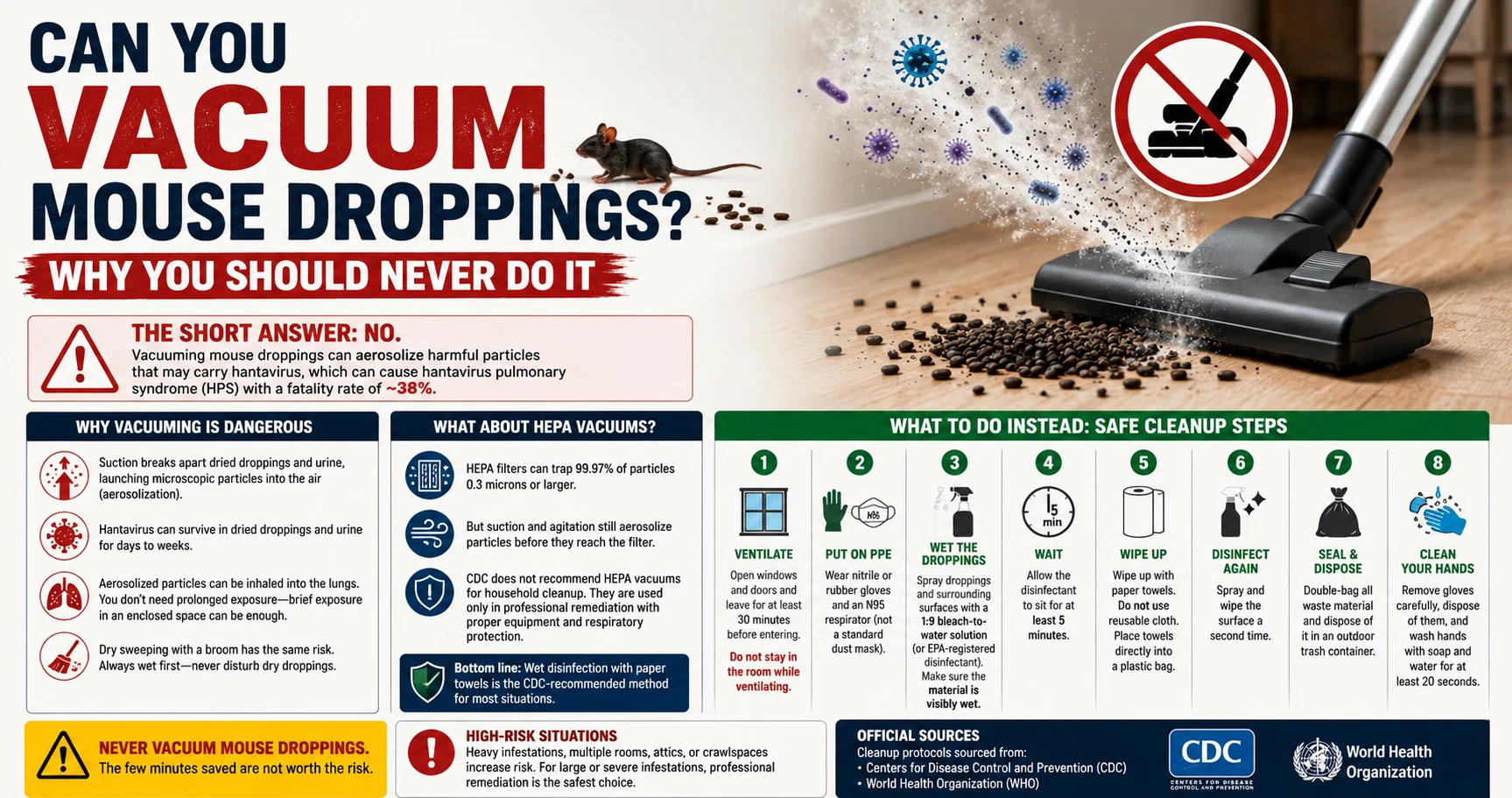
Don't use it. Health agencies specifically advise against vacuuming rodent droppings, because the suction sends contaminated dust into the air before any filter can catch it.
This question — "I already vacuumed, is that bad?" — is one of the most consistent patterns in online forums and pest control discussions. People vacuum first, then check. If that's you, scroll to If You Already Vacuumed below.
The Short Answer: No
The CDC recommends against vacuuming mouse droppings. Not because a few droppings in a ventilated kitchen is necessarily a medical emergency — but because vacuuming is the wrong tool for this specific job. It reliably makes the situation worse.
The safe alternative is wet disinfection: spray first, wait, then wipe. It takes about the same time and actually works.
Why Vacuuming Spreads the Problem
When you run a vacuum over dry droppings, the suction breaks apart the dried material and launches particles into the air — before they ever reach the filter. Hantavirus survives in dried droppings and can be breathed in once airborne. Brief exposure in a small enclosed space with active vacuum airflow is enough to create risk.
The same applies to dry sweeping. Any action that disturbs dry droppings without wetting them first creates a potential breathing hazard.
What About HEPA Filter Vacuums?
HEPA filters capture 99.97% of particles 0.3 microns or larger — and the CDC still doesn't recommend them as the primary household method.
The issue isn't whether the filter catches particles. It's what happens during operation. The suction, airflow, and agitation send material airborne before it reaches the filter. Viruses can also travel in clumps with other debris, or escape through gaskets on older units.
HEPA vacuums do have a role in professional remediation of heavily infested properties, where contractors use industrial equipment with full respiratory protection. For a typical household cleanup — droppings in a kitchen cabinet, under a sink, or along a baseboard — wet disinfection with paper towels is the right approach.
If You Already Vacuumed
This is probably why a lot of people find this page. You vacuumed first, and now you're wondering what to do.
The risk depends heavily on context. A quick pass over a couple of droppings in a well-ventilated room is a very different situation from running a shop vac for 20 minutes in a sealed attic. Most people who accidentally vacuum a small number of droppings in a normal household setting do not go on to develop illness — but because hantavirus has an incubation period of up to 8 weeks, it's worth monitoring.
What to do now:
- Ventilate immediately — open windows and leave the area for at least 30 minutes
- Clean the vacuum — empty the canister outdoors, double-bag the contents, wipe the interior with disinfectant
- Watch for symptoms — fever, severe muscle aches, and fatigue in the 2–8 weeks following exposure, especially if cleanup happened in a high-risk environment like a sealed cabin, attic, or RV
- Tell your doctor if symptoms develop — mention the exposure and when it happened
What to Do Instead
Step 1 — Ventilate first. Open windows and doors and leave for at least 30 minutes before touching anything. Don't stay in the room while it airs out.
Step 2 — Put on PPE. Nitrile or rubber gloves, and an N95 respirator. A standard dust mask won't filter viral particles.
Step 3 — Wet the droppings. Spray with a disinfectant — a 1:9 bleach-to-water solution is the CDC standard. The material should be visibly wet.
Step 4 — Wait 5 minutes. This is the contact time needed to inactivate the virus. Don't skip it.
Step 5 — Wipe up with paper towels. Bag them immediately.
Step 6 — Disinfect the surface again. Second pass with disinfectant, then wipe.
Step 7 — Double-bag and dispose. Seal all waste and put it in an outdoor bin.
Step 8 — Wash hands. Remove gloves carefully, bag them, and wash hands with soap and water for at least 20 seconds.
High-Risk Situations
A small number of droppings in a kitchen or bathroom — with good airflow and proper wet disinfection — is manageable without professional help.
A heavy infestation is different. Multiple rooms, attic or crawlspace contamination, a cabin sealed all winter with accumulated nesting material — those situations warrant professional remediation. Enclosed spaces with poor ventilation dramatically increase risk during any cleanup activity.
Official Sources
- CDC: Cleaning Up After Rodents — official protocol advising against vacuuming
- CDC Hantavirus Prevention — prevention and disinfection guidelines
Sources & References
- CDC — Centers for Disease Control and Prevention
Hantavirus: Prevention, Symptoms & Control
- cdc.gov — Cleaning Up
https://www.cdc.gov/hantavirus/prevention/cleaning-up.html
- WHO — World Health Organization
Hantavirus Disease: Fact Sheet
All health claims on this page are verified against the primary sources listed above. View our Editorial Policy
Frequently Asked Questions
Medical Disclaimer
The information on this page is for educational purposes only and is not medical advice. If you believe you may have been exposed to hantavirus or are experiencing symptoms, contact a qualified healthcare professional or local health authority immediately.