What PPE to Wear When Cleaning Mouse Droppings
Most people show up to this job with what's already in the house — a paper dust mask from a painting project, maybe some latex gloves. That's the setup that creates problems.
The issue isn't that cleanup is dangerous in some abstract way. It's that the things that feel protective (a mask on your face, gloves on your hands) aren't actually protective unless they're the right ones. Here's what works and why.
How Much PPE Do You Actually Need?
This depends on scale and location, not just the number of droppings.
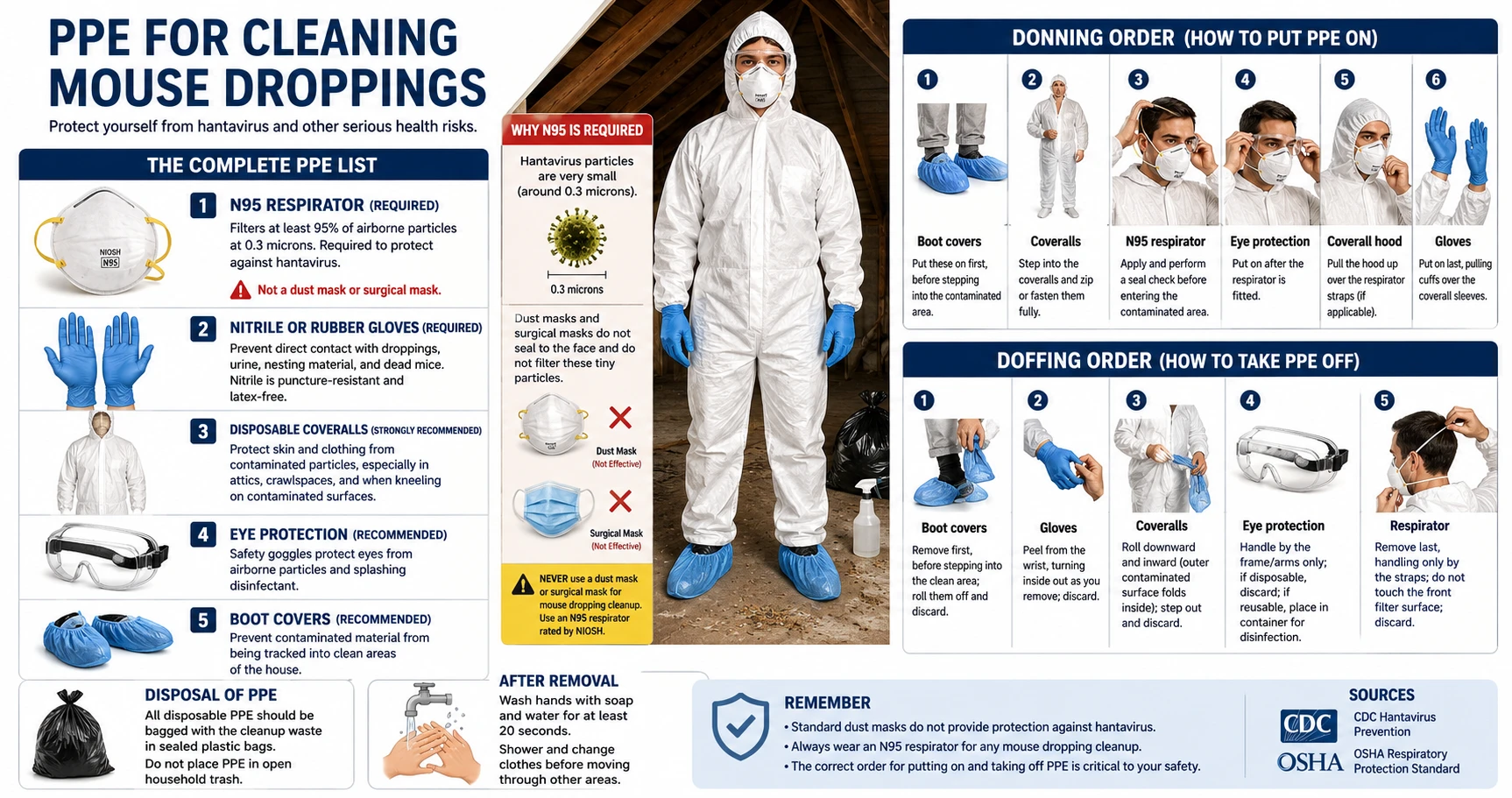
A few droppings in a ventilated kitchen or bathroom — gloves and an N95 are the minimum, and for a small, contained cleanup they're usually sufficient. Skip the coveralls if the area is open and you're not reaching into confined spaces.
A garage, storage area, or room with widespread droppings — gloves, N95, and coveralls. You'll be moving around, possibly kneeling, possibly reaching behind things. Contaminated dust ends up on clothing.
An attic, crawlspace, or anywhere with accumulated droppings and disturbed insulation — full kit: N95 (or P100), gloves, coveralls, goggles, boot covers. Enclosed spaces with poor ventilation and years of accumulated material are a different situation entirely.
The Respirator — This Is the Critical One
An N95 respirator is the minimum appropriate respiratory protection. It's certified by NIOSH to filter at least 95% of airborne particles at 0.3 microns — the size range where hantavirus falls.
What won't work:
- Paper dust masks — no face seal, no certification, filters large particles only. The kind you'd wear sanding drywall does nothing for viral particles.
- Blue surgical/procedure masks — loose-fitting by design. They weren't made for this.
N95s are at hardware stores, pharmacies, and online. Look for the NIOSH approval marking on the packaging. They're single-use — dispose after each session.
A few practical notes: N95s get uncomfortable in hot spaces. If you're cleaning an attic in summer, the mask will feel tight and warm after 20 minutes. That's normal. Resist the urge to pull it down to catch your breath — step outside the space instead. If you're doing extended attic work, a P100 half-face respirator is more breathable and provides a higher level of protection.
Gloves
Nitrile gloves are the right choice — puncture-resistant, no latex allergy risk, and available in different thicknesses. The thin examination-style nitrile gloves work for most cleanups. For rough environments like attics with exposed staples and nail heads, or garages with metal shelving, heavier utility nitrile gloves are less likely to tear mid-job.
Pull glove cuffs over your sleeves. When you're reaching into spaces you can't fully see, gloves that only cover the hand leave your wrist exposed.
Coveralls
Disposable Tyvek coveralls matter most when contaminated material is likely to land on you from above (attics, crawlspaces) or when you're working in close contact with contaminated surfaces — kneeling on a garage floor, moving stored items, reaching into wall cavities.
If you don't have coveralls, old clothes you can immediately seal in a bag and wash at high heat are an acceptable substitute for moderate cleanups. After an attic job, shower before going through the rest of the house.
Eye Protection
Safety goggles — the kind that fully enclose the eye socket — matter most when you're spraying disinfectant overhead or working in dusty, confined spaces. Bleach spray tends to drip when you're wiping ceiling surfaces or the undersides of shelves, and goggles prevent it from reaching your eyes.
Note: goggles fog up, especially in warm enclosed spaces. Anti-fog treated goggles exist; they're worth it if you're doing extended work in an attic or crawlspace.
Boot Covers
Most relevant when moving between contaminated and clean areas — attic to living space, garage to house. Disposable boot covers prevent tracking contaminated material through the home.
Putting It On — Order Matters
Put everything on before entering the contaminated area. The order:
- Boot covers
- Coveralls — zip fully
- N95 — fit and seal check before you go in
- Goggles — after the respirator is seated
- Coverall hood if applicable — pull over the respirator straps
- Gloves last — cuffs pulled over coverall sleeves
Once you're working in the contaminated area, don't adjust your respirator or goggles with gloved hands.
Taking It Off — Where People Go Wrong
This step is where cross-contamination usually happens. Remove everything at the boundary between the contaminated space and the clean area — not inside, not in the middle of the house.
- Boot covers — roll off before stepping into the clean area, discard
- Gloves — grip the outside at the wrist and peel off, turning inside out as you pull; the contaminated outer surface ends up contained inside
- Coveralls — roll downward and inward, outer surface folding in; step out and discard
- Goggles — handle by the frame or arms only; if reusable, set aside for disinfection
- Respirator last — remove by the straps only, don't touch the front filter; discard
Wash hands with soap and water for at least 20 seconds after. Shower before going through the rest of the house.
If You Already Started Without the Right Gear
Stop where you are. If you've been working bare-handed or with a dust mask, don't panic — the exposure risk from a brief encounter is lower than from sustained work in an enclosed space — but do wash your hands now and don't touch your face.
Get gloves and an N95 before continuing. Go back over whatever you've already cleaned with proper disinfectant — spray, wait 5 minutes, wipe — because the earlier pass without gloves likely spread contamination more than it removed.
If you were in an enclosed space for an extended period without a respirator, note the date and monitor for symptoms (fever, deep muscle aches, fatigue) for up to 8 weeks.
Official Sources
- CDC: Cleaning Up After Rodents — PPE requirements for rodent cleanup
- CDC Hantavirus Prevention — prevention guidelines
- OSHA Respiratory Protection — N95 respirator standards
Sources & References
- CDC — Centers for Disease Control and Prevention
Hantavirus: Prevention, Symptoms & Control
- cdc.gov — Cleaning Up
https://www.cdc.gov/hantavirus/prevention/cleaning-up.html
- WHO — World Health Organization
Hantavirus Disease: Fact Sheet
All health claims on this page are verified against the primary sources listed above. View our Editorial Policy
Frequently Asked Questions
Medical Disclaimer
The information on this page is for educational purposes only and is not medical advice. If you believe you may have been exposed to hantavirus or are experiencing symptoms, contact a qualified healthcare professional or local health authority immediately.