Deer Mouse vs House Mouse: Key Differences and Disease Risk
Why the Distinction Matters
The single most common misunderstanding in online rodent discussions: "I have a mouse problem, should I worry about hantavirus?" — followed by "what kind of mouse is it?" Most people can't answer the second question, because they've never had to identify a wild mouse before. This guide gives you the visual markers that actually work.
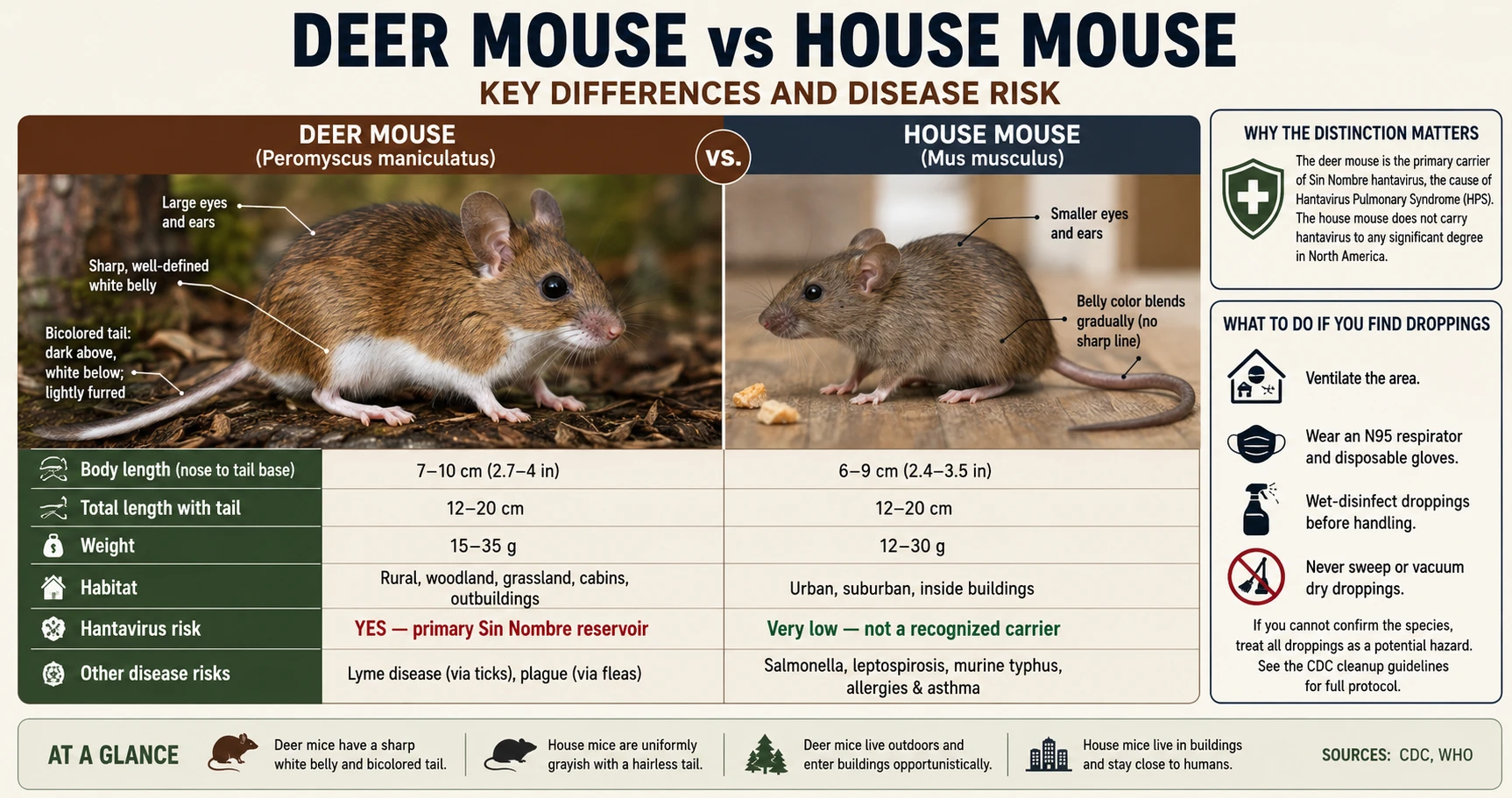
Most people who find a mouse in their kitchen or apartment assume it's just a house mouse. That's usually right — but if you're in a rural area, cabin, garage, or outbuilding, the assumption is worth questioning. In North America, the deer mouse (Peromyscus maniculatus) is the primary reservoir for Sin Nombre virus, the hantavirus strain responsible for Hantavirus Pulmonary Syndrome. The house mouse (Mus musculus) is not a recognized hantavirus carrier. Getting the identification right before you start cleaning can meaningfully change how cautious you need to be.
Quick Comparison Table
| Feature | Deer Mouse | House Mouse |
|---|---|---|
| Body length (nose to tail base) | 7–10 cm (2.7–4 in) | 6–9 cm (2.4–3.5 in) |
| Total length with tail | 12–20 cm | 12–20 cm |
| Weight | 15–35 g | 12–30 g |
| Coat color — back | Brown to reddish-brown | Gray to grayish-brown |
| Coat color — belly | Sharply defined white | Pale gray or off-white, blending gradually |
| Tail | Bicolor: dark above, white below; lightly furred | Single color (gray/brown); nearly hairless |
| Ears | Relatively large, prominent | Smaller, rounded |
| Eyes | Large, prominent | Smaller |
| Habitat | Rural, woodland, grassland, cabins, outbuildings | Urban, suburban, inside buildings |
| Hantavirus risk | YES — primary Sin Nombre reservoir | Very low — not a recognized carrier |
| Other disease risks | Lyme disease (via ticks), plague (via fleas) | Salmonella, leptospirosis, murine typhus |
Identifying Features in Detail
Coat and Belly Contrast
The most reliable field identification is the belly contrast on the deer mouse. The transition from brown back to white belly is sharp and clearly defined, almost like a painted line along the flank. On a house mouse, the underside is a lighter shade of gray that blends gradually from the back — there is no clean boundary.
Tail
The deer mouse tail is bicolored: noticeably darker on top and white or pale underneath, with light fuzz along the length. A house mouse tail is uniformly gray-brown and nearly hairless, which gives it a smooth, bare appearance.
The tail is often more reliable than body color for identification — especially with juvenile deer mice, which haven't fully developed the sharp belly contrast yet. If the tail is clearly two-toned, you're looking at a deer mouse regardless of age.
Eyes and Ears
Deer mice have noticeably larger, more prominent eyes and ears relative to their head size — adaptations for a life spent outdoors with active predators. House mice have smaller, less striking eyes and ears.
Habitat and Behavior
House mice are commensal rodents — they have evolved to live alongside humans in buildings, warehouses, and urban infrastructure. They rarely venture far from human structures.
Deer mice are wild rodents that enter human spaces opportunistically, especially in autumn when temperatures drop. They are the rodent most commonly found in rural cabins, sheds, RVs, and outbuildings that are left unoccupied for months at a time.
Disease Risk: Deer Mouse
The deer mouse is the primary carrier of Sin Nombre hantavirus across most of North America. Infected deer mice shed the virus in urine, droppings, and saliva. Humans are exposed primarily by breathing in dust particles from dried droppings — particularly in enclosed spaces that have been shut up for extended periods.
Deer mice can also carry Borrelia burgdorferi (the Lyme disease bacterium) indirectly, as a host for infected blacklegged ticks.
Disease Risk: House Mouse
If you're in a city or suburb and found droppings in your kitchen, there's actually a reasonable chance this isn't a major hantavirus concern — house mice are not recognized hantavirus carriers in North America. That's genuinely good news for most urban homeowners. The hantavirus risk is specific to deer mice, which are far more common in rural areas, cabins, sheds, and outbuildings than in city apartments.
That said, house mice are not without health risk:
- Salmonellosis: contamination of food surfaces and stored food
- Leptospirosis: shed in urine, can infect through cuts or mucous membranes
- Murine typhus: transmitted via fleas that infest house mice
- Allergies and asthma: mouse dander is a significant indoor allergen
What To Do If You Find Droppings
If you cannot confirm the species, treat any rodent droppings as a potential hazard. Ventilate the area, wear an N95 respirator and disposable gloves, wet-disinfect the droppings before handling, and never sweep or vacuum dry droppings. See the CDC cleanup guidelines for full protocol.
Official Sources
- CDC Hantavirus: Rodents — deer mouse as primary reservoir species
- CDC Rodent Control — identification and species differentiation
Sources & References
- CDC — Centers for Disease Control and Prevention
Hantavirus: Prevention, Symptoms & Control
- WHO — World Health Organization
Hantavirus Disease: Fact Sheet
All health claims on this page are verified against the primary sources listed above. View our Editorial Policy
Frequently Asked Questions
Medical Disclaimer
The information on this page is for educational purposes only and is not medical advice. If you believe you may have been exposed to hantavirus or are experiencing symptoms, contact a qualified healthcare professional or local health authority immediately.