Best Disinfectant for Mouse Droppings: What Actually Works
What's Actually Under Your Sink
Most people open the cabinet and reach for whatever spray is closest — Clorox Multi-Surface, Windex, some generic cleaner. Those work fine for everyday messes. They won't reliably kill hantavirus.
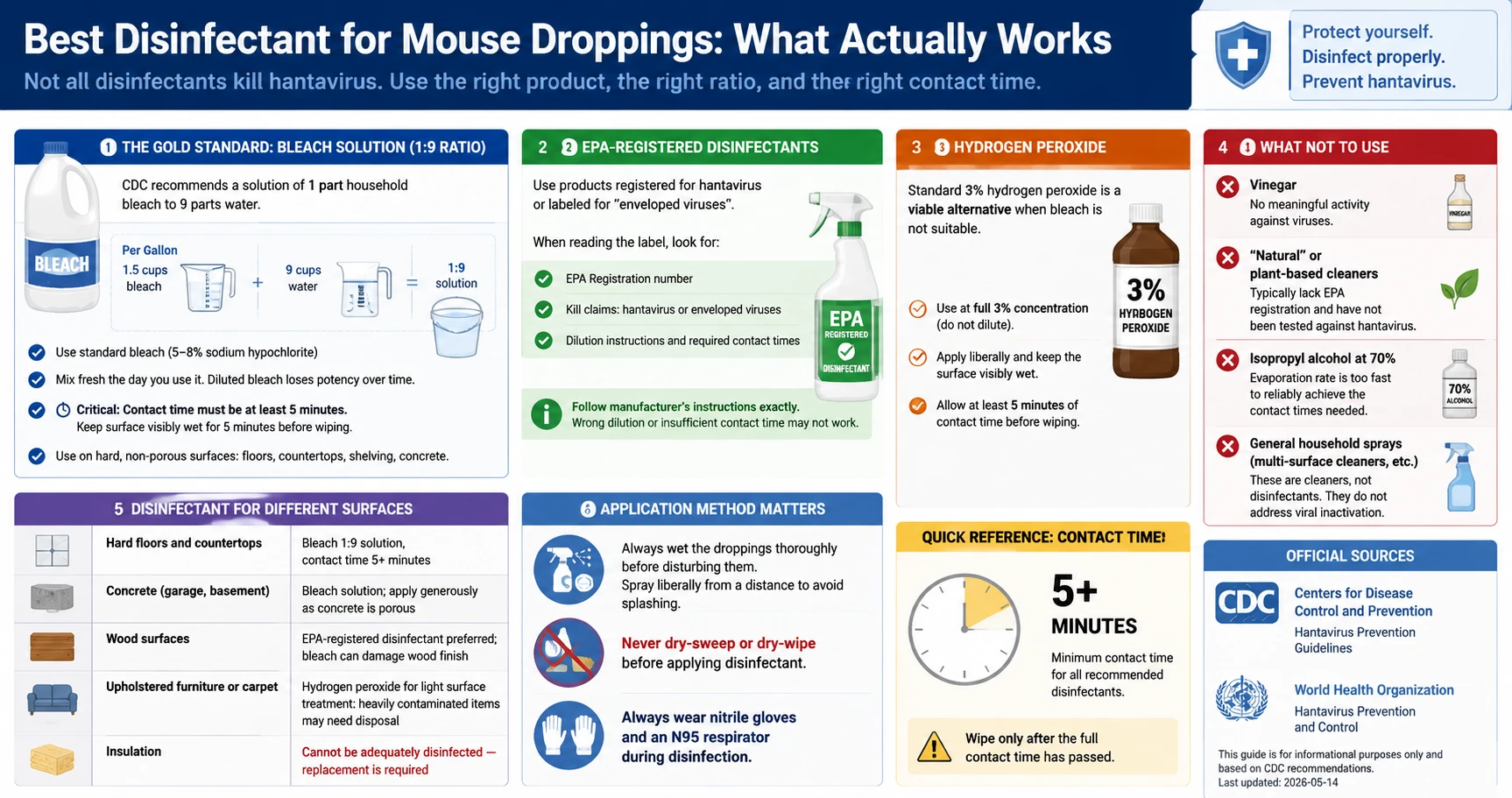
For rodent droppings, you need one of three things: bleach solution at the right ratio, hydrogen peroxide at full drugstore concentration, or an EPA-registered disinfectant with a specific virus kill claim. Everything else is a cleaner, not a disinfectant.
Bleach Solution: The CDC Standard
Household bleach (sodium hypochlorite) is what the CDC recommends. It's inexpensive, available everywhere, and has solid virucidal activity — when used correctly.
The ratio: 1 part bleach to 9 parts water. That's roughly 1.5 cups of standard bleach per gallon of water, or about 3 tablespoons per quart. Regular household bleach at 5–8% sodium hypochlorite is what you want.
Mix it fresh the day you use it. Diluted bleach loses potency over time — a solution left sitting since last week is not doing the job you think it is.
Contact time: at least 5 minutes. Spray or pour until the surface is visibly wet, then wait the full 5 minutes before wiping. This is where most people go wrong — they spray and immediately wipe. The contact time is what's doing the work, not the spray itself.
Bleach is appropriate for hard, non-porous surfaces: floors, countertops, shelving, and concrete.
EPA-Registered Disinfectants
If you'd rather not use bleach — or you're working on a surface bleach would damage — look for an EPA-registered disinfectant. The EPA maintains a list of products tested and approved against specific pathogens.
What to look for on the label:
- An EPA Registration number
- Kill claims listing hantavirus, or language covering "enveloped viruses"
- Specific dilution instructions and required contact time
Follow the label exactly. A registered product used at the wrong dilution, or wiped off before the contact time is up, may not perform as tested.
Hydrogen Peroxide
Standard 3% hydrogen peroxide — the brown bottle at any pharmacy — is a practical alternative when bleach isn't appropriate. It's gentler on colored fabrics and surfaces that bleach would damage or discolor.
Use it at full drugstore concentration. Don't dilute it further. Apply enough that the surface stays visibly wet, and wait at least 5 minutes before wiping.
What Doesn't Work — and Why
Clorox wipes and similar disinfectant wipes are designed for high-touch surfaces in everyday use. The problem is contact time: most wipes dry within seconds, nowhere near the 5 minutes needed to inactivate viruses in contaminated material. They're also not formulated for the biological load that rodent droppings present. Don't rely on them as your primary cleanup method.
Vinegar is not a disinfectant. Useful for cutting grease and mineral deposits, but has no meaningful activity against viruses. The internet has a lot of DIY cleaning recipes with vinegar — none of them apply here.
"Natural" or plant-based cleaners typically lack EPA registration and haven't been tested against hantavirus. "Natural" on a label says nothing about antiviral effectiveness.
Isopropyl alcohol at 70% evaporates too quickly to achieve reliable contact time. Useful as a final wipe after primary disinfection, but not a substitute for it.
General multi-surface sprays (Windex, Fantastik, most everyday cleaners) are designed to clean visible dirt, not inactivate viruses. They're not rated for hantavirus and shouldn't be your main tool here.
If You Already Used the Wrong Product
You cleaned up with Clorox wipes or a regular spray before finding this page. Go back over the area with the right disinfectant — bleach solution or an EPA-registered product — spray until visibly wet, wait 5 minutes, wipe, and repeat.
Whether this represents a meaningful exposure depends on context. A few droppings in a ventilated kitchen, quickly wiped with the wrong spray, is a different situation from disturbing a large nest in a sealed attic or RV. If you're uncertain about what you may have inhaled, see What Happens If You Inhale Mouse Droppings? for what symptoms to watch for and when to act.
Which Disinfectant for Which Surface
- Hard floors and countertops: Bleach 1:9, 5+ minutes contact time
- Concrete (garage, basement): Bleach solution applied generously — concrete is porous and absorbs liquid quickly
- Wood surfaces: EPA-registered disinfectant preferred; bleach can strip or discolor wood finish
- Upholstered furniture or carpet: Hydrogen peroxide for surface treatment; heavily contaminated items may need disposal
- Insulation: Cannot be disinfected — contaminated insulation needs to be removed and replaced
Application: The Setup Matters
Spray from a distance to avoid splashing dry droppings. Never dry-wipe or dry-sweep before applying disinfectant — the whole point is to wet the material before you disturb it.
Wear nitrile gloves and an N95 respirator throughout. Not a dust mask — an N95.
Official Sources
- CDC: Cleaning Up After Rodents — bleach ratio and disinfectant guidance
- CDC Hantavirus Prevention — prevention guidelines
Sources & References
- CDC — Centers for Disease Control and Prevention
Hantavirus: Prevention, Symptoms & Control
- cdc.gov — Cleaning Up
https://www.cdc.gov/hantavirus/prevention/cleaning-up.html
- WHO — World Health Organization
Hantavirus Disease: Fact Sheet
All health claims on this page are verified against the primary sources listed above. View our Editorial Policy
Frequently Asked Questions
Medical Disclaimer
The information on this page is for educational purposes only and is not medical advice. If you believe you may have been exposed to hantavirus or are experiencing symptoms, contact a qualified healthcare professional or local health authority immediately.