Hantavirus in New Mexico: Risk, Cases, and Where It Occurs
Why New Mexico Leads the US in Cases
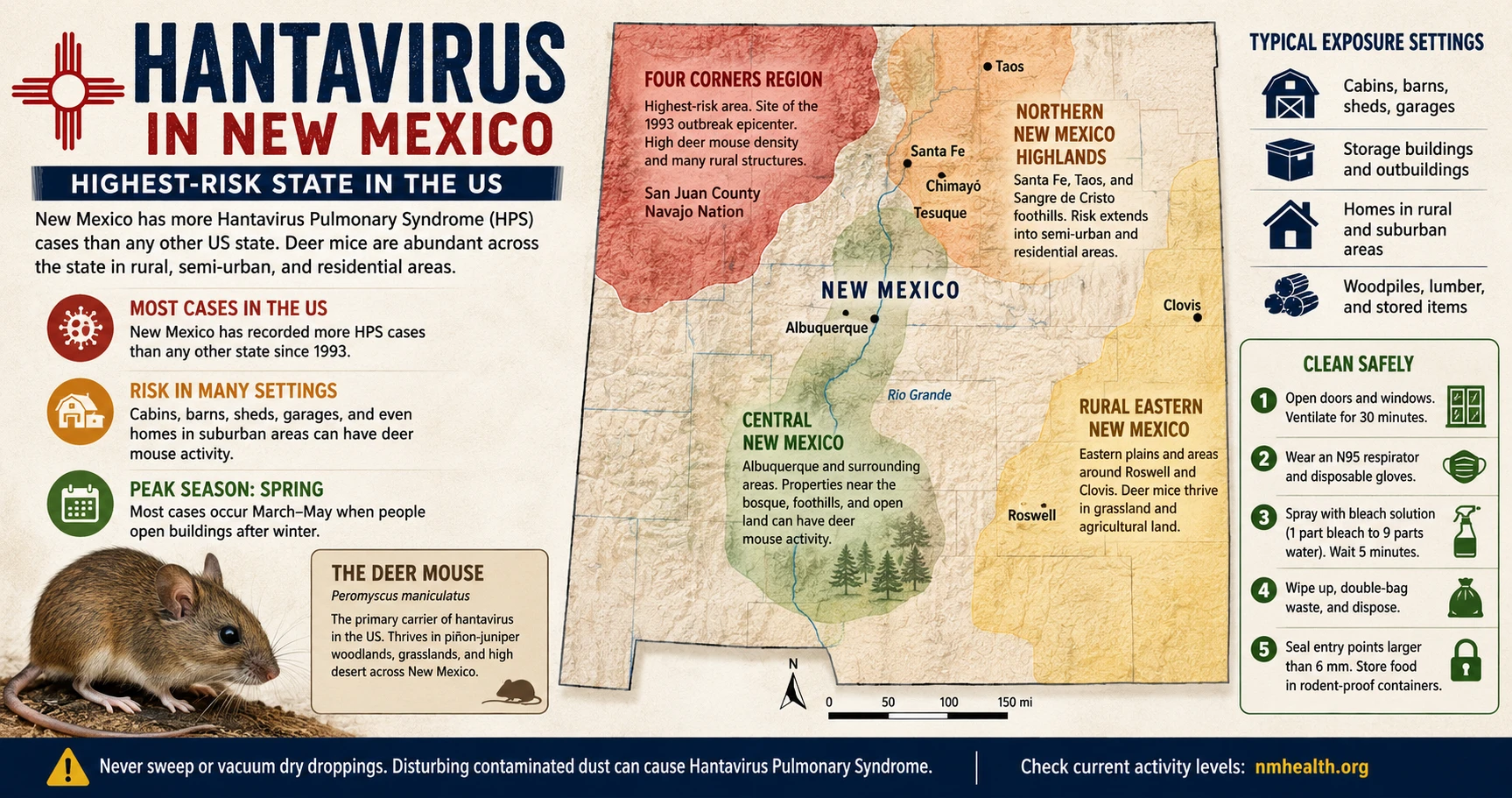
New Mexico has recorded more Hantavirus Pulmonary Syndrome cases than any other US state — a distinction that reflects both genuine risk and the state's history with the disease.
When the 1993 outbreak killed more than a dozen people in the Four Corners region within months, New Mexico was at the center of it. The investigation that followed transformed understanding of hantavirus in North America and established surveillance systems that remain in place. Those systems catch cases that might go undetected elsewhere, which contributes to New Mexico's high reported total.
But the case counts also reflect real ecology. The deer mouse (Peromyscus maniculatus) is abundant across the state's piñon-juniper woodlands, semi-arid grasslands, and high desert. These are not remote wilderness areas — they are the landscapes that surround Albuquerque, Santa Fe, Taos, and most of the state's rural communities.
Where in New Mexico the Risk Is Highest
Hantavirus cases in New Mexico have come from across the state, but certain areas have higher concentrations:
Four Corners region (northwestern New Mexico): San Juan County and adjacent areas in the Navajo Nation have historically been among the highest-risk areas. The 1993 outbreak epicenter was here. High deer mouse density and abundant rural structures create persistent exposure risk.
Northern New Mexico highlands: The area around Santa Fe, Taos, and the Sangre de Cristo foothills has significant deer mouse habitat. Properties in Tesuque, Chimayó, and other northern communities fall within this zone. The 2025 death of Betsy Arakawa illustrated that hantavirus risk is not limited to remote backcountry.
Rural eastern New Mexico: The eastern plains and the area around Roswell and Clovis have deer mouse populations in grassland and agricultural land, including the barns, storage buildings, and outbuildings common in farming communities.
Central New Mexico: Even the suburbs and semi-urban fringes of Albuquerque are not immune. Properties near the bosque, foothills, or open land have documented deer mouse activity.
The Typical Exposure Setting
Most New Mexico HPS cases have not involved people who went camping or hiked into wilderness areas. The more common scenario:
- Opening a structure — a cabin, barn, storage shed, garage, or secondary building — that has been closed for several months
- Doing maintenance or cleaning work in a space with accumulated rodent activity
- Disturbing dry droppings, nesting material, or contaminated insulation while sweeping, moving boxes, or ventilating a space
Deer mice don't need wilderness. They move into any available enclosed space in autumn seeking warmth and food. By spring, a closed structure can contain months of accumulated droppings, urine-soaked insulation, and nesting material. The first person to open that door and start cleaning is the one at risk.
Seasonal Patterns
New Mexico HPS cases occur throughout the year but show peaks that track deer mouse population cycles:
- Spring (March–May): Highest case frequency, coinciding with people opening cabins and outbuildings after winter, often encountering heavy rodent activity from the cold months
- Late summer and fall: Secondary peak following summer rodent population increases
Case counts vary year to year based on precipitation. Wet years produce more vegetation, more seeds, and more mice. The year following exceptional rainfall often sees elevated HPS risk — a pattern traceable back to the conditions preceding the 1993 outbreak.
Practical Guidance for New Mexico Residents and Visitors
Before entering any structure closed for weeks or months:
- Do not go directly inside — look for signs of rodent activity from outside first (droppings near the foundation, holes in walls, gnaw marks)
- Open all windows and doors and let the space air for at least 30 minutes before entering
- Put on an N95 respirator and disposable gloves before crossing the threshold
- Do not turn on a forced-air heating system or fans until you have inspected and cleaned the HVAC — disturbed dust from rodent-contaminated systems has caused cases
When cleaning:
- Never sweep or vacuum dry droppings
- Spray all contaminated areas with bleach solution (1:9 bleach to water) or an EPA-registered disinfectant, wait 5 minutes, wipe up, and double-bag the waste
- Bag and dispose of contaminated insulation, nesting material, and similar debris — do not shake or compress it
Year-round:
- Seal entry points larger than 6 mm — a gap the width of a pencil is enough for a deer mouse to enter
- Store food in rodent-proof containers
- Keep firewood, lumber, and stored items away from building foundations
Official Sources
- New Mexico Department of Health: Hantavirus — state surveillance, current case data, and guidance
- CDC Hantavirus Pulmonary Syndrome — national disease information
Sources & References
- CDC — Centers for Disease Control and Prevention
Hantavirus: Prevention, Symptoms & Control
- cdc.gov — Index
https://www.cdc.gov/hantavirus/php/surveillance/index.html
- nmhealth.org — Hps
https://www.nmhealth.org/about/erd/ideb/zdp/hps/
All health claims on this page are verified against the primary sources listed above. View our Editorial Policy
Frequently Asked Questions
Medical Disclaimer
The information on this page is for educational purposes only and is not medical advice. If you believe you may have been exposed to hantavirus or are experiencing symptoms, contact a qualified healthcare professional or local health authority immediately.