Betsy Arakawa's Death from Hantavirus: What the Gene Hackman Case Tells Us
What Happened
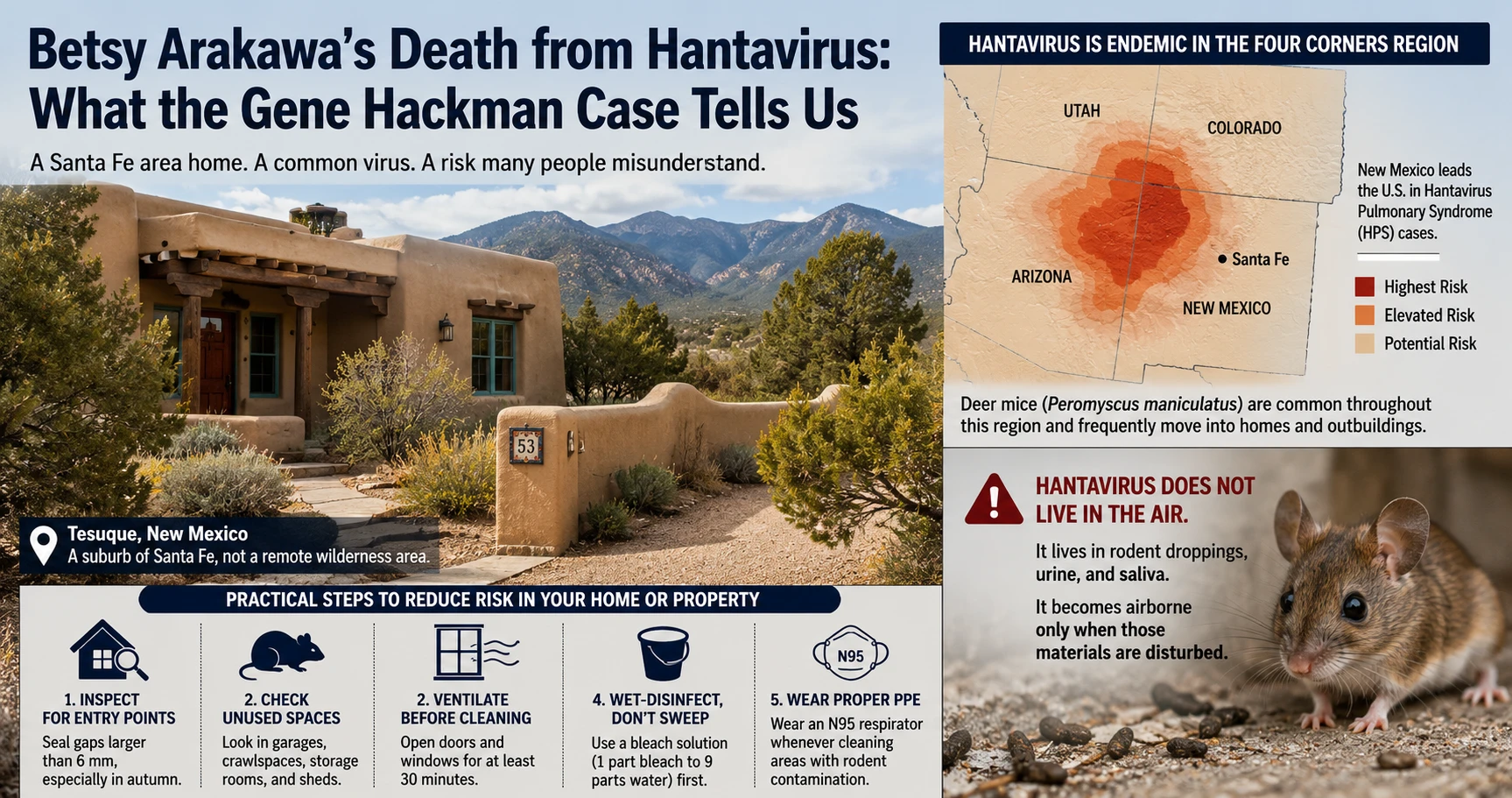
In late February 2025, Betsy Arakawa — the wife of actor Gene Hackman — was found dead at the couple's home in Tesuque, New Mexico, a small community just outside Santa Fe. She was 65.
The New Mexico Office of the Medical Investigator determined her cause of death to be hantavirus pulmonary syndrome. Gene Hackman, 95, was found dead at the same property approximately one week later. His death was attributed to hypertensive and atherosclerotic cardiovascular disease, with Alzheimer's disease noted as a contributing factor.
The deaths drew nationwide attention, in part because many people associate hantavirus with wilderness camping or extreme rural conditions — not with established residential properties near a city. The Hackman home was not a remote wilderness cabin. Tesuque is a suburb of Santa Fe.
Why New Mexico
New Mexico consistently leads the US in total Hantavirus Pulmonary Syndrome case counts, a fact that becomes less surprising when you understand the ecology of the state.
The deer mouse (Peromyscus maniculatus) — the primary carrier of Sin Nombre virus, the strain that causes HPS in North America — is extraordinarily common in New Mexico's landscape. The state sits at the heart of the Four Corners region, where the 1993 outbreak that first put hantavirus on the public health map occurred. Semi-arid grassland, piñon-juniper woodland, and the kind of scrubland that characterizes the land around Santa Fe is prime deer mouse habitat.
Properties in this region — whether year-round residences, vacation homes, or outbuildings — exist within that habitat. Deer mice move into structures in autumn seeking warmth and food. They can establish themselves inside walls, under floors, and in less-used storage spaces without being noticed for months.
The Assumption the Case Challenges
The widespread reaction to Betsy Arakawa's death — "How does someone get hantavirus at a house?" — reveals a common misunderstanding about how most HPS cases actually occur.
Most people imagine hantavirus risk as an outdoor, wilderness problem: a hiker inhales something in a national park, or a camper disturbs a rodent nest in the backcountry. Some cases do fit that pattern. But the majority of documented HPS cases in the US have involved enclosed structures — barns, cabins, outbuildings, and homes in rural and semi-rural areas — where rodent populations have established themselves undetected.
The virus doesn't live outdoors in the air. It lives in rodent droppings, urine, and saliva, and it becomes airborne only when those materials are disturbed — swept, vacuumed, handled, or agitated by something as simple as walking through a dusty space and kicking up settled particles.
A house in Santa Fe's outskirts, with deer mice present in less-used areas, is not fundamentally different from a rural cabin in terms of exposure potential. The enclosed space is what matters, not the category of structure.
What the Case Does and Doesn't Tell Us About Risk
What it confirms:
- Hantavirus risk is real in residential settings within endemic areas, not just in wilderness or camping contexts
- New Mexico's endemic status is not theoretical — it affects people in established homes, not just backcountry hikers
- HPS can affect anyone who is in an enclosed space with sufficient rodent contamination, regardless of lifestyle or age
What it does not tell us:
- The specific exposure point was never publicly confirmed. The case illustrates risk from living in deer mouse territory, but the exact circumstances — which room, which activity, what triggered the aerosolization — were not part of the public record
- The case was unusual in severity and outcome. HPS has a roughly 36% case fatality rate, meaning more than half of confirmed cases survive with medical support. Survival is more likely when the diagnosis is made early and treatment is initiated before the critical respiratory phase
Practical Takeaway for Property Owners in Endemic Areas
If you own or regularly use property in New Mexico, Colorado, Arizona, or other western US states with endemic deer mouse populations, the risk is not hypothetical — but it is also not unmanageable.
The most important practices:
- Inspect for rodent entry points annually — particularly in autumn, when deer mice move indoors. Seal gaps larger than 6 mm.
- Check unused spaces — storage rooms, garages, crawlspaces, and less-frequented areas of a property are where rodent activity is most likely to go undetected.
- Ventilate before cleaning — before working in any space that may have had rodent activity, open doors and windows for at least 30 minutes.
- Never sweep or vacuum dry droppings — wet-disinfect with a bleach solution first (1 part bleach to 9 parts water).
- Wear an N95 respirator whenever cleaning areas with known or suspected rodent contamination.
These steps apply whether you're opening a seasonal cabin or doing routine maintenance on a year-round home in deer mouse territory.
Sources & References
- CDC — Centers for Disease Control and Prevention
Hantavirus: Prevention, Symptoms & Control
- New Mexico Office of the Medical Investigator
All health claims on this page are verified against the primary sources listed above. View our Editorial Policy
Medical Disclaimer
The information on this page is for educational purposes only and is not medical advice. If you believe you may have been exposed to hantavirus or are experiencing symptoms, contact a qualified healthcare professional or local health authority immediately.