The 1993 Four Corners Hantavirus Discovery: How a Mystery Disease Was Identified
The Outbreak
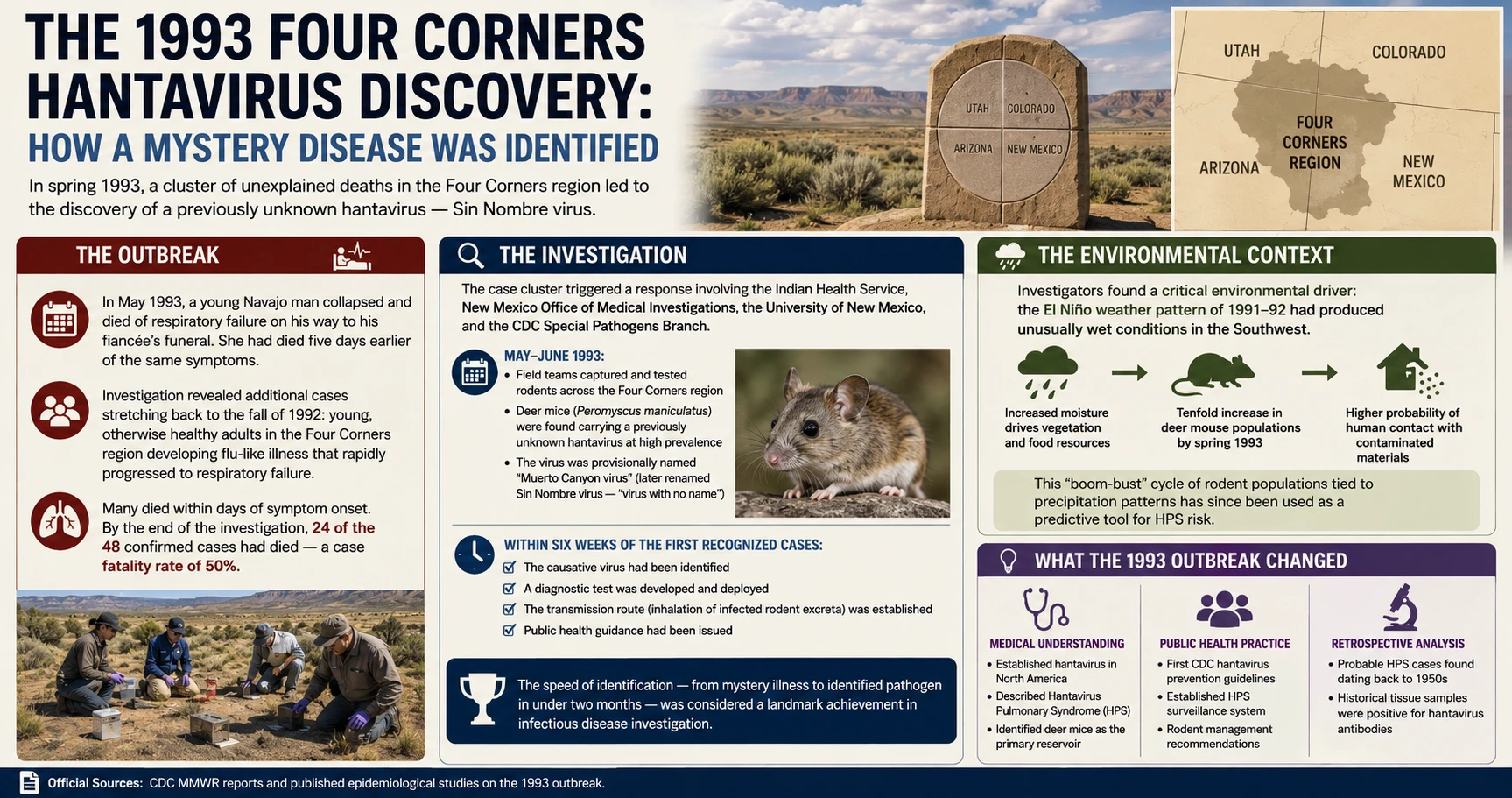
In May 1993, a young Navajo man collapsed and died of respiratory failure on his way to his fiancée's funeral. She had died five days earlier of the same symptoms. Their deaths prompted the Navajo Nation to contact health authorities.
Investigation revealed additional cases stretching back to the fall of 1992: young, otherwise healthy adults in the Four Corners region developing flu-like illness that rapidly progressed to respiratory failure. Many died within days of symptom onset.
By the end of the investigation, 24 of the 48 confirmed cases had died — a case fatality rate of 50%.
The Investigation
The case cluster triggered a response involving the Indian Health Service, New Mexico Office of Medical Investigations, the University of New Mexico, and the CDC Special Pathogens Branch.
Key investigative milestones:
May–June 1993:
- Field teams captured and tested rodents across the Four Corners region
- Deer mice (Peromyscus maniculatus) were found carrying a previously unknown hantavirus at high prevalence
- The virus was provisionally named "Muerto Canyon virus" (later renamed Sin Nombre virus — "virus with no name")
Within six weeks of the first recognized cases:
- The causative virus had been identified
- A diagnostic test was developed and deployed
- The transmission route (breathing in particles from infected rodent droppings) was established
- Public health guidance had been issued
The speed of identification — from mystery illness to identified virus in under two months — was considered a landmark achievement in infectious disease investigation.
The Environmental Context
Investigators found a critical environmental driver: the El Niño weather pattern of 1991–92 had produced unusually wet conditions in the Southwest. This moisture drove a bloom of vegetation and food resources, which in turn caused a tenfold increase in deer mouse populations in the Four Corners region by spring 1993.
The sudden increase in mice — and the correspondingly higher probability of human contact with infected droppings and nesting material — was the proximate cause of the outbreak. This "boom-bust" cycle of rodent populations tied to precipitation patterns has since been used as a predictive tool for HPS risk.
What the 1993 Outbreak Changed
Medical understanding:
- Established that hantavirus existed in North America (previously thought limited to Asia and Europe)
- Described a new clinical syndrome — hantavirus pulmonary syndrome (HPS) — distinct from the hemorrhagic fever with renal syndrome caused by Old World hantaviruses
- Identified deer mice as the primary North American reservoir
Public health practice:
- Created the first CDC guidelines for hantavirus prevention and rodent cleanup
- Established the Hantavirus Pulmonary Syndrome surveillance system
- Led to rodent management recommendations for high-risk occupations and environments
Retrospective analysis:
- Review of historical cases identified probable HPS cases dating back to at least the 1950s
- Tissue samples from patients who died of unexplained respiratory illness in earlier decades were found to be positive for hantavirus antibodies
Sources & References
- CDC — Centers for Disease Control and Prevention
Hantavirus: Prevention, Symptoms & Control
- WHO — World Health Organization
Hantavirus Disease: Fact Sheet
All health claims on this page are verified against the primary sources listed above. View our Editorial Policy
Medical Disclaimer
The information on this page is for educational purposes only and is not medical advice. If you believe you may have been exposed to hantavirus or are experiencing symptoms, contact a qualified healthcare professional or local health authority immediately.