Hantavirus Cases by State: Where HPS Occurs in the US
The Geographic Pattern
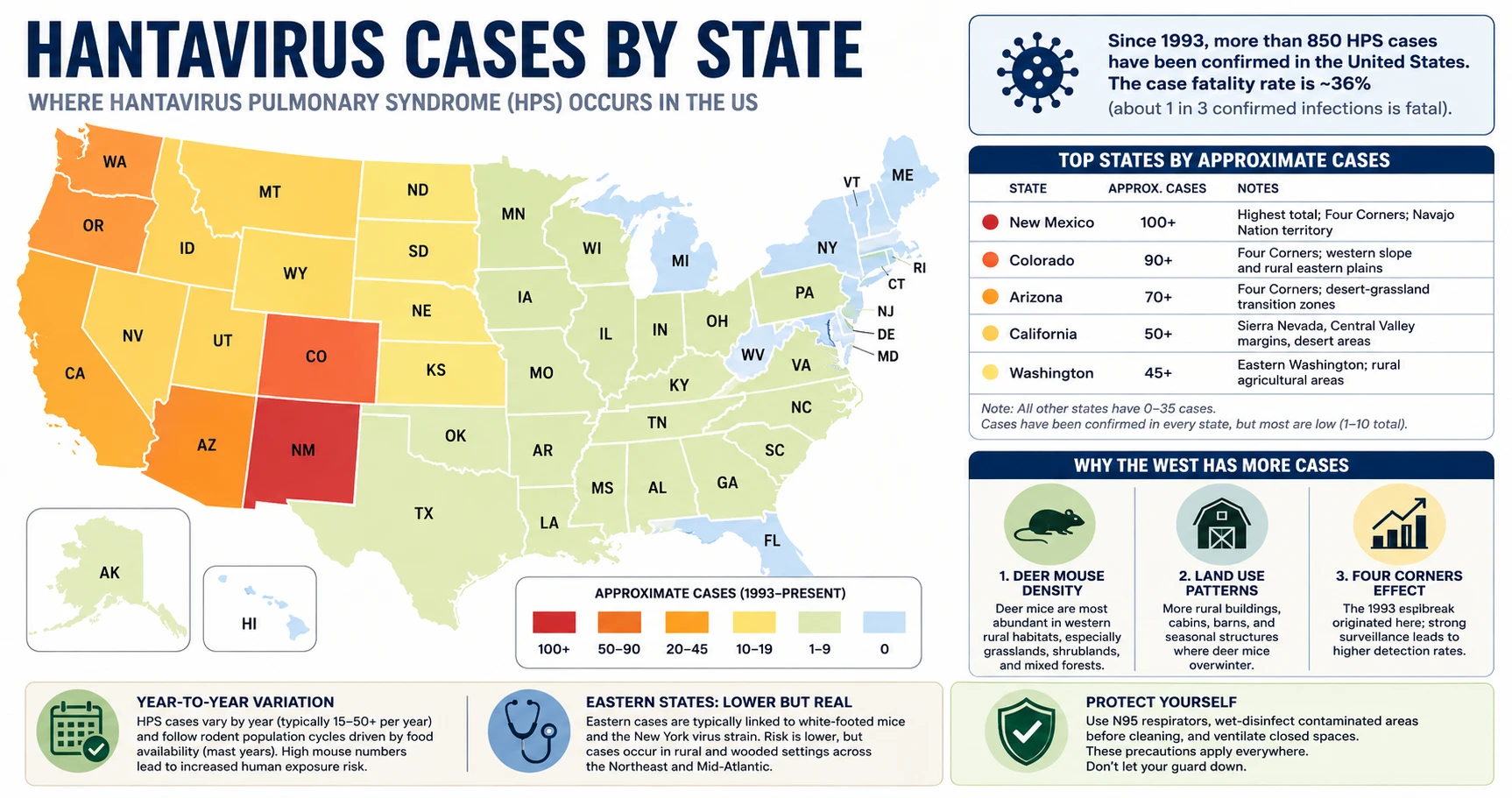
Since Hantavirus Pulmonary Syndrome was first identified in the Four Corners region in 1993, more than 850 cases have been confirmed across the United States. The case fatality rate is approximately 36% — roughly 1 in 3 confirmed infections is fatal.
The distribution is not even. Most cases come from the western US, where deer mice (Peromyscus maniculatus) — the primary Sin Nombre virus reservoir — are abundant in rural and semi-rural settings. Eastern states have their own hantavirus-carrying rodents (primarily the white-footed mouse, Peromyscus leucopus), but HPS is documented there far less frequently.
Cases by State (Approximate Totals, 1993–Present)
The following data is based on CDC surveillance reports. Exact totals are updated periodically; check the CDC's HPS surveillance page for current figures.
| State | Approximate Cases | Notes |
|---|---|---|
| New Mexico | 100+ | Highest total; Four Corners; Navajo Nation territory |
| Colorado | 90+ | Four Corners; western slope and rural eastern plains |
| Arizona | 70+ | Four Corners; desert-grassland transition zones |
| California | 50+ | Sierra Nevada, Central Valley margins, desert areas |
| Washington | 45+ | Eastern Washington; rural agricultural areas |
| Montana | 35+ | Prairie and forest transition zones |
| Utah | 25+ | Four Corners region, rural central Utah |
| Texas | 25+ | West Texas, Panhandle; low KD but present |
| Idaho | 20+ | Southern and central rural areas |
| Oregon | 20+ | Eastern Oregon; high desert |
| South Dakota | 15+ | Black Hills; prairie grassland |
| North Dakota | 10+ | Prairie regions |
| Wyoming | 10+ | Rural areas; Yellowstone surroundings |
| Kansas | 10+ | Prairie grassland transition |
| Nebraska | 10+ | Western Nebraska prairies |
| Minnesota | 10+ | Rural northern regions |
| Nevada | 10+ | Rural areas |
| Oklahoma | 10+ | Panhandle; western rural areas |
| All other states | Low | Cases confirmed in most states; rarely exceed single digits |
Eastern states with confirmed cases include New York, Pennsylvania, Virginia, Massachusetts, Connecticut, and Florida — but total case counts in these states are typically low (1–10 over the full surveillance period).
Why the West Has More Cases
Three factors converge in western states:
1. Deer mouse range and density. The deer mouse lives across nearly all of North America, but population densities are highest in the rural west — particularly in grassland, shrubland, and mixed forest habitats characteristic of states like New Mexico, Colorado, and Arizona.
2. Land use patterns. Western states have more rural cabins, outbuildings, barns, and seasonal-use structures — the environments where deer mice overwinter and HPS exposure most commonly occurs. The typical HPS case involves someone entering a building that has been closed for weeks or months and disturbing accumulated droppings.
3. The Four Corners effect. The original 1993 outbreak was centered in the Four Corners region, and surveillance infrastructure built in that region has maintained higher case detection rates. Some eastern cases may be underdiagnosed because hantavirus is less routinely considered by physicians in those areas.
Eastern States: A Different Picture
Eastern HPS cases typically involve white-footed mice (Peromyscus leucopus) and the New York virus strain rather than Sin Nombre. The biology is similar — the mouse sheds virus in droppings and urine, and humans are exposed by disturbing contaminated material — but the ecology differs.
White-footed mice are more associated with woodland edges and suburban environments than the open grasslands favored by deer mice. Eastern HPS cases have occurred in settings ranging from rural camps and cabins to woodpiles and garage spaces near wooded areas.
The risk in eastern states is real but lower. Anyone spending time in rural or wooded settings in the Northeast or Mid-Atlantic should be aware that hantavirus is not exclusively a western problem.
Year-to-Year Variation
Annual case counts vary significantly, typically ranging from 15 to 50+ cases per year in the US. The variation follows rodent population cycles:
- Mast years (high tree seed production) → more food → deer mouse population boom
- The following 1–2 years → elevated HPS risk as high mouse densities increase human-mouse contact
The Four Corners region experienced the original 1993 outbreak following a particularly wet year that produced unusually high piñon nut and grasshopper abundance, leading to a deer mouse population explosion. Similar dynamics recur on a smaller scale roughly every few years.
Finding Current Data
Case counts are updated regularly as new cases are confirmed and investigations completed. For the most current state-by-state data:
- CDC HPS Surveillance: the primary source for US case counts by state and year
- State health departments: publish state-specific data and current alerts
What the Numbers Mean for Your Risk
If you live in a western state — particularly in or near rural areas — hantavirus is a real hazard worth taking seriously when entering enclosed spaces with rodent activity. It is not common enough to generate daily worry, but it is common enough that the precautions are not theoretical.
If you live in an eastern state: the risk exists but is substantially lower. The same precautions apply — N95, wet-disinfect before handling, ventilate first — but the baseline probability of exposure is lower.
Official Sources
- CDC Hantavirus Pulmonary Syndrome (HPS) Surveillance — case counts by state and year
- CDC Hantavirus: Rodents — reservoir species by region
Sources & References
- CDC — Centers for Disease Control and Prevention
Hantavirus: Prevention, Symptoms & Control
- cdc.gov — Index
https://www.cdc.gov/hantavirus/php/surveillance/index.html
- WHO — World Health Organization
Hantavirus Disease: Fact Sheet
All health claims on this page are verified against the primary sources listed above. View our Editorial Policy
Frequently Asked Questions
Medical Disclaimer
The information on this page is for educational purposes only and is not medical advice. If you believe you may have been exposed to hantavirus or are experiencing symptoms, contact a qualified healthcare professional or local health authority immediately.