Hantavirus Outbreak Timeline: Key Events from 1993 to Present
How Hantavirus Came to Light
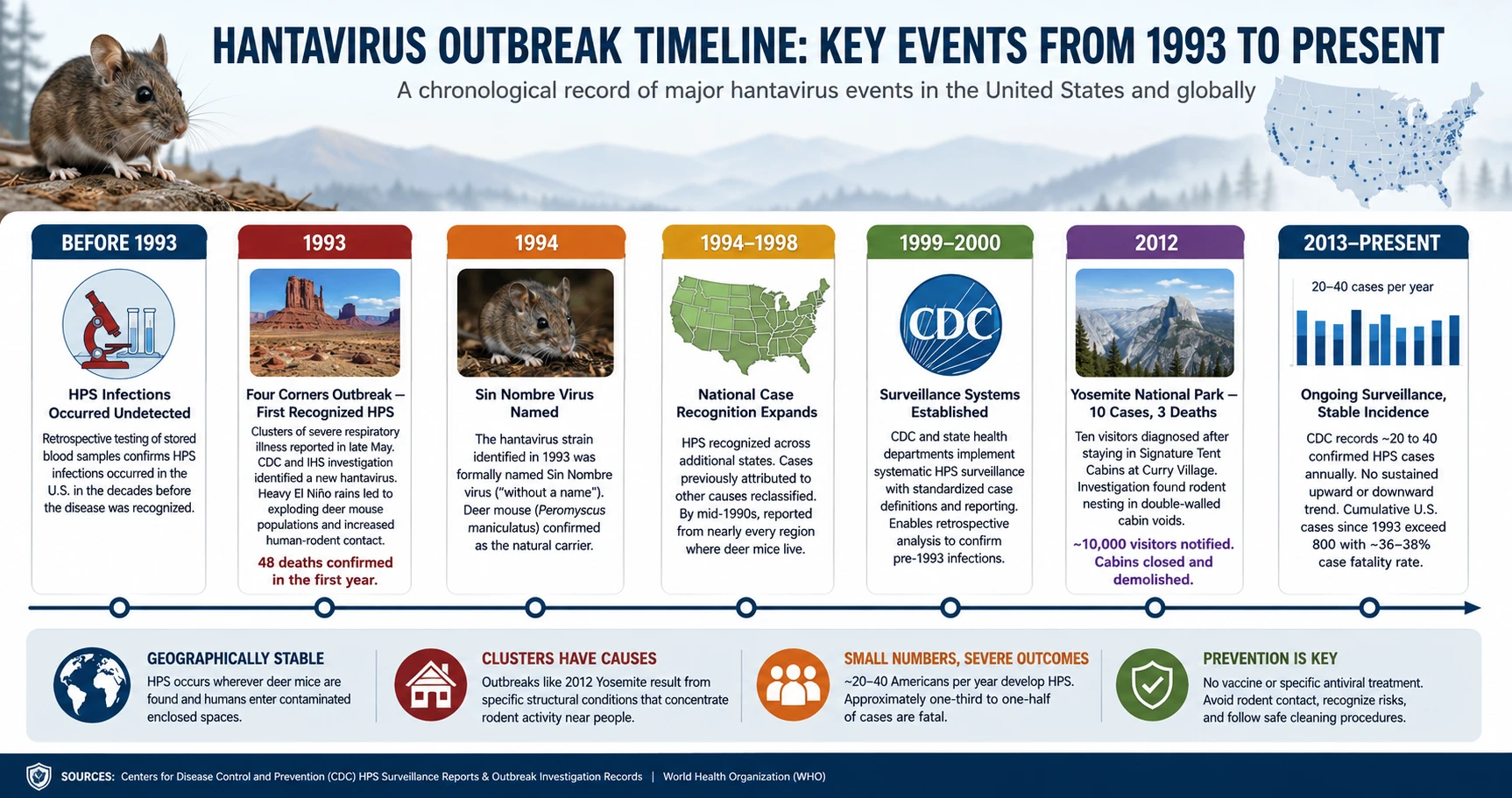
Hantavirus did not suddenly appear in 1993. Retrospective analysis of stored blood samples has confirmed that sporadic HPS infections occurred in the United States in the decades before the syndrome was formally recognized. What changed in 1993 was a cluster of severe, rapidly fatal respiratory illnesses unusual enough to trigger intensive investigation.
1993: The Four Corners Outbreak — First Recognized HPS
In late May 1993, physicians in the Four Corners region reported clusters of previously healthy young adults presenting with rapidly progressive respiratory failure. Many died within days after a brief flu-like prodrome. For a period, no one knew what was killing them.
The CDC and Indian Health Service launched a joint investigation. By summer, they had identified the causative agent as a previously unknown hantavirus strain and recognized the disease as Hantavirus Pulmonary Syndrome.
The outbreak occurred against a backdrop of unusually heavy El Niño rainfall, which had caused deer mouse populations to explode due to abundant food. More deer mice meant more human-rodent contact.
In the first year of recognized HPS: 48 deaths confirmed.
Retrospective testing confirmed infections going back to at least the early 1980s — HPS had been killing people for years before it was recognized.
1994–2000: Naming, Recognition, Surveillance
The hantavirus strain was formally named Sin Nombre virus — Spanish for "without a name." Its carrier, the deer mouse (Peromyscus maniculatus), was confirmed as the primary reservoir. The deer mouse remains healthy while persistently infected and shedding virus throughout its life.
Over the following years, HPS was recognized retroactively and prospectively across additional states. Cases previously attributed to other causes were reclassified. By the mid-1990s, it was clear HPS was not confined to the Southwest — cases appeared in the Pacific Northwest, the Great Plains, and nearly every region where deer mice live. The CDC established systematic surveillance programs with standardized case definitions and reporting requirements.
2012: Yosemite National Park — 10 Cases, 3 Deaths
The most significant HPS cluster since the 1993 outbreak occurred in summer 2012 at Yosemite National Park.
Ten visitors were diagnosed with HPS after staying in the Signature Tent Cabins at Curry Village. Three died. The cabins looked normal — beds were made, nothing visible suggested a problem. But double-walled construction had created concealed voids where deer mice had nested for years, accumulating droppings and contaminated material inside the walls. Visitors were sleeping within inches of it, breathing that enclosed air for hours each night.
Response included notification of approximately 10,000 visitors who had stayed in the implicated accommodations — including international travelers, requiring coordination with foreign public health agencies. The tent cabins were closed and demolished. The outbreak prompted a nationwide review of rodent exclusion in national park lodging.
Full details: hantavirus in California and national park hantavirus warnings explained.
2026: Hondius Cruise Ship — Andes Virus in a Confined Vessel
In early 2026, multiple passengers aboard the expedition cruise ship Hondius were diagnosed with hantavirus infection following a shore excursion in southern Argentina — a region where Andes virus circulates. The event drew attention because Andes virus is the one hantavirus strain with documented person-to-person transmission, and a cruise ship represents an unusually enclosed exposure environment.
Andes virus is not present in North America. But the Hondius cases served as a reminder that hantavirus risk extends beyond deer mice and rural cabins — and that travel to endemic regions carries its own exposure calculus.
2013–Present: Ongoing Surveillance, Stable Incidence
Since 2013, CDC surveillance has recorded approximately 20 to 40 confirmed HPS cases per year in the United States — a rate that has remained broadly stable without a sustained upward or downward trend.
The cumulative US case count since 1993 exceeded 800 confirmed cases as of recent surveillance periods, with the overall case fatality rate holding at approximately 36 to 38 percent.
States with the highest cumulative case totals include New Mexico, Colorado, Arizona, California, Washington, and Montana — reflecting the geographic distribution of deer mouse habitat and recreational human activity.
What the Timeline Tells Us
The disease is geographically stable. HPS occurs wherever deer mice are found and humans enter contaminated enclosed spaces. The affected-state map has not changed substantially since the 1990s.
Clusters have structural explanations. The 2012 Yosemite outbreak was the predictable result of an accommodation design that concentrated rodent activity near sleeping guests. Infrastructure management is a public health function.
Annual case counts are small but outcomes are severe. Roughly 20 to 40 Americans per year develop HPS, and approximately a third to half die.
Prevention remains behavioral. No licensed vaccine or specific antiviral treatment exists. Risk reduction depends entirely on avoiding rodent contact, recognizing high-risk environments, and following proper cleanup and disinfection procedures. See how to clean mouse droppings safely for practical steps, and the hantavirus symptoms timeline for what to watch for after a potential exposure.
Official Sources
- CDC Hantavirus — HPS surveillance and outbreak records
- CDC MMWR — historical outbreak investigation reports
- WHO Hantavirus Fact Sheet — global case data
Sources & References
- CDC — Centers for Disease Control and Prevention
Hantavirus: Prevention, Symptoms & Control
- cdc.gov — Index
https://www.cdc.gov/hantavirus/php/surveillance/index.html
- WHO — World Health Organization
Hantavirus Disease: Fact Sheet
All health claims on this page are verified against the primary sources listed above. View our Editorial Policy
Frequently Asked Questions
Medical Disclaimer
The information on this page is for educational purposes only and is not medical advice. If you believe you may have been exposed to hantavirus or are experiencing symptoms, contact a qualified healthcare professional or local health authority immediately.