Can Hantavirus Spread Between Humans?
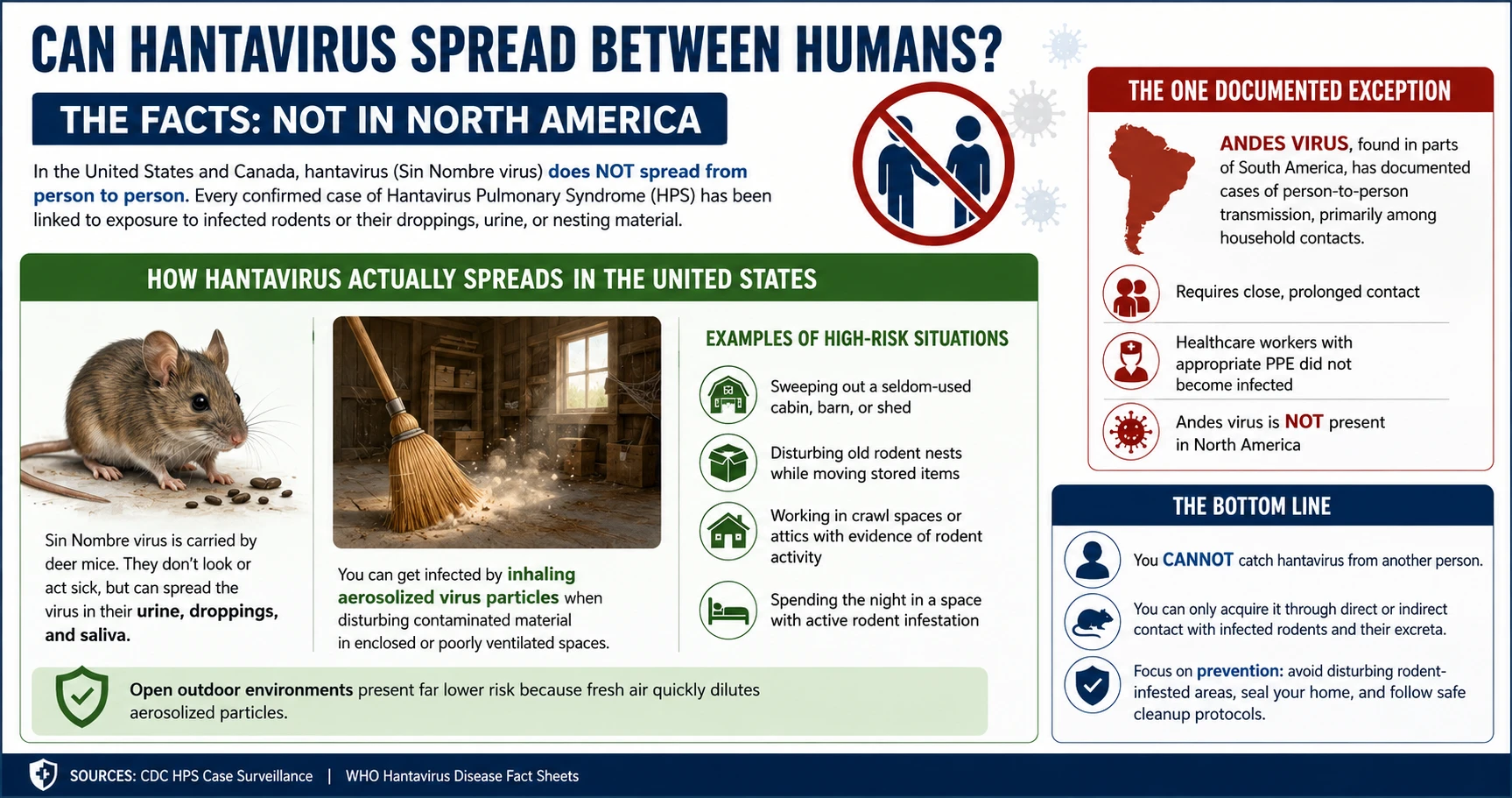
The Short Answer: Not in North America
People hear "virus" and think COVID — airborne, person-to-person, one infected person spreading it to others. Hantavirus doesn't work that way. In the United States and Canada, hantavirus (Sin Nombre virus) does not spread from person to person.
This isn't a gap in the research. Contact tracing of HPS patients — including healthcare workers who treated patients without protective equipment in the early days of the 1993 outbreak — found zero secondary infections. Spouses, family members, and hospital staff exposed to HPS patients did not develop the disease. Every single confirmed US case traces back to a rodent, not another person.
How Hantavirus Actually Spreads in the United States
Every confirmed case of HPS in the US traces back to a single source: infected rodents. Specifically, the deer mouse (Peromyscus maniculatus) is the primary reservoir for Sin Nombre virus. The virus is shed in the urine, droppings, and saliva of infected deer mice, which show no signs of illness themselves.
Transmission to humans occurs almost exclusively by breathing in virus particles released into the air. This happens when dried rodent droppings or nesting material is disturbed in an enclosed or poorly ventilated space. Examples include:
- Sweeping out a seldom-used cabin, barn, or shed
- Disturbing old rodent nests while moving stored items
- Working in crawl spaces or attics with evidence of rodent activity
- Spending the night in a space with active rodent infestation
The risk is fundamentally tied to the physical act of disturbing contaminated material in a space where fresh air cannot quickly dilute particles that have been sent into the air. Open outdoor environments present far lower risk.
The One Documented Exception: Andes Virus
There is one known hantavirus strain that has been documented to spread between people. Andes virus, circulating in Argentina and Chile, has caused several well-documented clusters of human-to-human transmission, primarily within households where close, prolonged contact occurred.
The evidence for Andes virus person-to-person spread is credible and accepted by the CDC and WHO. In these cases, transmission appeared to require close, sustained contact rather than casual exposure. Healthcare workers with appropriate PPE did not become infected.
Andes virus is not present in North America. It is a genetically and geographically distinct strain from Sin Nombre virus. The fact that Andes virus can spread between humans does not change the epidemiology of North American HPS.
What This Means If Someone You Know Has It
If a family member, coworker, or neighbor is diagnosed with HPS in the United States: you do not need to quarantine, get tested, or take any special precautions from a transmission standpoint. The risk to you ended at whatever rodent-contaminated space they were exposed to. You cannot catch it from them.
This matters because HPS carries a roughly 38% fatality rate — a number that naturally triggers fear of contagion. That fear is understandable but misdirected for North American cases. The danger is in the rodent-contaminated environment, not in the person who got sick.
What to Actually Worry About
In North America, hantavirus behaves more like an environmental exposure hazard than a contagious disease. The people who get infected are almost always people who disturbed something — swept out an old shed, opened a stored RV, moved boxes in a contaminated attic, spent a night in a cabin with active rodent activity.
If you're concerned about hantavirus, the question worth asking isn't "was I near someone who's sick?" It's "was I in a space with rodent contamination, and did I disturb it?"
The protective actions that matter:
- Wear an N95 and gloves before cleaning any space with rodent evidence
- Ventilate enclosed spaces before entering
- Never sweep or vacuum dry droppings
- Seal rodent entry points before the next season
Official Sources
- CDC Hantavirus — HPS transmission surveillance data
- WHO Hantavirus Fact Sheet — Andes virus person-to-person transmission data
Sources & References
- CDC — Centers for Disease Control and Prevention
Hantavirus: Prevention, Symptoms & Control
- WHO — World Health Organization
Hantavirus Disease: Fact Sheet
All health claims on this page are verified against the primary sources listed above. View our Editorial Policy
Frequently Asked Questions
Medical Disclaimer
The information on this page is for educational purposes only and is not medical advice. If you believe you may have been exposed to hantavirus or are experiencing symptoms, contact a qualified healthcare professional or local health authority immediately.