What Happens If You Inhale Mouse Droppings? Risks and Next Steps
If You're Reading This After It Happened
I found this information at 11pm, sitting in my kitchen after spending the afternoon cleaning out my garage. I had swept up droppings along the baseboards — dry, no mask, windows closed. Didn't think much of it at the time. Then I made the mistake of googling "mouse droppings hantavirus" and spent the next hour reading case reports.
That specific feeling — doing the research hours too late, trying to figure out how worried you should actually be — is why I wrote this. It is also why I built this site.
Many people find this article because they've already swept up mouse droppings without a mask, disturbed an old nest while cleaning, or spent time in a space that smelled like rodents — and are now wondering if they're at risk.
The short answer: inhaling dust from mouse droppings is the primary route of hantavirus infection in North America, and it warrants monitoring. This article explains what actually happens, what symptoms to watch for, and when to seek medical care.
How Inhalation Exposure Happens
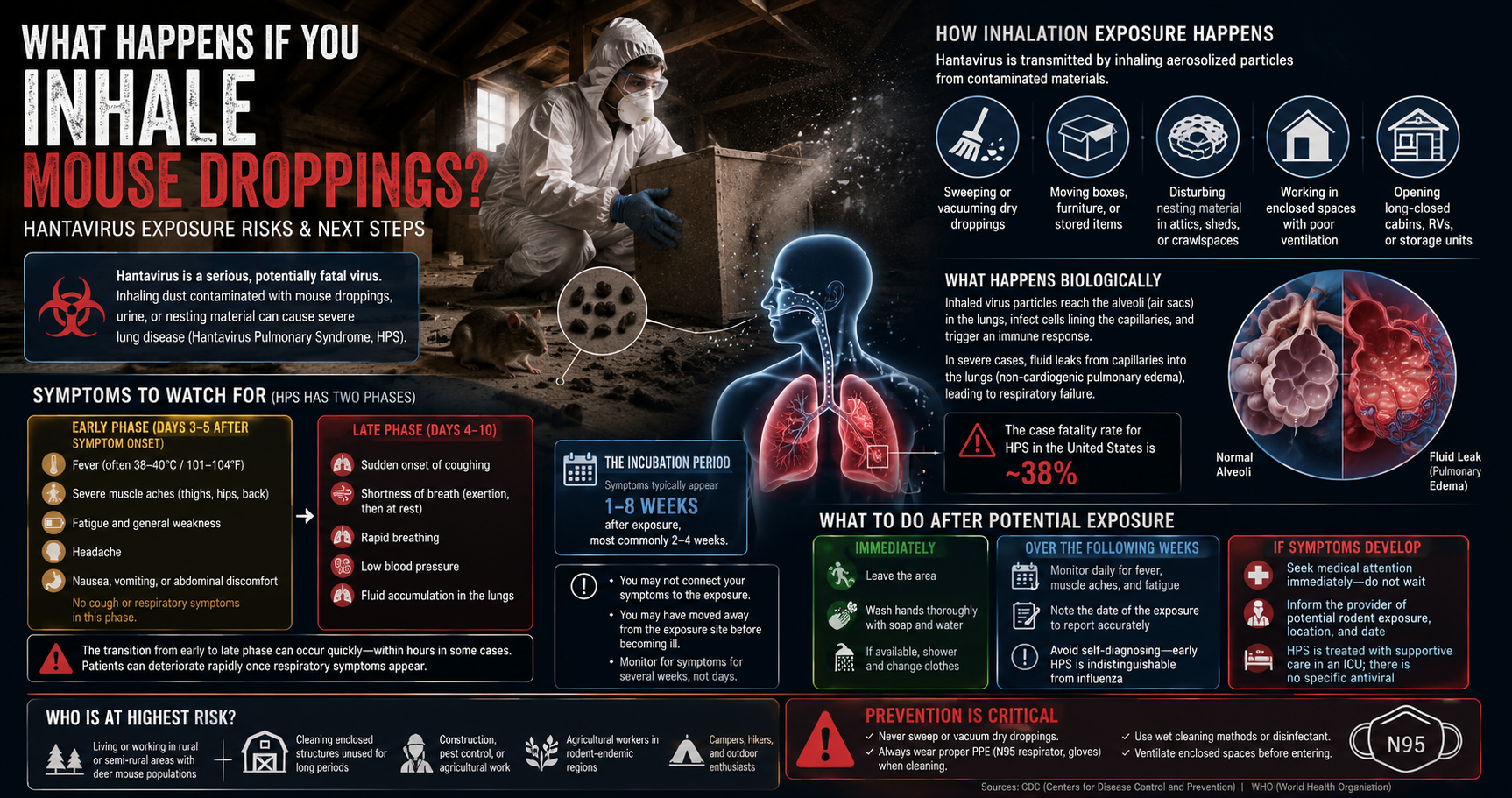
Hantavirus is not transmitted by touching droppings. The primary way the virus spreads is through breathing in viral particles — dust that becomes airborne when dried droppings, urine, or nesting material is disturbed.
The most common situations:
- Sweeping or vacuuming dry droppings without respiratory protection
- Moving boxes, furniture, or stored items in infested spaces
- Disturbing nesting material in attics, crawlspaces, or outbuildings
- Working in an enclosed space with accumulated contamination and poor ventilation
- Opening a long-closed structure like a cabin, RV, or storage unit
The particles are microscopic. Most people never realize they breathed anything in — there's no dust cloud, no visible sign, no smell that signals the exposure.
What Happens After Inhalation
When airborne hantavirus particles are breathed in, they reach the deep airways where oxygen enters the bloodstream. The virus triggers an immune response in the lung tissue.
In severe cases — hantavirus pulmonary syndrome — that immune response causes fluid to leak into the lungs faster than the body can clear it. Breathing becomes progressively harder as the lungs fill. This can progress to respiratory failure requiring a ventilator.
The case fatality rate for hantavirus pulmonary syndrome in the United States is approximately 38%.
Symptoms to Watch For
HPS progresses in two phases:
Early phase (days 3–5 after symptom onset):
- Fever (often 38–40°C / 101–104°F)
- Severe muscle aches, particularly in the thighs, hips, and back
- Fatigue and general weakness
- Headache
- Occasional nausea, vomiting, or abdominal discomfort
- No cough or respiratory symptoms in this phase
Late phase (days 4–10):
- Sudden onset of coughing
- Shortness of breath — initially on exertion, then at rest
- Rapid breathing
- Low blood pressure
- Fluid accumulation in the lungs
The transition from early to late phase can occur quickly — within hours in some cases. Patients can deteriorate rapidly once respiratory symptoms appear.
The Incubation Period
Symptoms typically appear 1–8 weeks after exposure, with most cases presenting at 2–4 weeks. This long incubation period means:
- You may not connect your symptoms to the exposure event
- You may have moved away from the exposure site before becoming ill
- The window during which you should monitor for symptoms is several weeks, not days
A pattern that comes up repeatedly in documented HPS investigations: the patient didn't realize the significance of the exposure until days or weeks later, when symptoms appeared. Several confirmed cases describe the exposure event as unremarkable at the time — 20 minutes sweeping a cabin, carrying boxes out of a garage, briefly entering a shed. The invisibility of the exposure is part of what makes it dangerous.
How Serious Is Your Exposure?
Not all inhalation events carry the same risk. The factors that matter most:
Higher risk: Extended time in an enclosed, poorly ventilated space — an attic, sealed cabin, stored RV, or barn — with visible droppings, nesting material, or signs of heavy infestation. Using a shop vac or broom in that space without a mask. This is the scenario most likely to result in a meaningful dose of aerosolized particles.
Lower risk: Brief encounter in a ventilated space — sweeping a few droppings in a kitchen or hallway with windows open, or walking through a garage and spotting droppings without disturbing them. The inhalation risk from a short, incidental exposure in a ventilated area is real but significantly lower.
In either case, the right response is the same: monitor for symptoms over the following weeks. But if you swept a few droppings in your kitchen and are now reading this at 2am convinced you have hantavirus, understand that the infection rate — even among people with confirmed exposures — reflects how many variables have to align for transmission to occur.
What To Do After Potential Inhalation Exposure
Immediately:
- Leave the area
- Wash hands thoroughly with soap and water
- If available, shower and change clothes
Over the following weeks:
- Monitor daily for fever, muscle aches, and fatigue
- Note the date of the exposure so you can report it accurately to a provider
- Avoid self-diagnosing based on symptoms alone — early HPS is indistinguishable from influenza
If symptoms develop:
- Seek medical attention immediately — do not wait to see if symptoms resolve
- Inform the provider of potential rodent exposure, the location, and when it occurred
- HPS is treated with supportive care in an ICU setting; there is no specific antiviral
Who Is at Highest Risk
Anyone can develop HPS after sufficient exposure. The following factors are associated with higher risk:
- Working or living in rural or semi-rural environments with deer mouse populations
- Cleaning enclosed structures (cabins, barns, storage units) that have been unused for extended periods
- Working in construction or pest control
- Agricultural workers in rodent-endemic regions
- Campers and hikers in endemic areas of the western United States
HPS cases have been documented in all regions of the United States but are concentrated in the Southwest, Northwest, and mountain West, where deer mouse populations are highest.
Official Sources
- CDC Hantavirus — transmission risk and prevention data
- WHO Hantavirus Fact Sheet — global disease reference
Sources & References
- CDC — Centers for Disease Control and Prevention
Hantavirus: Prevention, Symptoms & Control
- WHO — World Health Organization
Hantavirus Disease: Fact Sheet
All health claims on this page are verified against the primary sources listed above. View our Editorial Policy
Frequently Asked Questions
Medical Disclaimer
The information on this page is for educational purposes only and is not medical advice. If you believe you may have been exposed to hantavirus or are experiencing symptoms, contact a qualified healthcare professional or local health authority immediately.