Can Dried Mouse Poop Carry Hantavirus? What the Research Shows
The Short Answer
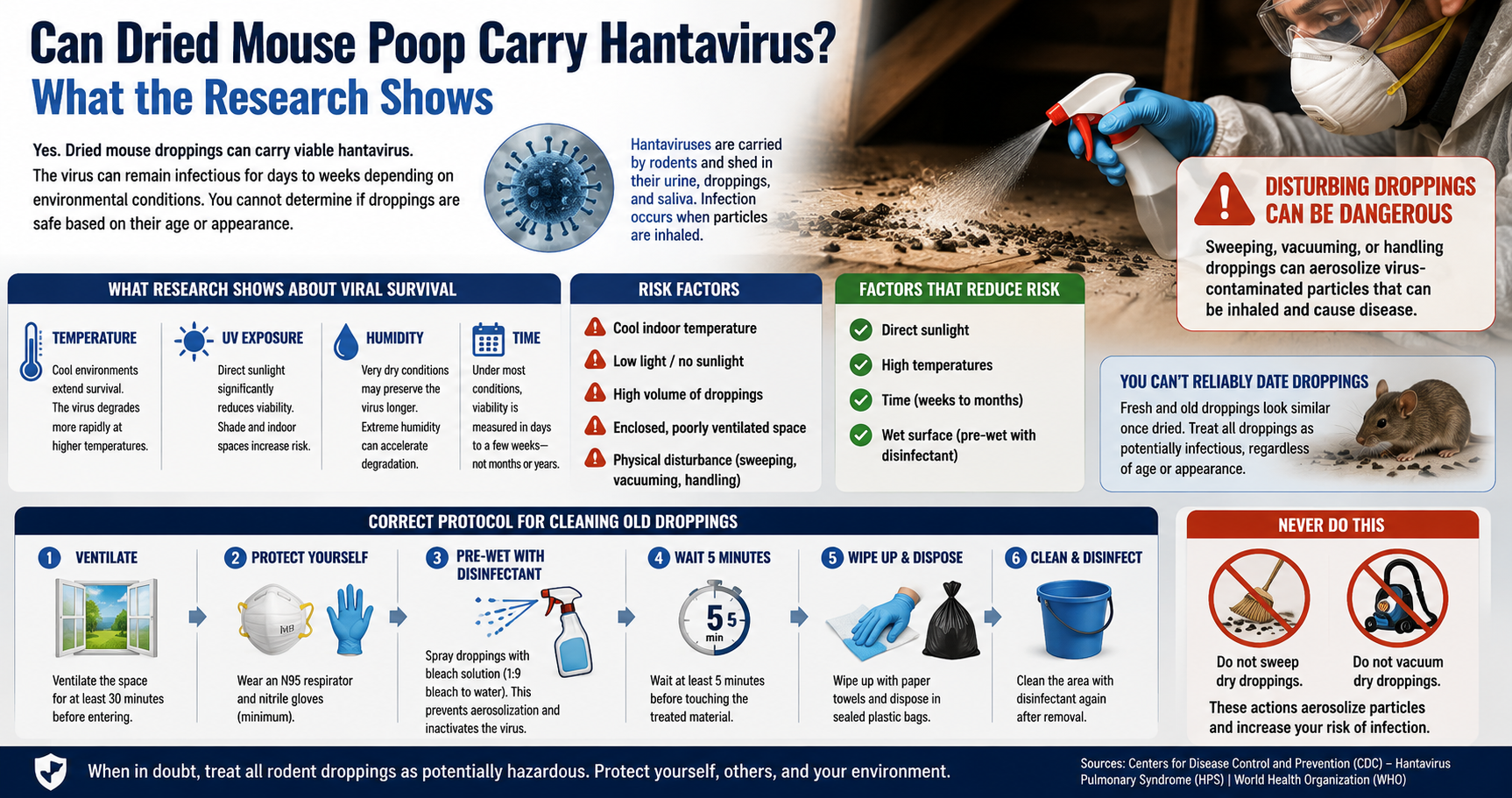
Yes — dried mouse droppings can carry viable hantavirus. The virus does not die instantly when it leaves a host. Under favorable conditions (cool, dark, indoor environments), the virus can remain infectious in dried droppings for days to weeks.
The critical safety implication: you cannot determine whether droppings are safe to handle based on their age or appearance.
That said, context matters. Finding a few old droppings in a ventilated kitchen presents a very different risk than disturbing accumulated droppings and insulation in a sealed attic. The virus is real, but actual infection in ordinary household situations is rare. What determines risk is mostly what you do next — specifically, whether you disturb the material without protection and breathe the dust.
What Research Shows About Viral Survival
Hantavirus viability in dried material has been studied under controlled conditions. Key findings:
- Temperature is the primary factor: The virus degrades more rapidly at higher temperatures. Cool environments extend survival.
- UV exposure degrades the virus: Direct sunlight shortens viability significantly. Droppings in shaded, enclosed spaces present greater risk.
- Humidity plays a role: Very dry conditions appear to preserve the virus longer in some studies; extreme humidity can accelerate degradation.
- The virus does not survive indefinitely: Under most conditions, viability is measured in days to a few weeks — not months or years.
What this means in practice: droppings in a cool, dark attic or storage shed may still carry risk weeks after being deposited. There's no visual way to tell, and no age threshold after which you can safely treat them as inert.
Why "Old" Droppings Are Not Automatically Safe
Age alone doesn't make droppings safe to handle carelessly. A few practical reasons:
You cannot reliably date droppings. Fresh and old droppings look similar once dried. Color and consistency vary based on the mouse's diet, the surface, and humidity — not just age. Droppings you find behind a rarely moved appliance or in a storage shed closed for months could be weeks or years old, and there's no visual way to know.
Enclosed spaces preserve viability. Droppings in an attic, behind a wall, inside a cabinet, or in a storage unit are protected from UV radiation and temperature extremes — the factors that most reliably degrade the virus. A garage or cabin closed up for a season is a different situation from droppings on an outdoor surface exposed to sun and rain.
Disturbing old droppings creates the same inhalation risk as fresh ones. Even if viral load is reduced over time, particles still become airborne when droppings are swept, vacuumed, or broken up. The disturbance is the risk, not the droppings sitting undisturbed.
Factors That Increase Risk
| Factor | Effect |
|---|---|
| Cool indoor temperature | Extends virus survival |
| Low light / no sunlight | Extends virus survival |
| High volume of droppings | More viral particles present |
| Enclosed, poorly ventilated space | Particles concentrate in air |
| Physical disturbance (sweeping, vacuuming) | Sends particles into the air |
Factors That Reduce Risk
| Factor | Effect |
|---|---|
| Direct sunlight | Degrades virus more quickly |
| High temperatures | Accelerates degradation |
| Time (weeks to months) | Reduces but does not eliminate viability |
| Wet surface (pre-wet with disinfectant) | Prevents particles from becoming airborne |
Correct Protocol for Old Droppings
The cleanup protocol is the same regardless of how old droppings appear:
- Ventilate the space for at least 30 minutes before entering
- Wear an N95 respirator and nitrile gloves (minimum)
- Spray droppings with bleach solution (1:9 bleach to water) — this keeps particles from becoming airborne and inactivates any viable virus
- Wait at least 5 minutes before touching the treated material
- Wipe up with paper towels and dispose in sealed plastic bags
- Do not sweep or vacuum dry droppings
Pre-wetting with disinfectant is the key safety step. It does two things: inactivates the virus and keeps particles from becoming airborne when the material is picked up.
If You Already Swept or Vacuumed
This is the most common situation people find themselves in before reading a page like this. You saw the droppings, grabbed a broom or vacuum, and then started wondering if that was a mistake.
Here's what to do:
Ventilate immediately. Open windows and doors and leave the space for at least 30 minutes. The sweeping or vacuuming has already sent particles into the air — let the air exchange clear what it can before you go back in.
Then go back in with proper PPE and do the wet disinfection. Spray the area where the droppings were with bleach solution (1 part bleach to 9 parts water), wait 5 minutes, wipe with paper towels. This addresses the surface contamination that's still there.
If you vacuumed: the vacuum bag or canister now contains contaminated material. Handle it with gloves, seal it in a plastic bag, and dispose of it outdoors. If you have a bagless vacuum, the canister and filter should be treated as contaminated.
Monitor for symptoms for up to 8 weeks if you were working in a high-risk environment — a sealed, poorly ventilated space with significant mouse activity. Symptoms to watch for: fever, deep muscle aches (especially thighs and back), fatigue. If those develop within that window after a cleanup, mention the exposure to your doctor.
For most people who swept a few droppings in a ventilated kitchen or hallway, the risk from that single event is low. The more serious concern is extended work in enclosed spaces with large accumulations.
Official Sources
- CDC Hantavirus — viral survival data and transmission risk
- CDC: Cleaning Up After Rodents — disinfection and cleanup protocols
Sources & References
- CDC — Centers for Disease Control and Prevention
Hantavirus: Prevention, Symptoms & Control
- WHO — World Health Organization
Hantavirus Disease: Fact Sheet
All health claims on this page are verified against the primary sources listed above. View our Editorial Policy
Frequently Asked Questions
Medical Disclaimer
The information on this page is for educational purposes only and is not medical advice. If you believe you may have been exposed to hantavirus or are experiencing symptoms, contact a qualified healthcare professional or local health authority immediately.