How to Clean Mouse Droppings Safely
A Common Situation
When I found mouse droppings along the back wall of my garage — scattered across a wooden shelf, concentrated in the corner behind some boxes — my first move was to grab a roll of paper towels. I wiped up the ones I could reach, then swept the rest toward the center of the floor. It took maybe fifteen minutes.
I didn't own an N95. I didn't mix a bleach solution. I didn't open the garage door first to let air through. I just cleaned it up the way I would clean up anything else, and went back inside.
Hours later, going down a rabbit hole trying to figure out what kind of mice I had, I ended up on a CDC page about hantavirus and read the words "never sweep or vacuum dry droppings." The sweeping had already happened. The droppings were dry. There was no going back to do it differently.
That sequence — clean first, research after — is how most people end up on this page. This guide is the research you want to do first.
You open a kitchen cabinet, move a storage box in the garage, or pull out the couch — and there they are: small dark pellets scattered across the surface. The critical thing to avoid is disturbing them dry. Sweeping, vacuuming, or wiping them up without wetting them first sends contaminated particles into the air. Hantavirus survives in dried droppings and is released when that material is broken up or agitated.
For most people, a small number of droppings in a normal household setting is manageable with the right approach. Here's the protocol.
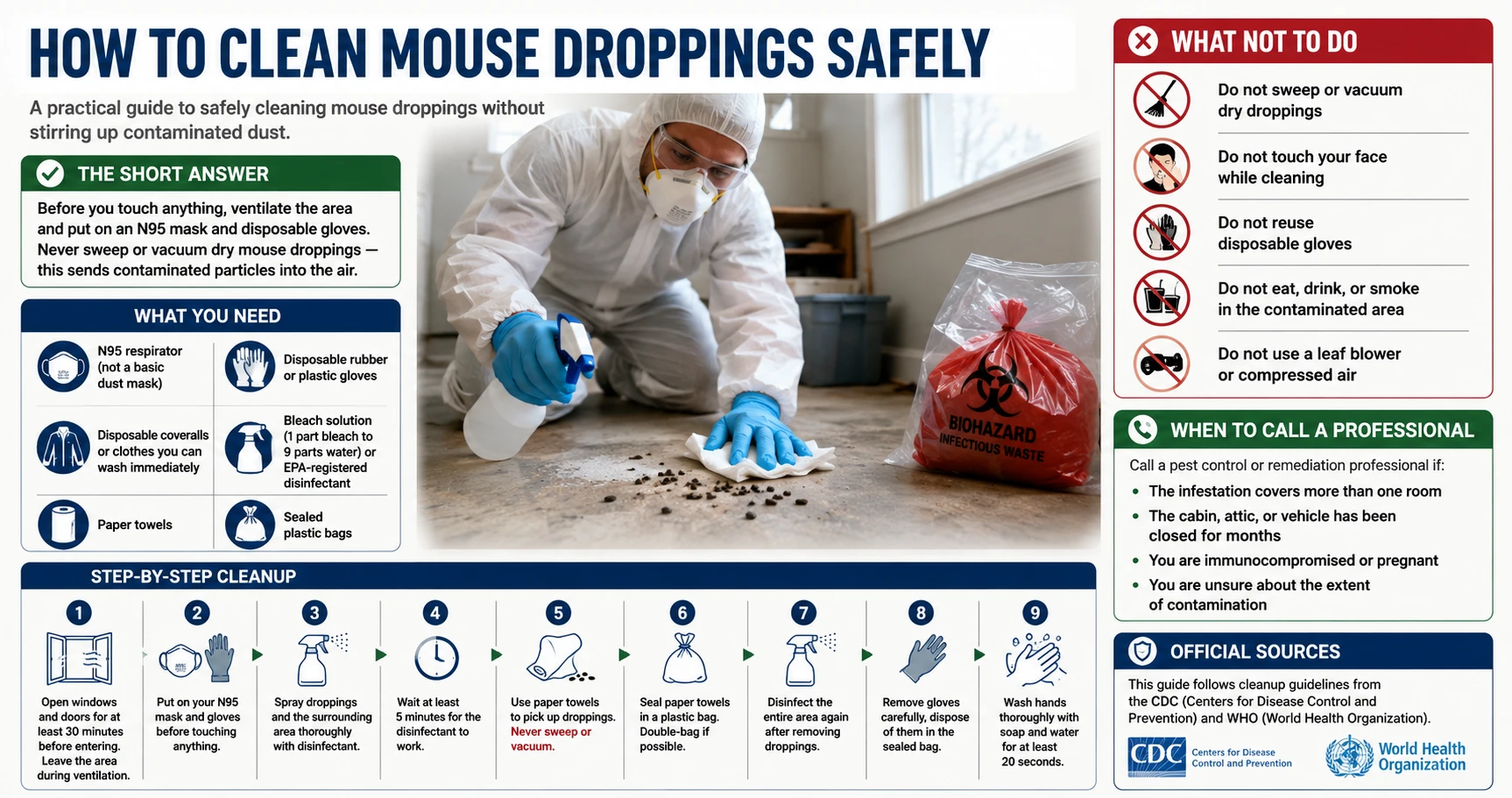
What You Need
- N95 respirator (not a basic dust mask — it won't filter fine viral particles)
- Disposable rubber or nitrile gloves
- Bleach solution (1 part bleach to 9 parts water) or EPA-registered disinfectant
- Paper towels
- Sealed plastic bags
- Disposable coveralls or clothes you can wash immediately at high heat
Step-by-Step Cleanup
Step 1 — Ventilate before you go in. Open windows and doors and leave the space for at least 30 minutes. This reduces the concentration of any particles already in the air. Don't stay in the room while it airs out.
Step 2 — Gear up before touching anything. N95 on, gloves on. If you're working in an attic, crawlspace, or any enclosed area with heavy contamination, add coveralls.
Step 3 — Wet the droppings. Spray generously with disinfectant — the material should be visibly wet. A 1:9 bleach-to-water solution is the CDC standard. EPA-registered disinfectant sprays work too.
Step 4 — Wait 5 minutes. Don't skip this. The contact time is what inactivates the virus, not just the presence of the spray.
Step 5 — Wipe up with paper towels. Bag them immediately. Never sweep or vacuum dry droppings at any point in this process.
Step 6 — Disinfect the surface again. Second pass with disinfectant, then wipe.
Step 7 — Double-bag and dispose. Seal all waste and put it in an outdoor trash bin.
Step 8 — Remove and dispose of gloves carefully. Peel them off so the outer surface doesn't contact your skin. Bag them with the waste.
Step 9 — Wash hands. Soap and water, at least 20 seconds.
Common Mistakes
Sweeping or vacuuming dry droppings is the most common error — and the one health agencies specifically warn against. Any action that agitates dry droppings before wetting them sends particles into the air.
Shop-vacs and standard vacuums are one of the most frequently mentioned wrong choices in homeowner accounts. They feel like a thorough solution for a garage or shed — and they are, for dirt. Unlike HEPA-filtered vacuums, standard shop-vacs exhaust air through the filter and back into the room, dispersing fine particles rather than capturing them. If a shop-vac is what you have, save it for after you've wet-wiped all contaminated surfaces with disinfectant. Use it for the floor wash, not the droppings themselves.
Using a dust mask instead of an N95 is the second. Dust masks don't filter fine viral particles. If you only have a dust mask, ventilate more aggressively, work outdoors if possible, and keep the area moving.
A few others:
- Don't touch your face while cleaning
- Don't reuse disposable gloves
- Don't eat, drink, or smoke in the area
- Don't use a leaf blower or compressed air anywhere near droppings
If You Already Made a Mistake
Touched droppings bare-handed: Wash your hands immediately with soap and water for at least 20 seconds. Skin contact alone is not a documented hantavirus transmission route — the primary risk is inhalation. Wash, avoid touching your face, and continue cleanup with gloves.
Swept or vacuumed dry droppings without a mask: Ventilate the area immediately and leave. Monitor for symptoms — fever, severe muscle aches, fatigue — for up to 8 weeks. If you develop flu-like symptoms following a specific cleanup incident, tell your doctor what happened and when.
When the Standard Protocol Isn't Enough
A small number of droppings in a kitchen or bathroom is manageable on your own with the steps above.
Some situations call for a professional:
- More than one room affected
- Attic, crawlspace, or vehicle contamination — especially after months of storage
- Heavy nesting material present, not just scattered droppings
- You're immunocompromised or pregnant
- You're not sure how far the contamination extends
Enclosed spaces with limited airflow carry higher risk during cleanup regardless of technique — a sealed attic, an RV that spent the winter in storage, a cabin nobody's opened since fall. When in doubt about the scale, call a professional before going in.
Official Sources
- CDC: Cleaning Up After Rodents — official step-by-step cleanup protocol
- CDC Hantavirus Prevention — prevention guidelines
Sources & References
- CDC — Centers for Disease Control and Prevention
Hantavirus: Prevention, Symptoms & Control
- cdc.gov — Cleaning Up
https://www.cdc.gov/hantavirus/prevention/cleaning-up.html
- WHO — World Health Organization
Hantavirus Disease: Fact Sheet
All health claims on this page are verified against the primary sources listed above. View our Editorial Policy
Frequently Asked Questions
Medical Disclaimer
The information on this page is for educational purposes only and is not medical advice. If you believe you may have been exposed to hantavirus or are experiencing symptoms, contact a qualified healthcare professional or local health authority immediately.