Hantavirus in California: Where the Risk Is Highest and What Happened at Yosemite
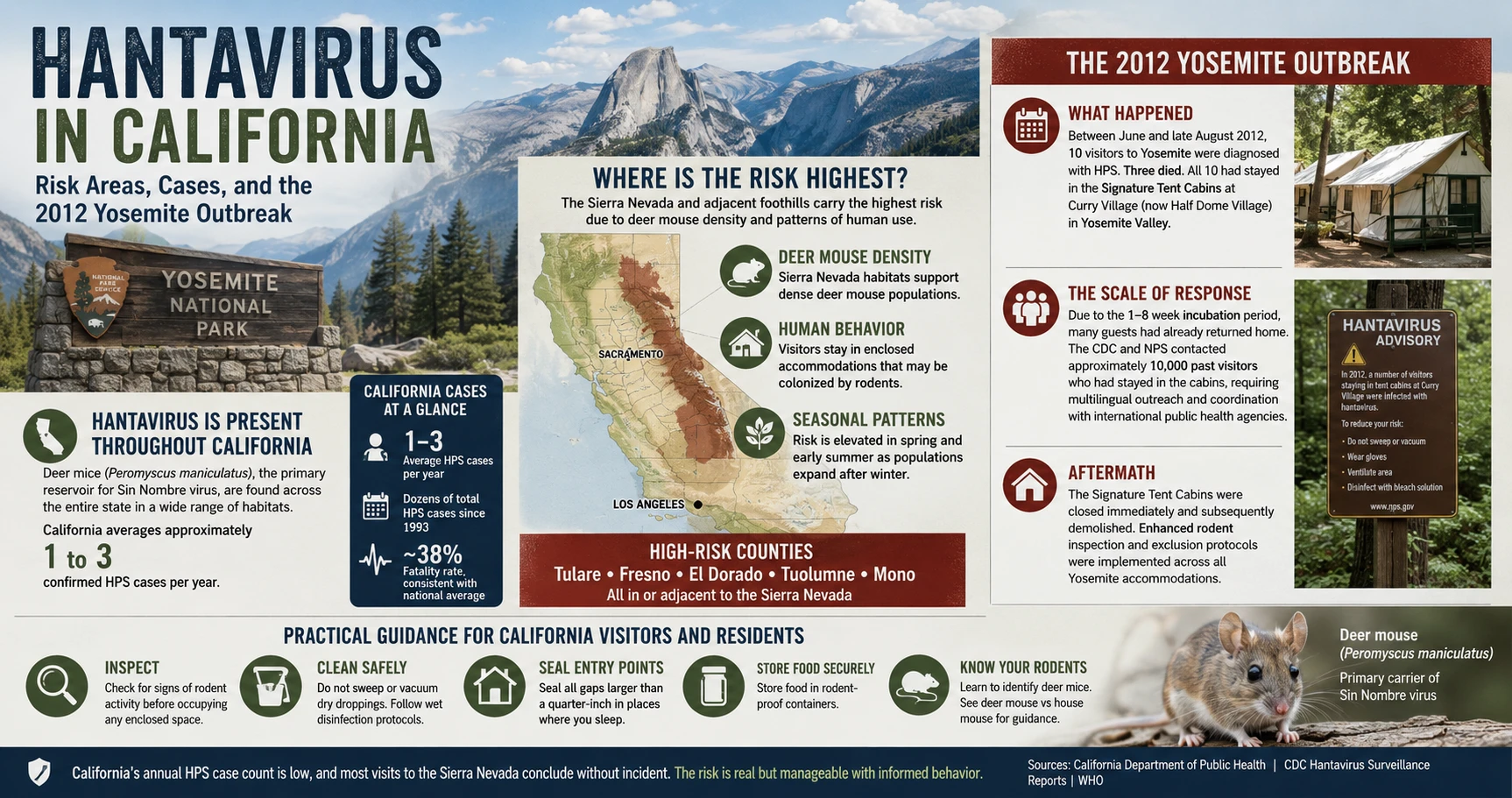
Hantavirus Is Present Throughout California
California is hantavirus country. The deer mouse (Peromyscus maniculatus), the primary reservoir for Sin Nombre virus in the United States, is found across virtually the entire state — in the Sierra Nevada, the coastal ranges, foothill chaparral, and high desert margins. Wherever deer mice live, they share space with campgrounds, cabins, storage sheds, vacation homes, and rural properties.
California averages approximately 1 to 3 confirmed HPS cases per year. Since 1993, California has recorded dozens of total HPS cases, with a fatality rate consistent with the national average of roughly 38 percent.
Where in California Is the Risk Highest?
Several factors combine to make the Sierra Nevada range and adjacent foothill areas the highest-risk zone in the state. The scenarios that come up repeatedly in California cases aren't dramatic — they're ordinary: a rental cabin in Tuolumne County that sat closed since fall, a storage shed on a foothill property, an RV that wintered in the driveway. Enclosed spaces, rodent activity, and human disturbance.
Deer mouse density: Sierra Nevada habitats — mixed conifer forests, chaparral, and subalpine meadow edges — support dense deer mouse populations.
Human behavior: Visitors often stay in enclosed accommodations such as tent cabins, rental cabins, or rustic structures that are unoccupied for extended periods. Rodents exploit these spaces as shelter. When visitors arrive and disturb accumulated droppings in a confined space, the risk of breathing in infectious particles is highest.
Seasonal patterns: Risk is elevated in spring and early summer as deer mouse populations expand after winter. Visitors cleaning out winter-closed cabins face the highest exposure potential.
High-risk California counties include Tulare, Fresno, El Dorado, Tuolumne, and Mono — all in or adjacent to the Sierra Nevada.
The 2012 Yosemite National Park Outbreak
The most significant hantavirus event in California history occurred in summer 2012 at Yosemite National Park.
What Happened
Between June and late August 2012, 10 visitors to Yosemite were diagnosed with HPS. Three died. All 10 had stayed in the Signature Tent Cabins at Curry Village (now Half Dome Village) in Yosemite Valley.
Investigation by the CDC and National Park Service determined that the double-walled construction of the tent cabins had created void spaces between inner and outer canvas walls. Deer mice had colonized this void extensively, accumulating years of droppings and urine-saturated nesting material inside the walls. Guests had no way of knowing — the cabins looked normal, the beds were made, and there was no visible sign of contamination. They were sleeping in an enclosed space breathing that air for hours each night.
The Scale of Response
Because HPS has an incubation period of 1 to 8 weeks, many guests had already returned home before falling ill. The CDC and NPS conducted a massive notification effort, contacting approximately 10,000 past visitors who had stayed in the implicated cabins. The notification required outreach in multiple languages and coordination with foreign public health agencies.
Aftermath
The Signature Tent Cabins were closed immediately and subsequently demolished. Enhanced rodent inspection and exclusion protocols were implemented across all Yosemite accommodations. The outbreak prompted a nationwide review of rodent exclusion practices in national park lodging facilities.
To put the numbers in context: tens of millions of people visit Yosemite and the Sierra Nevada each year, and HPS cases remain rare. The 2012 outbreak was the largest single cluster in park history — and it required a specific combination of contaminated infrastructure, enclosed sleeping space, and extended nightly exposure. Most visits to the region don't involve that level of contact with rodent-contaminated material.
Practical Guidance for California Visitors and Residents
The highest-risk moment is typically the first hour after arrival — opening a cabin that's been closed for months, pulling equipment out of a shed, clearing out an attic or crawlspace. That's when disturbed droppings become airborne. Here's what to do instead:
- Inspect before you settle in. The most common mistake is dropping bags and assuming an unoccupied cabin is fine. Check for droppings, nesting material, and gnaw marks before doing anything else — and do it with gloves on.
- Do not sweep or vacuum dry rodent droppings — follow wet disinfection protocols.
- Seal all gaps larger than a quarter-inch in structures where you sleep.
- Store food in rodent-proof containers.
- Learn to identify deer mice — see deer mouse vs house mouse for identification guidance.
California's annual HPS case count is low, and most visits to the Sierra Nevada conclude without incident. The risk is real but manageable with informed behavior.
Official Sources
- CDC Hantavirus — national HPS surveillance data
- California Department of Public Health — Hantavirus — California-specific case data
Sources & References
- CDC — Centers for Disease Control and Prevention
Hantavirus: Prevention, Symptoms & Control
- cdc.gov — Index
https://www.cdc.gov/hantavirus/php/surveillance/index.html
- cdph.ca.gov — HantavirusPulmonarySyndrome.Aspx
https://www.cdph.ca.gov/Programs/CID/DCDC/Pages/HantavirusPulmonarySyndrome.aspx
All health claims on this page are verified against the primary sources listed above. View our Editorial Policy
Frequently Asked Questions
Medical Disclaimer
The information on this page is for educational purposes only and is not medical advice. If you believe you may have been exposed to hantavirus or are experiencing symptoms, contact a qualified healthcare professional or local health authority immediately.