Found Signs of Deer Mice in Your Cabin? Here's What to Know
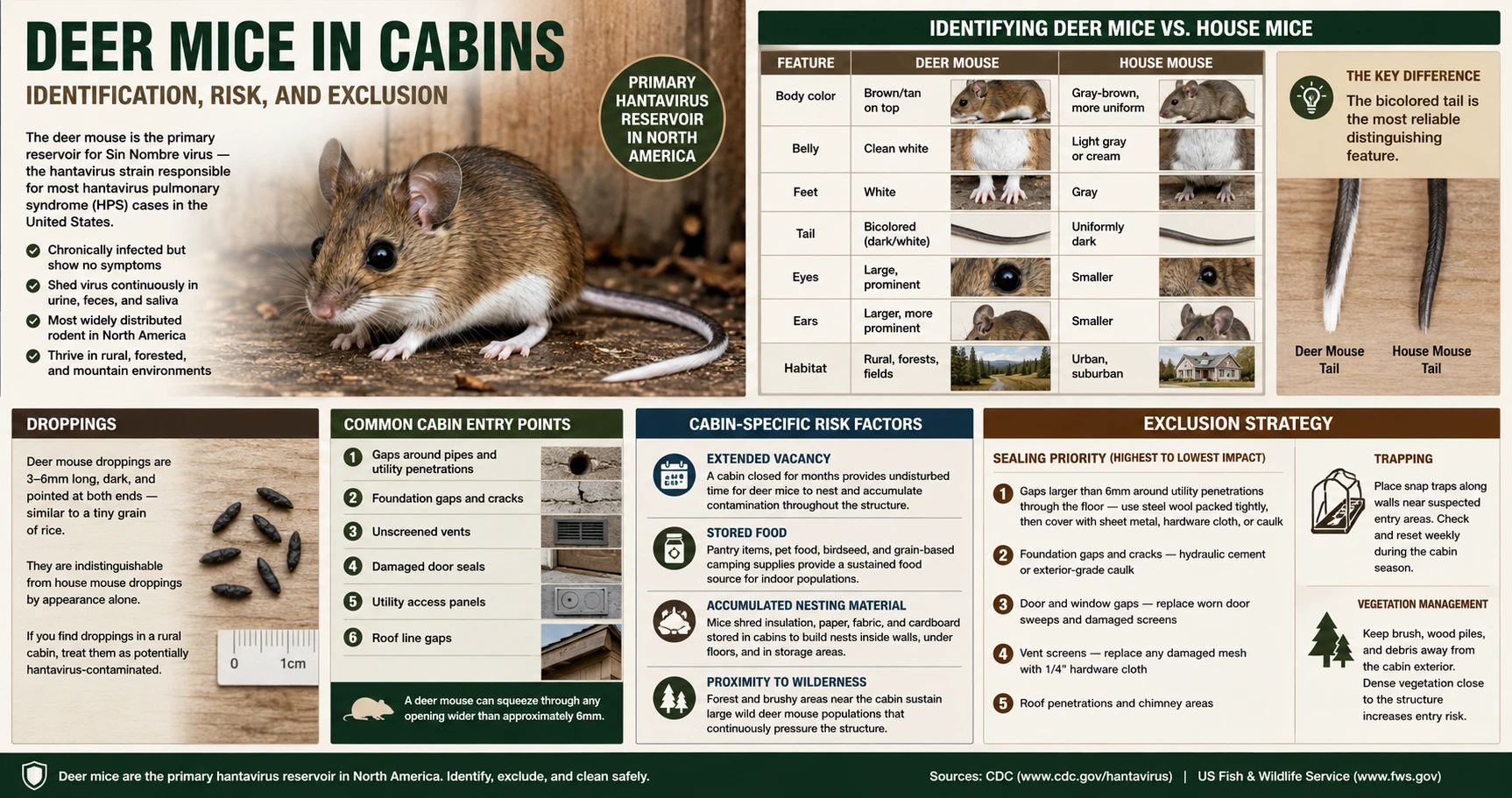
You open the cabin after months away. There are droppings on the countertops, maybe some nesting material stuffed into a drawer. And now you're wondering if you just walked into a hazard.
You might have. Deer mice are the primary hantavirus carrier in North America, and cabins — especially ones that sit closed through winter — are one of their favorite spots. The mice move in, nest in the walls, deposit droppings and urine throughout the space, and leave. Then you arrive in spring and disturb everything.
Here's what the risk actually looks like, how to identify what you're dealing with, and what to do next.
Why Deer Mice Are a Specific Concern
Not all mice carry hantavirus at equal prevalence. In North America, the deer mouse (Peromyscus maniculatus) is the primary reservoir for Sin Nombre virus — the strain of hantavirus responsible for the majority of hantavirus pulmonary syndrome (HPS) cases in the United States.
Deer mice:
- Are chronically infected but show no symptoms
- Shed virus continuously in urine, feces, and saliva
- Are the most widely distributed rodent in North America
- Thrive in exactly the rural, forested, and mountain environments where cabins are typically located
The risk in a cabin doesn't come from a mouse running across the floor. It comes from dried droppings and nesting material that gets disturbed — and the particles that go airborne the moment you start cleaning.
Identifying Deer Mice vs. House Mice
| Feature | Deer Mouse | House Mouse |
|---|---|---|
| Body color | Brown/tan on top | Gray-brown, more uniform |
| Belly | Clean white | Light gray or cream |
| Feet | White | Gray |
| Tail | Bicolored (dark/white) | Uniformly dark |
| Eyes | Large, prominent | Smaller |
| Ears | Larger, more prominent | Smaller |
| Habitat | Rural, forests, fields | Urban, suburban |
The bicolored tail is the most reliable distinguishing feature. A deer mouse's tail is clearly dark on top and white underneath with a sharp dividing line.
That said, most people can't make a confident species ID in the field, and for cleanup purposes it rarely matters. Any droppings found in a rural cabin should be treated as potentially contaminated regardless of species.
Droppings
Deer mouse droppings are 3–6mm long, dark, and pointed at both ends — similar in appearance to a tiny grain of rice. They are deposited in concentrated areas along travel routes, in cabinets, in drawers, and near nesting sites.
They are indistinguishable from house mouse droppings by appearance alone. If you find droppings in a rural cabin, treat them as potentially hantavirus-contaminated regardless of whether you can confirm the species.
Common Cabin Entry Points
Deer mice typically enter cabins through:
- Gaps around pipes and utility penetrations — anywhere water, electrical, or gas lines enter the structure
- Foundation gaps — cracks in the concrete or masonry where walls meet the slab
- Unscreened vents — foundation vents, crawlspace vents, and roof vents
- Damaged door seals — worn door sweeps, gaps at corners of door frames
- Utility access panels — plumbing or electrical access points that lack proper sealing
- Roof line gaps — where the roof meets the exterior walls, especially at gable ends
A deer mouse can squeeze through any opening wider than approximately 6mm.
Cabin-Specific Risk Factors
Cabins present specific hantavirus risk factors that are less common in primary residences:
Extended vacancy: A cabin closed for months provides undisturbed time for deer mice to nest and accumulate contamination throughout the structure. The worst of it is usually invisible — inside walls, under flooring, in the stuffing of upholstered furniture. You'll often smell something off before you see the full extent.
Stored food: Pantry items, pet food, birdseed, and grain-based camping supplies provide a sustained food source for indoor populations.
Accumulated nesting material: Mice shred insulation, paper, fabric, and cardboard stored in cabins to build nests inside walls, under floors, and in storage areas.
Proximity to wilderness: Forested areas and brushy terrain adjacent to the cabin sustain large wild deer mouse populations that continuously exert pressure on the structure's exclusion perimeter.
Exclusion Strategy
Sealing priority (highest to lowest impact):
- Gaps larger than 6mm around utility penetrations through the floor — use steel wool packed tightly, then cover with sheet metal, hardware cloth, or caulk
- Foundation gaps and cracks — hydraulic cement or exterior-grade caulk
- Door and window gaps — replace worn door sweeps and damaged screens
- Vent screens — replace any damaged mesh with 1/4" hardware cloth
- Roof penetrations and chimney areas
Trapping: Place snap traps along walls near suspected entry areas. Check and reset weekly during the cabin season. Dispose of any caught mice following the disinfect-first protocol.
Vegetation management: Keep brush, wood piles, and debris away from the cabin exterior. Dense vegetation close to the structure provides shelter for outdoor deer mouse populations and increases the likelihood of entry attempts.
Official Sources
- CDC Hantavirus: Rodents — deer mouse reservoir data
- CDC Hantavirus Prevention — prevention and exclusion guidance
Sources & References
- CDC — Centers for Disease Control and Prevention
Hantavirus: Prevention, Symptoms & Control
- WHO — World Health Organization
Hantavirus Disease: Fact Sheet
All health claims on this page are verified against the primary sources listed above. View our Editorial Policy
Frequently Asked Questions
Medical Disclaimer
The information on this page is for educational purposes only and is not medical advice. If you believe you may have been exposed to hantavirus or are experiencing symptoms, contact a qualified healthcare professional or local health authority immediately.