Dead Mouse Cleanup Safety Guide: Disinfect First, Then Remove
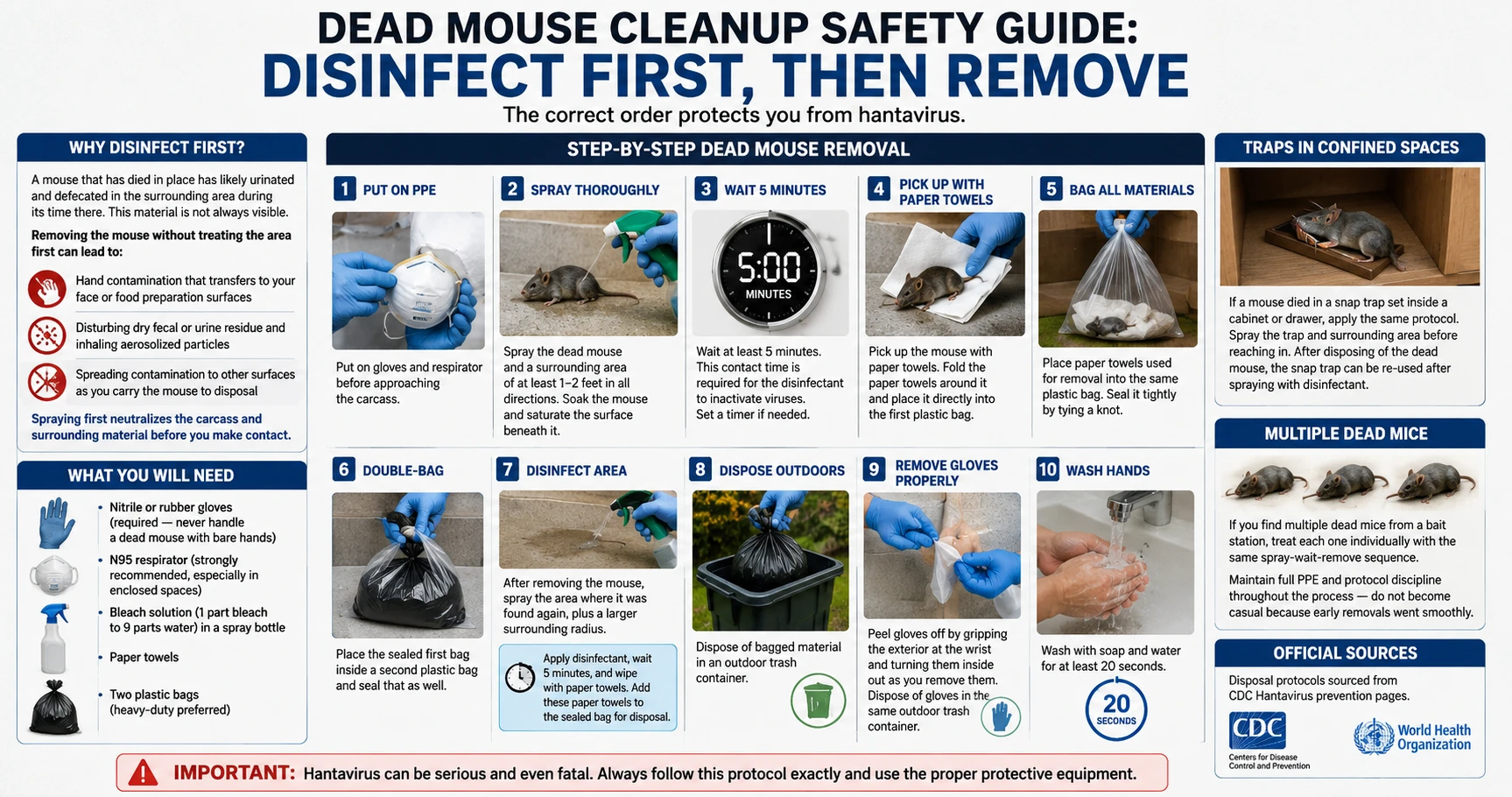
The Situation
You found a dead mouse — in a snap trap under the sink, behind the refrigerator, tucked into a corner of the garage, or somewhere you'd rather not think about. Maybe you smelled it before you saw it.
The instinct is to grab it and get it out of there. That's the part to slow down on.
A mouse that died in place has been there for some time. It urinated and left droppings in the surrounding area — material that isn't always visible but is still there. Reaching in without gloves and without treating the area first means handling the carcass with bare skin and potentially disturbing dry residue around it. Both are avoidable risks.
The correct sequence is simple: spray first, wait, then remove. It takes about 10 minutes longer than just grabbing it. Worth it.
Fresh vs. Decomposed — Does It Change Things?
A mouse found the same day it died is different from one that's been there for a week.
A recently dead mouse is easier to handle and the surrounding contamination is more contained. A decomposed mouse — soft, dried out, or partially flattened — has often spread more material into the surrounding surface, and disturbing it releases more. Use extra caution with older carcasses: spray more liberally, wait the full contact time, and don't compress the bag.
If the mouse died in the wall and you're only smelling the decomposition without being able to access it, that's a different problem — the wall may need to be opened, or you wait for the smell to dissipate over weeks.
What You'll Need
- Nitrile or rubber gloves — required, no exceptions
- N95 respirator — strongly recommended, especially in enclosed spaces like cabinets or crawlspaces
- Bleach solution (1 part bleach to 9 parts water) in a spray bottle
- Paper towels
- Two plastic bags, heavy-duty if you have them
The Cleanup Sequence
Step 1 — Gloves and respirator on before you approach. Not after you've already reached in to look. Before.
Step 2 — Spray the carcass and surrounding area. Soak the mouse and saturate the surface within 1–2 feet in all directions. The area around the mouse has urine residue whether you can see it or not.
Step 3 — Wait 5 minutes. Set a timer. The contact time is what inactivates the virus — spraying and immediately wiping does very little.
Step 4 — Pick up with paper towels. Wrap the carcass in the paper towels and place directly into the first bag.
Step 5 — Add cleanup materials and seal. Paper towels, the wrapped mouse — all into bag one. Tie a knot.
Step 6 — Double-bag. Bag one goes inside bag two. Seal.
Step 7 — Treat the surrounding area again. Spray the spot where the mouse was, and a wider radius. Wait 5 minutes, wipe with paper towels, bag those too.
Step 8 — Remove gloves properly and wash hands. Peel gloves off by gripping the outside at the wrist, turn inside out as you pull. Bag them. Wash hands with soap and water for at least 20 seconds.
Step 9 — Dispose in an outdoor trash container the same day.
Traps in Confined Spaces
If the mouse died in a snap trap inside a cabinet or drawer, the protocol is the same — you're just working in a smaller space. Spray the trap and the surfaces around it before reaching in. After disposal, the trap itself can be reused after spraying with disinfectant and wiping.
If you can't reach the trap without your face being close to the surface, open whatever doors or drawers you can and let the space air out for a few minutes first.
Multiple Dead Mice
If you're clearing several dead mice from bait stations, treat each one with the same sequence. Don't start cutting corners after the second or third removal because the first ones went fine. The risk is the same throughout — the spray-wait-remove discipline matters every time.
If You Already Picked It Up Without Gloves
Wash your hands immediately with soap and water — thoroughly, at least 20 seconds. Don't touch your face before washing.
Then go back and disinfect the area where the mouse was: spray, wait 5 minutes, wipe. Even if the mouse is already bagged and disposed of, the surface it was on still needs treatment.
Hand-to-face contact is one route of potential exposure. If you touched the mouse and then touched your face or prepared food without washing, that's the concern — not the initial handling itself. Wash hands, treat the area, and monitor for symptoms (fever, muscle aches, fatigue) for up to 8 weeks if you were working in a high-risk environment like an enclosed, poorly ventilated space with significant mouse activity.
Official Sources
- CDC: Cleaning Up After Rodents — dead rodent disposal protocol
- CDC Hantavirus Prevention — prevention guidelines
Sources & References
- CDC — Centers for Disease Control and Prevention
Hantavirus: Prevention, Symptoms & Control
- cdc.gov — Cleaning Up
https://www.cdc.gov/hantavirus/prevention/cleaning-up.html
- WHO — World Health Organization
Hantavirus Disease: Fact Sheet
All health claims on this page are verified against the primary sources listed above. View our Editorial Policy
Frequently Asked Questions
Medical Disclaimer
The information on this page is for educational purposes only and is not medical advice. If you believe you may have been exposed to hantavirus or are experiencing symptoms, contact a qualified healthcare professional or local health authority immediately.