42 Days of Waiting: Inside the US Hantavirus Quarantine After the Hondius Outbreak
The Return
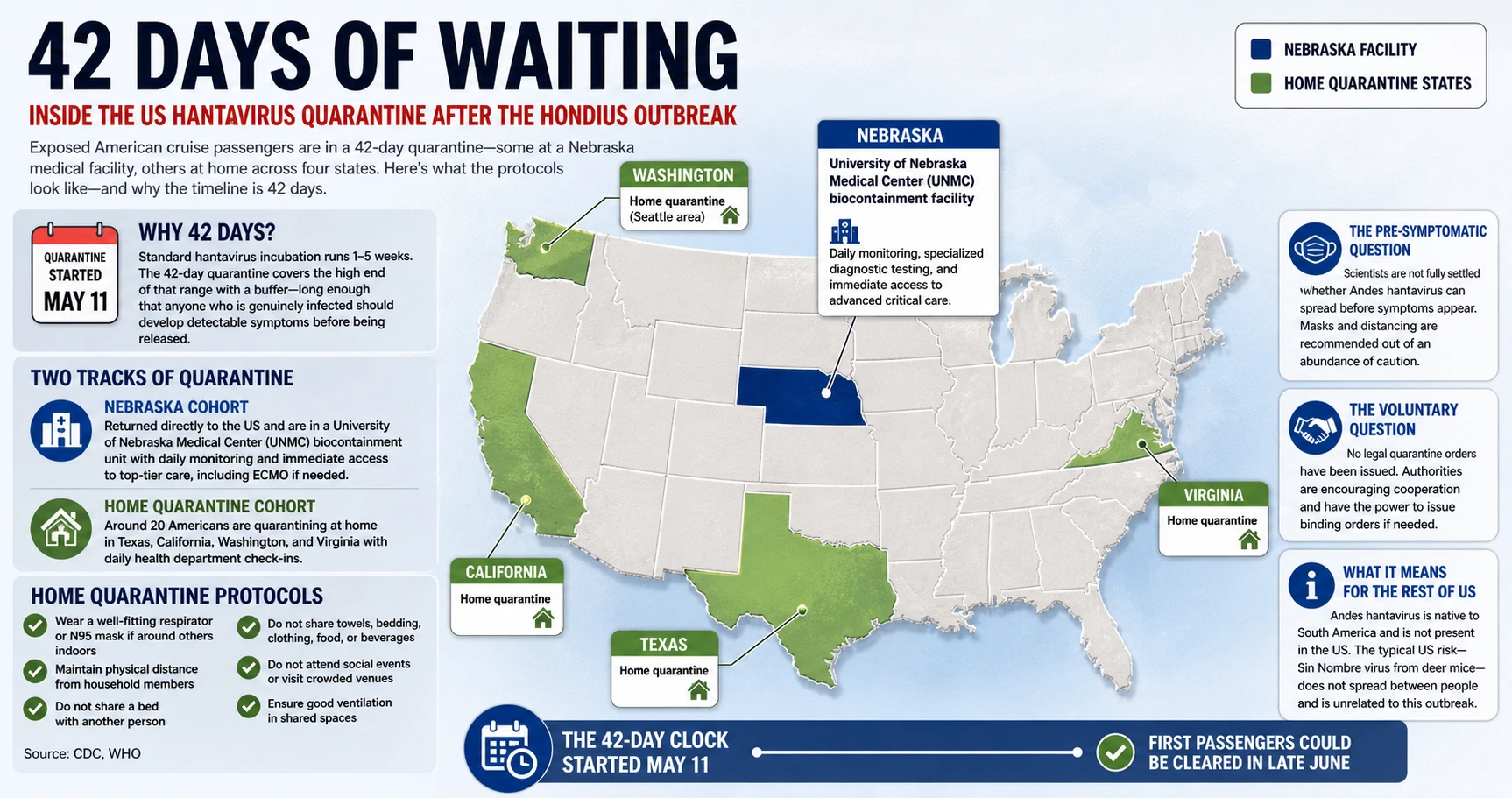
Sixteen American cruise passengers landed in the US on May 12 and went directly to the University of Nebraska Medical Center (UNMC) — a facility with one of the few specialized biocontainment units in the country. Two more arrived shortly after, transferred from Emory University Hospital in Atlanta, bringing the Nebraska cohort to 18. They had been aboard the MV Hondius, an expedition cruise ship hit with a deadly Andes hantavirus outbreak that has infected at least 12 people and killed three.
As of May 22, all 18 passengers at UNMC are doing well. No one has reported concerning symptoms. The medical team conducts twice-daily temperature and symptom checks, with physicians reviewing the data daily and meeting with patients individually and in group sessions.
Their quarantine started May 11. It runs 42 days.
Why 42 Days
Standard hantavirus incubation runs 1–5 weeks. The 42-day quarantine covers the high end of that range with a buffer — long enough that anyone who was genuinely infected should develop detectable symptoms before being released.
It's the same logic that drove COVID-19 quarantine timelines, applied to a pathogen with a longer and less precisely characterized incubation window. For Andes hantavirus specifically, which has documented human-to-human transmission and limited long-term study, a conservative upper bound reduces the risk of releasing someone who is infected but hasn't yet developed signs of illness.
The passengers in Nebraska have a room, a bathroom, a TV, and an exercise bike. They have staff checking on them daily.
Two Tracks: Nebraska and Home
Not all exposed Americans ended up in Nebraska. The quarantine is running on two tracks:
The Nebraska cohort: Passengers who returned directly to the US went to UNMC, which developed its own Andes hantavirus diagnostic test within days of being notified it would receive passengers. These individuals are close to top-tier medical care — which matters, because hantavirus pulmonary syndrome can deteriorate rapidly enough to require ECMO (heart-lung bypass). Being 10 minutes from a biocontainment team is not a trivial advantage.
The home quarantine cohort: Around 20 Americans who left the ship earlier — some before the outbreak was fully recognized, others who shared a flight with a later-confirmed case — are quarantining in their own homes across Texas, California, Washington, and Virginia.
For those at home, health departments are conducting daily temperature and symptom checks. The protocols are specific:
- Wear a well-fitting respirator or N95 mask if around others indoors
- Maintain physical distance from household members
- Do not share a bed with another person
- Do not share towels, bedding, clothing, food, or beverages
- Do not attend social events or visit crowded venues
- Ensure good ventilation in shared spaces
"Even though they were identified as contacts, they are not considered contagious because they currently do not have symptoms," said Dr. Sandra Valenciano, health director for Seattle-King County, confirming two exposed individuals are currently in the Seattle area.
The Pre-Symptomatic Question
The mask and distancing requirements for asymptomatic individuals reflect a genuine uncertainty that scientists are not fully settled on.
Dr. Donald Milton, professor of environmental health at the University of Maryland School of Public Health, has noted that past research on Andes hantavirus suggests those infected may be contagious before obvious symptoms develop. That possibility — not a confirmed fact, but a credible hypothesis — is what makes the mask guidance critical even for people who feel completely fine.
This is specific to Andes virus. Sin Nombre virus, which causes the majority of US hantavirus pulmonary syndrome cases and is transmitted from rodent droppings and urine, has no documented person-to-person transmission. The quarantine protocols and the scientific uncertainty around the Hondius outbreak do not apply to the typical North American hantavirus exposure scenario.
From Voluntary to Mandatory
The quarantine began as a voluntary arrangement. That changed in the third week.
By May 22, the CDC had issued formal quarantine orders to at least two passengers at UNMC, requiring them to remain at the facility through at least May 31. Officials confirmed the orders without disclosing the individuals involved. The shift from encouraged compliance to legal obligation reflects both the passage of time — six weeks is a long time to ask people to stay away from their families — and the continued emergence of new cases abroad that have kept the outbreak in an active phase.
A Canadian passenger who shared a flight with Nebraska patients tested positive after arriving home. A Dutch crew member was confirmed infected and hospitalized in the Netherlands. Both new cases occurred while the Nebraska quarantine was ongoing, and officials acknowledged these developments are directly influencing decision-making about when and whether to release passengers early.
At the same time, the CDC is evaluating each passenger individually, and officials have indicated that some may be released before the full 42-day period ends — depending on their specific exposure profile and the evolving scientific picture. A blanket early release has been ruled out; individual cases are being considered on their own merits.
The 42-day timeline, combined with the severity of the disease — HPS has roughly a 36% case fatality rate — persuaded most to cooperate initially. Whether the formal orders signal a broader shift toward mandatory containment for the remaining cohort depends on what the CDC determines in the coming days.
What It Means for the Rest of Us
The situation in Nebraska and across four states is an unusual public health response to an unusual event. Andes hantavirus is native to South America, the Hondius outbreak is geographically contained, and the US has no established Andes virus reservoir rodents.
For anyone not connected to the cruise ship, this outbreak does not change their hantavirus risk profile. The relevant hantavirus for people in the US — Sin Nombre virus, carried by deer mice — spreads through disturbing rodent droppings in enclosed spaces, not through contact with other people. The precautions are different, the virus is different, and the outbreak in Nebraska does not represent a new ambient risk.
The 42-day clock started May 11. The CDC has ordered all passengers to remain at least through May 31. For those who complete the full quarantine period, the earliest possible release is late June.
Sources & References
- CDC — Centers for Disease Control and Prevention
Hantavirus: Prevention, Symptoms & Control
- WHO — World Health Organization
Hantavirus Disease: Fact Sheet
- ideastream.org — Northeast Ohio Epidemiologist Explains Latest Hantavirus Ebola Outbreaks
https://www.ideastream.org/show/sound-of-ideas/2026-05-21/northeast-ohio-epidemiologist-explains-latest-hantavirus-ebola-outbreaks
- ketv.com — 71385481
https://www.ketv.com/article/hantavirus-outbreak-live-nebraska-medicine-update-quarantine/71385481
All health claims on this page are verified against the primary sources listed above. View our Editorial Policy
Medical Disclaimer
The information on this page is for educational purposes only and is not medical advice. If you believe you may have been exposed to hantavirus or are experiencing symptoms, contact a qualified healthcare professional or local health authority immediately.