Hantavirus Around the World: Which Countries and Strains Pose the Most Risk
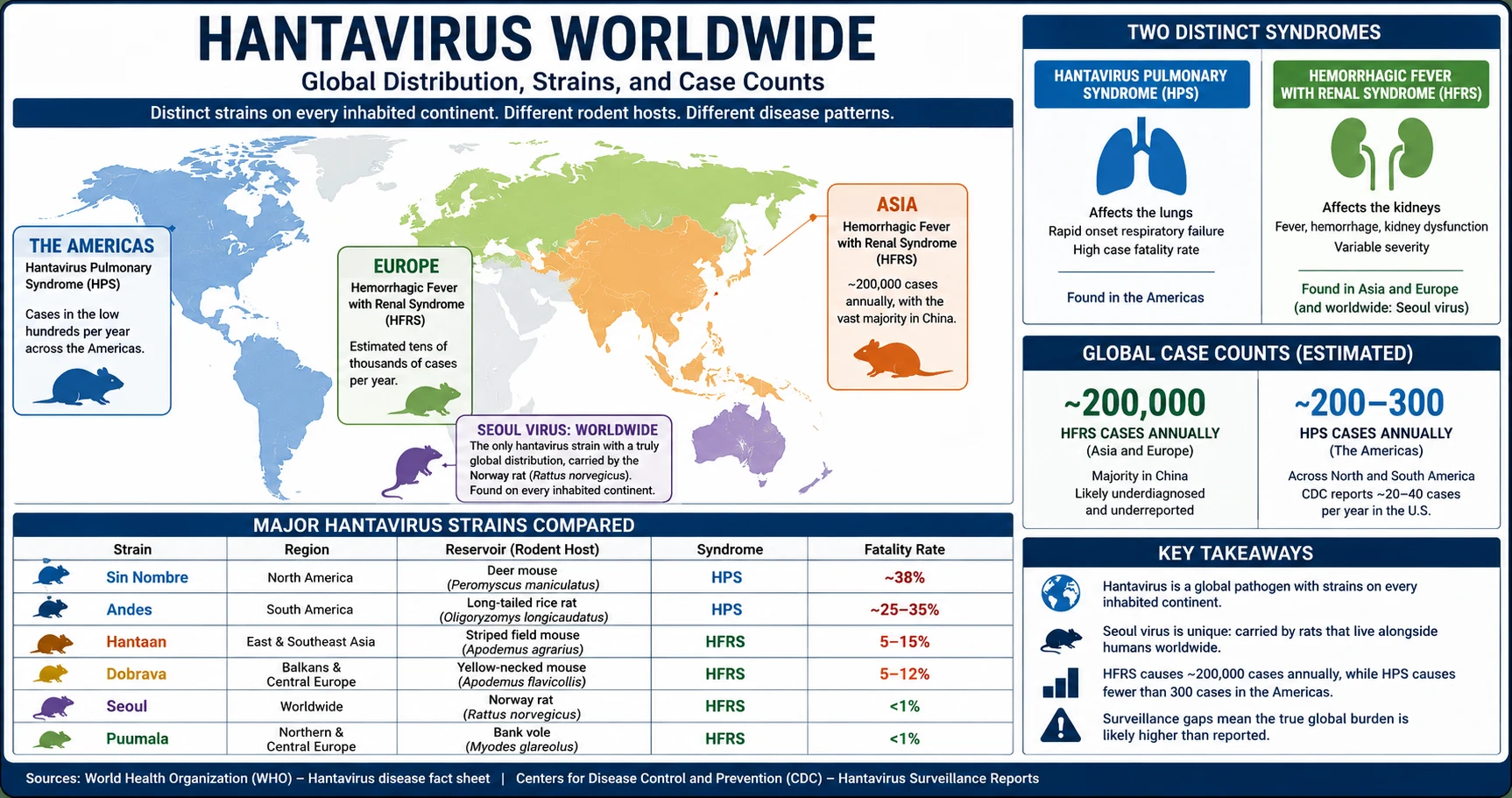
If you're dealing with a rodent problem in the US, the strain you're most likely to encounter is the Sin Nombre virus — the one behind the severe lung disease called HPS. That's the one with the 38% fatality rate. That's the one worth understanding first.
But hantavirus isn't just a US problem. Different strains exist around the world, some more dangerous than others. Here's what's out there globally and which regions carry real risk.
The Americas: Hantavirus Pulmonary Syndrome
In North and South America, hantavirus causes Hantavirus Pulmonary Syndrome (HPS), characterized by rapid respiratory failure and a case fatality rate of approximately 38 percent.
Sin Nombre virus is the dominant strain in the United States, carried by the deer mouse. Related strains causing HPS in other parts of the Americas include Black Creek Canal virus (Florida, cotton rat), Bayou virus (southeastern US, rice rat), and New York virus (northeastern US, white-footed mouse).
Andes virus, found in Argentina and Chile, is notable for being the only hantavirus strain with documented person-to-person transmission.
Across the Americas as a whole, HPS cases number in the low hundreds per year.
Asia and Europe: Hemorrhagic Fever with Renal Syndrome
HFRS is the dominant form of hantavirus disease outside the Americas. It primarily affects the kidneys rather than the lungs. Annual case counts are estimated at approximately 200,000 globally, with China accounting for the large majority.
Hantaan Virus
Found primarily in East and Southeast Asia, carried by the striped field mouse (Apodemus agrarius). Case fatality rate ranges from approximately 5 to 15 percent. The most severe HFRS-causing strain.
Puumala Virus
Circulates across Northern and Central Europe, carried by the bank vole (Myodes glareolus). Causes a generally mild form of HFRS known in Scandinavia as "nephropathia epidemica." Case fatality rate typically below 1 percent. Finland, Sweden, and Russia's western regions report the highest European case counts.
Dobrava Virus
Found in the Balkans and parts of Central Europe, carried by the yellow-necked mouse (Apodemus flavicollis). Causes more severe HFRS than Puumala.
Seoul Virus: The Worldwide Strain
Seoul virus occupies a unique position in hantavirus epidemiology. It is the only hantavirus strain with a genuinely global distribution, carried by the Norway rat (Rattus norvegicus) which has been transported worldwide through shipping and trade.
Seoul virus causes a moderate form of HFRS with a case fatality rate typically below 1 percent. In the United States, Seoul virus infections have been documented in people who keep rats as pets or work with laboratory rat colonies — not in hikers or campers, but in suburban and urban households. That's worth noting: if you keep pet rats, Seoul virus is the strain relevant to you, not Sin Nombre. It changes the assumption that hantavirus is strictly a wilderness problem.
Comparing Strains: Mortality and Disease Burden
The short version: North American strains kill at a far higher rate per infection, but Asian and European strains infect far more people overall. The 200,000 annual HFRS cases globally dwarf the low hundreds of HPS cases in the Americas — but if you're the one who gets HPS, the 38% fatality rate is what matters.
| Strain | Region | Reservoir | Syndrome | Fatality Rate |
|---|---|---|---|---|
| Sin Nombre | North America | Deer mouse | HPS | ~38% |
| Andes | South America | Long-tailed rice rat | HPS | ~25-35% |
| Hantaan | East/Southeast Asia | Striped field mouse | HFRS | 5-15% |
| Dobrava | Balkans/Central Europe | Yellow-necked mouse | HFRS | 5-12% |
| Seoul | Worldwide | Norway rat | HFRS | <1% |
| Puumala | Northern/Central Europe | Bank vole | HFRS | <1% |
Surveillance and Reporting Gaps
Global case counts should be treated as floor estimates. HFRS in rural Asia is almost certainly underdiagnosed — reliable testing isn't available in all regions, and mild cases may be attributed to other causes. The CDC's US HPS numbers are more reliable, running approximately 20 to 40 confirmed cases per year in recent years.
Official Sources
- WHO Hantavirus Fact Sheet — global disease burden and strain distribution
- CDC Hantavirus — HPS surveillance data
Sources & References
- CDC — Centers for Disease Control and Prevention
Hantavirus: Prevention, Symptoms & Control
- WHO — World Health Organization
Hantavirus Disease: Fact Sheet
All health claims on this page are verified against the primary sources listed above. View our Editorial Policy
Frequently Asked Questions
Medical Disclaimer
The information on this page is for educational purposes only and is not medical advice. If you believe you may have been exposed to hantavirus or are experiencing symptoms, contact a qualified healthcare professional or local health authority immediately.