Hondius Cruise Ship Hantavirus Outbreak: 41 Under Monitoring as Scientists Debate Transmission
The Outbreak
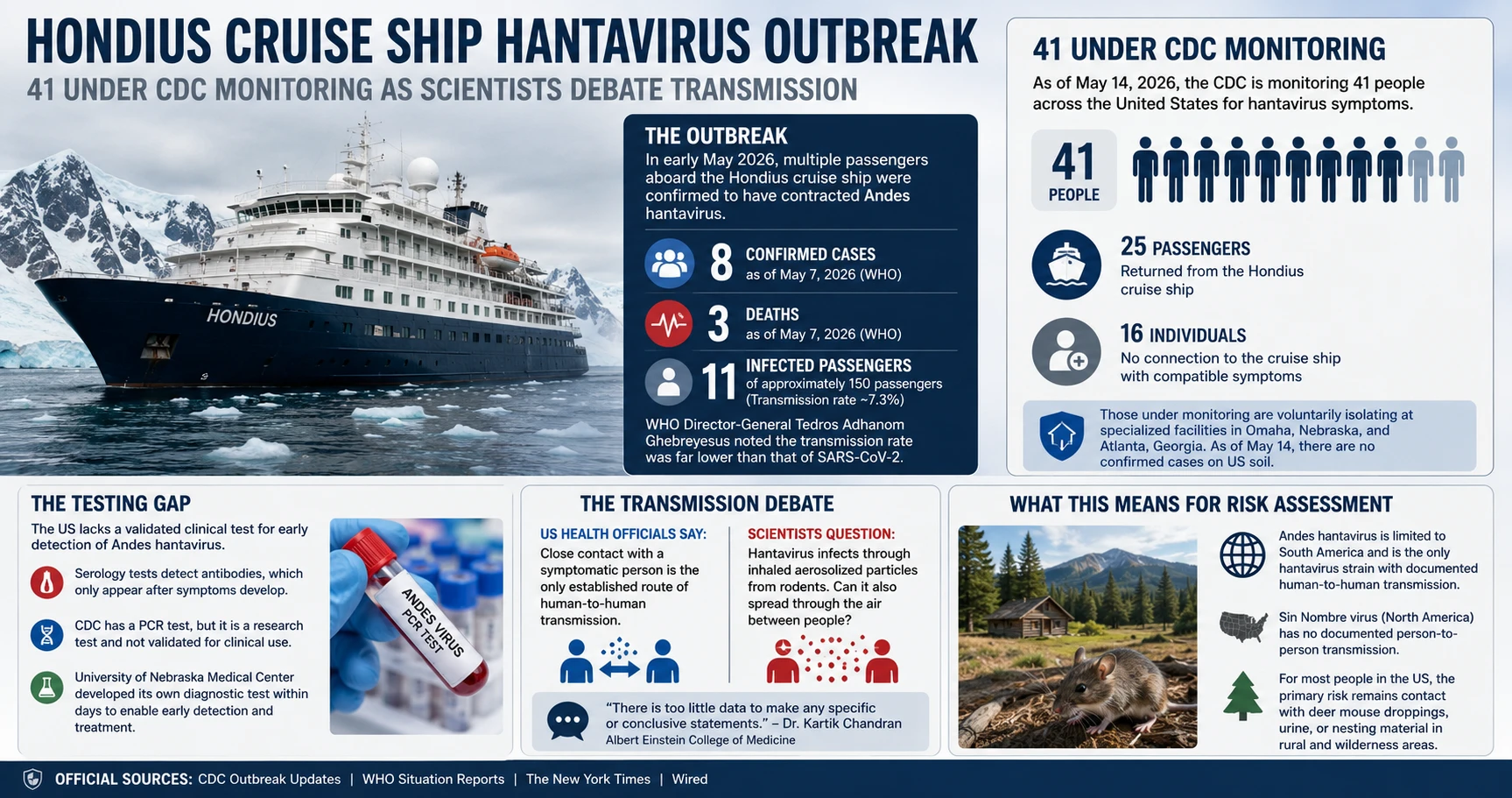
In May 2026, the Hondius — an expedition cruise ship — became the focus of a global public health response after multiple passengers were diagnosed with Andes hantavirus. The WHO issued a statement on May 7 confirming 8 cases and 3 deaths linked to the vessel. The causative agent, Andes virus, is the only hantavirus strain known to transmit between humans.
Of approximately 150 passengers aboard during the relevant period, 11 were infected — a transmission rate that WHO Director-General Tedros Adhanom Ghebreyesus noted was far lower than that of SARS-CoV-2. "You can see that this virus is not as efficient in transmission as COVID-19," he said.
41 Under CDC Monitoring
As of May 14, the CDC was monitoring 41 people across the United States for hantavirus symptoms. This figure includes returning passengers from the Hondius as well as 16 additional individuals with no connection to the cruise ship who had developed compatible symptoms.
David Fette, the CDC official leading the outbreak response, confirmed that as of May 14 there were no confirmed cases on US soil. Those under monitoring were voluntarily isolating at specialized facilities in Omaha, Nebraska, and Atlanta, Georgia.
The Testing Gap
The outbreak has exposed a significant gap in US public health infrastructure: the absence of a validated clinical test capable of diagnosing Andes hantavirus infection early in its course.
When Nebraska health authorities were notified they would receive passengers, they asked the CDC whether a ready-to-use test existed. They were told the CDC had serology testing capability — tests that detect hantavirus antibodies in the blood. The problem: the human immune system only produces detectable antibodies after symptoms have already developed, meaning serology cannot be used for early diagnosis.
The CDC does have a PCR test for Andes virus, but HHS spokesperson Andrew Nixon confirmed it is a research-grade test not validated for clinical patient management. Validating a diagnostic test for clinical use requires rigorous standardization to ensure consistent, reliable results — a process that takes time.
In response, the University of Nebraska Medical Center (UNMC) developed its own Andes virus diagnostic test within days. Their goal: detect cases early enough to begin treatment before severe disease develops.
The Transmission Debate
US health officials have repeatedly stated that close contact with a symptomatic person is the only route of human-to-human Andes hantavirus transmission. Scientists who have studied hantavirus for decades are less certain.
Researchers have pointed out an apparent inconsistency: hantavirus routinely infects humans through breathing in virus particles released from rodent droppings and urine. If the virus can travel through the air from a rodent source to a human, some argue, the question of whether it can travel through the air from an infected person to another person deserves serious consideration.
"I don't understand why we are so reluctant to acknowledge the inhalation route when discussing person-to-person transmission," said Linsey Marr, a viral aerosol transmission expert at Virginia Tech.
Kartik Chandran, a virologist at Albert Einstein College of Medicine, took a more cautious position: "There is too little data to make any specific or conclusive statements." He and other experts noted that the low number of infections among the ship's passengers — confined together for weeks — is itself reassuring evidence that the virus does not spread efficiently.
What This Means for Risk Assessment
The Hondius outbreak is an unusual event. Andes hantavirus is geographically limited to South America and is the only hantavirus strain with documented human-to-human transmission. The Sin Nombre virus responsible for North American hantavirus pulmonary syndrome (HPS) has no documented person-to-person transmission.
For people in the United States not connected to the cruise ship, the outbreak does not change their hantavirus risk profile. The primary risk for US residents remains contact with deer mouse droppings, urine, or nesting material in rural, wilderness, and cabin environments — not person-to-person exposure.
Sources & References
- CDC — Centers for Disease Control and Prevention
Hantavirus: Prevention, Symptoms & Control
- WHO — World Health Organization
Hantavirus Disease: Fact Sheet
All health claims on this page are verified against the primary sources listed above. View our Editorial Policy
Medical Disclaimer
The information on this page is for educational purposes only and is not medical advice. If you believe you may have been exposed to hantavirus or are experiencing symptoms, contact a qualified healthcare professional or local health authority immediately.