First Hantavirus Case in Canada: Hondius Passenger on Vancouver Island Tests Positive
The Case
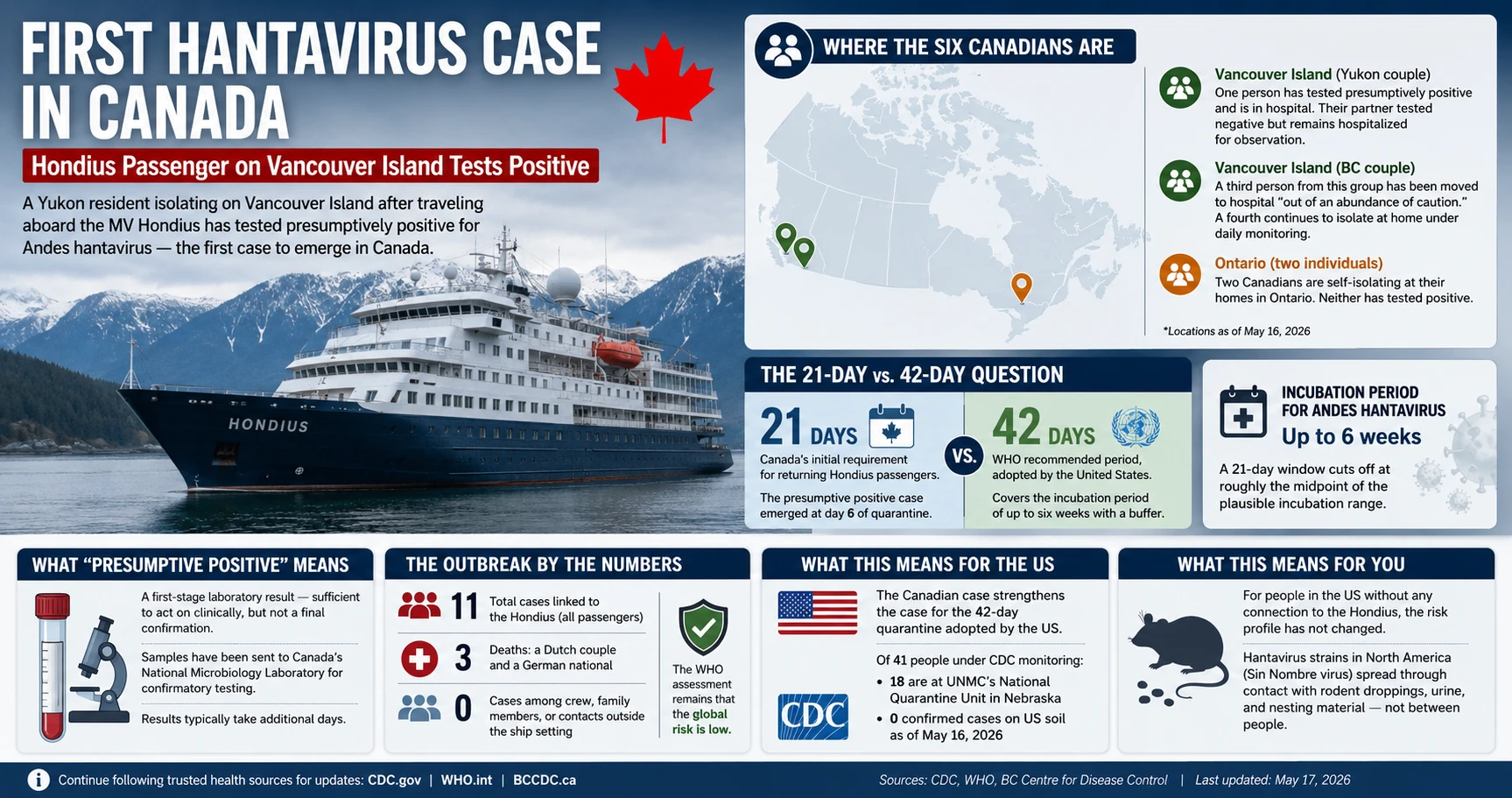
A Canadian national who traveled aboard the MV Hondius has tested presumptively positive for Andes hantavirus — the first case to emerge in Canada since the cruise ship outbreak began in April 2026.
British Columbia's provincial health officer, Dr. Bonnie Henry, confirmed Friday that the individual developed mild symptoms including fever and headache while isolating on Vancouver Island. The person was moved to hospital in Victoria, where testing returned a presumptive positive result. That result still requires confirmation by Canada's National Microbiology Laboratory.
"The patient is stable, and their symptoms remain mild at this point," Dr. Henry said. "They are still in hospital, in isolation, being monitored and receiving care as needed."
The individual is from Yukon and had been isolating on Vancouver Island alongside a partner and another couple — also Hondius passengers — from British Columbia.
Where the Six Canadians Are
Six Canadian nationals were aboard the MV Hondius when the outbreak began. Their locations as of May 16:
- Vancouver Island (Yukon couple): One person has tested presumptively positive and is in hospital. Their partner tested negative but remains hospitalized for observation.
- Vancouver Island (BC couple): A third person from this group has been moved to hospital "out of an abundance of caution." A fourth continues to isolate at home under daily monitoring.
- Ontario (two individuals): Two Canadians are self-isolating at their homes in Ontario. Neither has tested positive.
The four Vancouver Island residents arrived in Victoria on May 10, having been repatriated from Tenerife after the ship finally docked in the Canary Islands. They were placed in quarantine immediately upon arrival despite showing no symptoms at the time.
The 21-Day vs. 42-Day Question
Canada initially required 21 days of isolation for returning Hondius passengers — half the 42-day period recommended by the WHO and adopted by the United States for its own returning passengers.
The presumptive positive now emerging at day 6 of the Canadian quarantine does not itself resolve the debate over timeline — the person has developed symptoms early, well within both windows — but Dr. Henry acknowledged the quarantine period may need to be adjusted: "That timeline could now change."
The incubation period for Andes hantavirus is documented at up to six weeks. The 42-day quarantine adopted by the US is calibrated to cover the high end of that range with a small buffer. A 21-day window cuts off at roughly the midpoint of the plausible incubation range. The emerging Canadian case will likely accelerate a review of that decision.
For background on why the quarantine timelines were set the way they were and what the monitoring involves, see our full breakdown of the US quarantine protocols.
What "Presumptive Positive" Means
A presumptive positive is a first-stage laboratory result — sufficient to act on clinically, but not a final confirmation. Samples from the British Columbia patient have been sent to the National Microbiology Laboratory for confirmatory testing, a process that typically takes additional days.
For the purposes of hantavirus testing, the Andes virus presents specific challenges. The standard serology tests that detect hantavirus antibodies are only reliable after symptoms have developed, and the PCR tests used for early detection must be validated for the specific strain involved. Canada's situation mirrors the testing infrastructure gap that US authorities confronted when the Nebraska quarantine began — one that UNMC addressed by developing its own diagnostic test internally.
What the Case Adds to the Outbreak Picture
With the Canadian presumptive positive, the total number of cases linked to the Hondius now stands at 11, all among passengers who traveled on the ship. Three people have died — a Dutch couple and a German national. No cases have been confirmed among crew members, family members of passengers, or contacts outside the ship setting.
The outbreak has so far been contained to individuals who were aboard the vessel. Person-to-person transmission of Andes hantavirus is documented, but has occurred only in the context of prolonged close contact — typically household or caregiving settings. There have been no confirmed secondary transmissions to anyone outside the original passenger group.
The WHO's assessment remains that the global risk is low. The Canadian case is consistent with what health officials have been preparing for: delayed symptom onset within the incubation window, producing additional cases among passengers as weeks pass.
What This Means for the US
Canada and the United States share a border and have citizens who traveled on the same ship. The Canadian case is a useful data point for understanding how the incubation period is playing out in practice, and it directly strengthens the case for the longer 42-day quarantine the US adopted.
Of the 41 people currently under CDC monitoring in the United States, 18 are at the National Quarantine Unit at the University of Nebraska Medical Center. As of May 16, there are no confirmed cases on US soil. But the Canadian positive — appearing in a person who arrived from Tenerife on May 10 and was asymptomatic at the time — illustrates precisely why that monitoring continues.
For people in the US without any connection to the Hondius, the risk profile has not changed. The hantavirus strains endemic to North America — primarily Sin Nombre virus, carried by deer mice — spread through contact with rodent droppings, urine, and nesting material, not between people. The Andes virus outbreak remains confined to the population that traveled aboard the ship.
Sources & References
- CDC — Centers for Disease Control and Prevention
Hantavirus: Prevention, Symptoms & Control
- WHO — World Health Organization
Hantavirus Disease: Fact Sheet
- BC Centre for Disease Control
All health claims on this page are verified against the primary sources listed above. View our Editorial Policy
Medical Disclaimer
The information on this page is for educational purposes only and is not medical advice. If you believe you may have been exposed to hantavirus or are experiencing symptoms, contact a qualified healthcare professional or local health authority immediately.