Hantavirus in Washington State: Eastern Risk vs. Seattle Reality
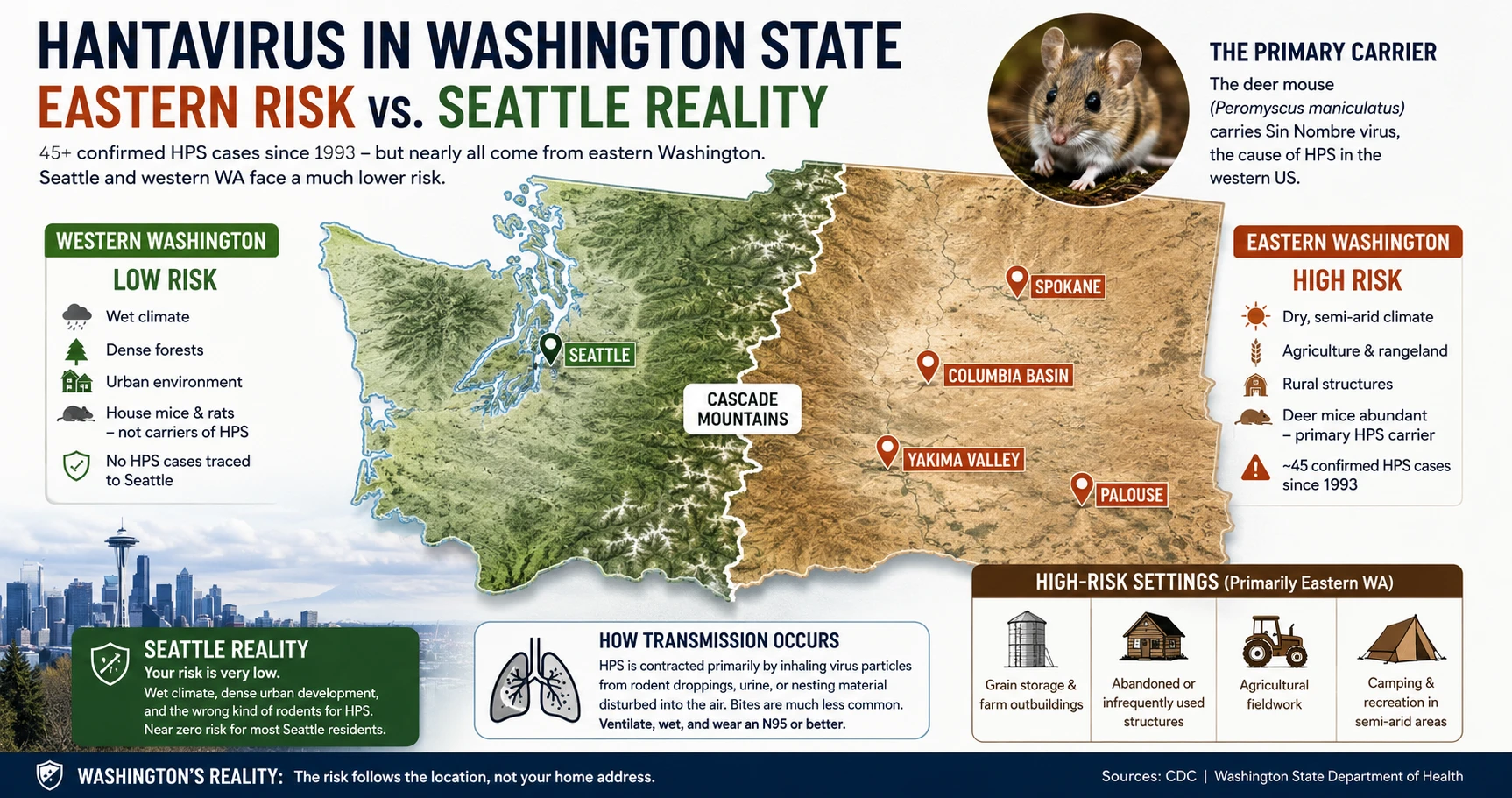
Washington State has recorded approximately 45 confirmed cases of Hantavirus Pulmonary Syndrome (HPS) since 1993 — a count that places it among the higher-risk states in the US. But that number tells only part of the story. The risk is not spread evenly across the state. It is heavily concentrated on one side of the Cascades.
If you live in Seattle or the wet western part of the state, you are almost certainly not at meaningful risk. If you work or recreate in eastern Washington's agricultural zones, shrub-steppe, or rural cabins, that is a different situation entirely.
Eastern Washington: Where the Risk Lives
The deer mouse (Peromyscus maniculatus) is the primary reservoir for Sin Nombre virus, the strain responsible for nearly all HPS cases in the western US. Eastern Washington is some of the best deer mouse habitat in the country.
The Columbia Basin, Spokane region, Yakima Valley, and the wheat country stretching across the Palouse all share the conditions deer mice prefer: open rangeland, shrub-steppe, dryland farming, and scattered rural structures. Populations fluctuate with precipitation and food availability — wet years that produce abundant seed crops can drive significant increases in deer mouse numbers.
The exposure settings that show up most often in eastern Washington cases:
- Grain storage facilities and farm outbuildings — deer mice nest in these structures, leaving droppings and urine on surfaces workers contact
- Abandoned or infrequently used rural structures — a cabin or equipment shed that has been closed up for months can have heavy contamination
- Agricultural fieldwork — tilling, harvesting, or working in areas with high rodent activity
- Camping and outdoor recreation in semi-arid terrain — particularly in structures like pit toilets, shelters, or stored equipment at rural campsites
Eastern Washington residents who work in agriculture, manage rural property, or spend time in older outbuildings should treat mouse activity as a genuine risk — not a remote one.
Western Washington and Seattle: Why the Risk Is Lower
Cross the Cascades heading west and the landscape changes completely. The wet, heavily forested environment of the Puget Sound region, the Olympic Peninsula, and the coast does not favor deer mice. The dominant small rodents in western Washington are house mice, rats, and the white-footed mouse — none of which are known carriers of HPS-causing hantavirus.
Seattle itself sits at the low end of any realistic risk scale:
- The climate is consistently wet, which suppresses deer mouse populations
- Dense urban development eliminates the open, semi-arid habitat deer mice require
- Most rodent encounters in Seattle involve Mus musculus (house mouse) or Rattus species — neither implicated in HPS
- No documented HPS cases have been traced to Seattle proper
When "hantavirus Seattle" spikes as a search term, it typically reflects anxiety following national news coverage of hantavirus cases elsewhere — not a local outbreak or elevated local risk. Seattleites searching for hantavirus information after reading a national story are generally looking at a risk that does not meaningfully apply to their daily environment.
Washington's Case History
Washington's approximately 45 confirmed HPS cases since 1993 place it in the upper tier of affected states nationally. For context, across all western states, total confirmed US cases since 1993 number around 900, with a case fatality rate near 35%.
The Washington State Department of Health tracks cases and publishes periodic updates. The consistent geographic pattern across those decades points to eastern Washington as the persistent risk zone, with agricultural and rural exposure as the dominant route.
Exposure Scenarios in Washington
Understanding where cases actually occur helps people calibrate their concern accurately:
High-risk scenarios (primarily eastern WA):
- Cleaning an outbuilding, grain shed, or cabin that has had mouse activity
- Working in or around stored grain, hay, or feed where mice nest
- Disturbing rodent nesting material without respiratory protection
- Sleeping in a rural structure that shows signs of infestation
Lower-risk scenarios:
- Outdoor hiking and camping in western Washington forests
- Urban and suburban pest control involving house mice in Seattle or the Eastside
- General outdoor recreation west of the Cascades
How transmission occurs: HPS is contracted primarily by inhaling virus particles from rodent droppings, urine, or nesting material disturbed into the air. Bites are a much less common route. The practical implication: ventilate enclosed spaces before cleaning, wear an N95 or better respirator, and wet-wipe rather than dry-sweep rodent contamination.
What Seattle and Western WA Residents Should Know
If you are in Seattle and worried about hantavirus after reading a news story, your risk in your day-to-day environment is near zero. Standard household pest control — sealing entry points, trapping mice with basic precautions — is appropriate if you have a mouse problem, but HPS is not the realistic concern for a Seattle homeowner dealing with a house mouse.
Where this changes: if you are a Seattle or western WA resident who also owns rural property in eastern Washington, travels to the Columbia Basin for hunting or agricultural work, or spends time in older structures east of the Cascades, the eastern Washington risk profile applies to those activities. The risk follows the location, not your home address.
For eastern Washington residents, practical steps matter:
- Before entering a structure that has been closed up, open windows and doors and let it air out for 30 minutes before entering
- Use an N95 respirator when cleaning areas with visible rodent sign
- Wet the area with a diluted bleach solution before wiping — never dry sweep
- Seal rodent entry points in outbuildings and storage areas
- Store grain and feed in rodent-proof containers
Washington's hantavirus history is real. The geographic reality of where that risk concentrates is equally real.
Sources & References
- CDC — Centers for Disease Control and Prevention
Hantavirus: Prevention, Symptoms & Control
- cdc.gov — Index
https://www.cdc.gov/hantavirus/php/surveillance/index.html
- doh.wa.gov — Hantavirus
https://doh.wa.gov/you-and-your-family/illness-and-disease-z/hantavirus
- news.wsu.edu — Wsu Study Finds High Prevalence Of Hantavirus In Some Parts Of Pacific Northwest
https://news.wsu.edu/press-release/2026/05/21/wsu-study-finds-high-prevalence-of-hantavirus-in-some-parts-of-pacific-northwest/
All health claims on this page are verified against the primary sources listed above. View our Editorial Policy
Frequently Asked Questions
Medical Disclaimer
The information on this page is for educational purposes only and is not medical advice. If you believe you may have been exposed to hantavirus or are experiencing symptoms, contact a qualified healthcare professional or local health authority immediately.