Which US Rodents Actually Carry Disease — and Where They Live
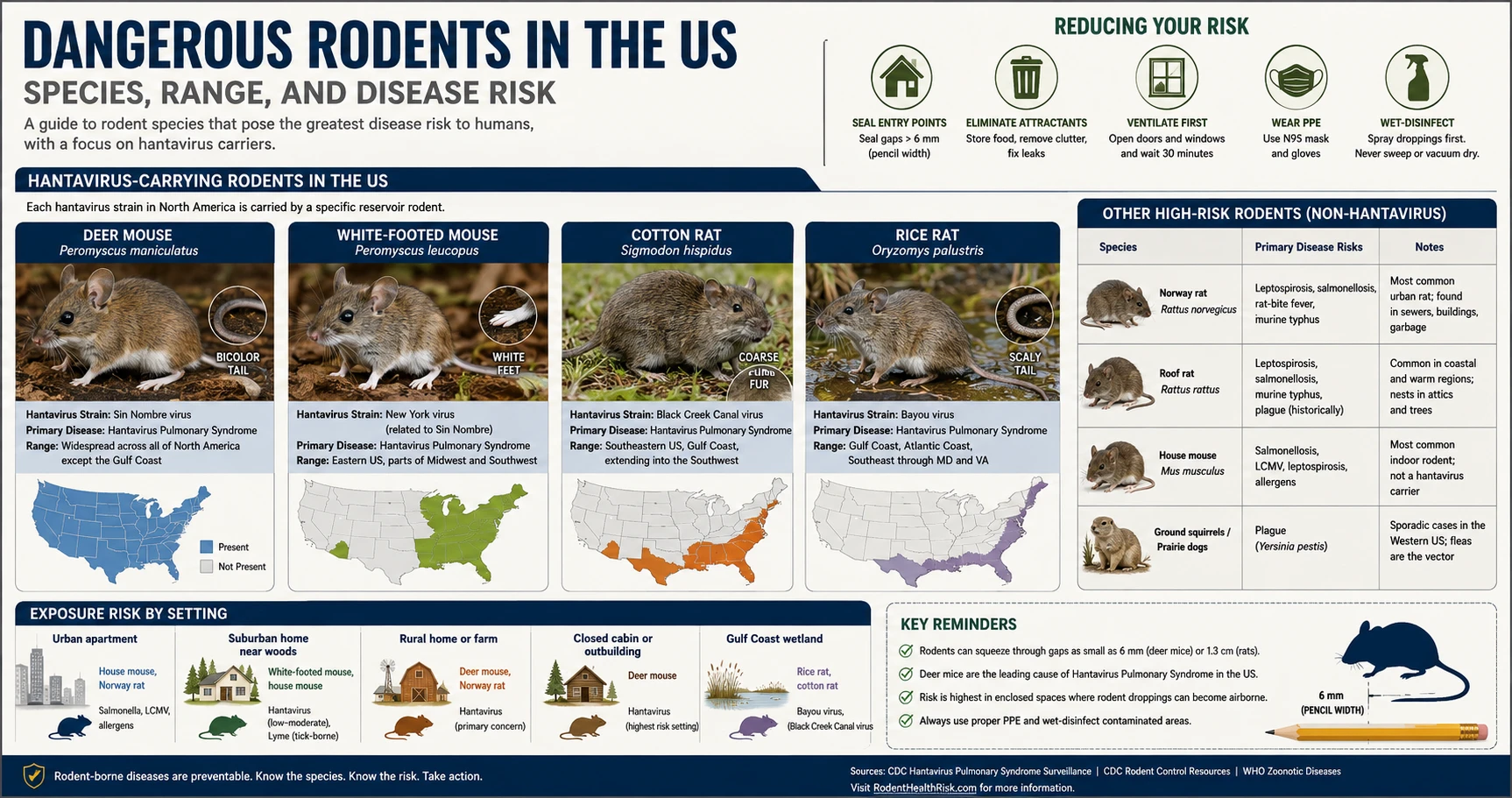
The house mouse that lives in your walls? Probably not your biggest health concern.
It's the deer mouse — smaller, bicolored, and found across most of the US — that carries the hantavirus strain responsible for HPS. But it's not the only rodent worth knowing about. Some parts of the country have different hantavirus-carrying species entirely, and rats bring a separate set of diseases that don't get nearly enough attention.
Here's a breakdown of which US rodent species actually carry disease, where they live, and what the real risk level looks like in different settings.
Hantavirus-Carrying Rodents in the US
Each hantavirus strain in North America is carried by a specific reservoir rodent. Understanding which species lives in your region is the first step in assessing your risk.
| Species | Common Name | Hantavirus Strain | Primary Disease | Geographic Range |
|---|---|---|---|---|
| Peromyscus maniculatus | Deer mouse | Sin Nombre virus | Hantavirus Pulmonary Syndrome | Widespread across all of North America except the Gulf Coast |
| Peromyscus leucopus | White-footed mouse | New York virus (related to Sin Nombre) | Hantavirus Pulmonary Syndrome | Eastern US, parts of Midwest and Southwest |
| Sigmodon hispidus | Cotton rat | Black Creek Canal virus | Hantavirus Pulmonary Syndrome | Southeastern US, Gulf Coast |
| Oryzomys palustris | Rice rat | Bayou virus | Hantavirus Pulmonary Syndrome | Gulf Coast, Atlantic Coast, Southeast |
Species Profiles
Deer Mouse (Peromyscus maniculatus)
The deer mouse is the most important rodent from a public health standpoint in the US. It is the primary reservoir for Sin Nombre virus and accounts for the majority of HPS cases recorded since the disease was first identified in 1993.
Appearance: Brown to reddish-brown back, sharply defined white belly, bicolor tail (dark above, white below), large eyes and ears.
Habitat: Enormously adaptable. Found in forests, grasslands, shrublands, deserts, agricultural land, and human structures — particularly rural cabins, outbuildings, barns, and vehicles left unoccupied for extended periods.
Range: One of the most widely distributed mammals in North America, present in almost every habitat type except dense tropical environments.
Risk behavior: Deer mice don't migrate, but they do move into enclosed structures in autumn looking for warmth. A cabin, shed, or RV that sat closed all winter can accumulate months of droppings, nesting material, and urine-contaminated insulation by the time you open it in spring. Disturbing that material — sweeping, moving boxes, turning on the furnace — is where most real-world exposures happen.
White-Footed Mouse (Peromyscus leucopus)
Closely related to the deer mouse and nearly identical in appearance, the white-footed mouse is the dominant Peromyscus species in eastern North America.
Appearance: Similar to deer mouse — brown back, white belly and feet, bicolor tail. Slightly warmer in color tone and marginally larger in the eastern part of its range.
Habitat: Woodland edges, brushy areas, suburban gardens, and structures near wooded areas. More tolerant of deciduous forest habitat than the deer mouse.
Range: Eastern US and parts of the Midwest and Southwest. The white-footed mouse is also the primary host for the blacklegged tick (Ixodes scapularis), making it a key driver of Lyme disease transmission in the Northeast.
Disease risk: Hantavirus (New York virus strain), Lyme disease (tick-borne, not direct transmission), babesiosis.
Cotton Rat (Sigmodon hispidus)
The cotton rat is a stocky, coarse-furred rodent found in the American South. It is the reservoir for Black Creek Canal hantavirus, which has caused a small number of HPS cases in Florida and the Southeast.
Appearance: Larger and stockier than deer mice (body length up to 18 cm), with grizzled gray-brown fur and a shorter, less prominent tail.
Habitat: Grasslands, brushy fields, sugarcane fields, overgrown areas, and roadsides. Less likely to enter structures than deer mice.
Range: Southeastern US, Gulf Coast states, extending into the Southwest.
Disease risk: Black Creek Canal hantavirus (HPS), Venezuelan equine encephalitis (via mosquitoes that feed on cotton rats).
Rice Rat (Oryzomys palustris)
The rice rat is a semi-aquatic rodent associated with wetland and marsh habitats along the Gulf and Atlantic coasts. It carries Bayou virus, a hantavirus strain linked to a small number of HPS cases.
Appearance: Slender build, grayish-brown fur, long scaly tail, partially webbed hind feet adapted for wet habitats.
Habitat: Tidal marshes, freshwater wetlands, rice fields, and flooded grasslands. Rarely enters buildings.
Range: Gulf Coast from Texas to Florida, Atlantic Coast up through Maryland and Virginia.
Disease risk: Bayou virus (HPS), limited risk due to restricted and specialized habitat.
Other High-Risk Rodents (Non-Hantavirus)
These species do not carry hantavirus but represent significant disease risks:
| Species | Primary Disease Risks | Notes |
|---|---|---|
| Norway rat (Rattus norvegicus) | Leptospirosis, salmonellosis, rat-bite fever, murine typhus | Most common urban rat; found in sewers, buildings, garbage |
| Roof rat (Rattus rattus) | Leptospirosis, salmonellosis, murine typhus, plague (historically) | Common in coastal and warm regions; nests in attics and trees |
| House mouse (Mus musculus) | Salmonellosis, LCMV, leptospirosis, allergens | Most common indoor rodent; not a hantavirus carrier |
| Ground squirrels / Prairie dogs | Plague (Yersinia pestis) | Sporadic cases in the Western US; fleas are the carrier |
Exposure Risk by Setting
| Setting | Most Likely Species | Key Risk |
|---|---|---|
| Urban apartment | House mouse, Norway rat | Salmonella, LCMV, allergens |
| Suburban home near woods | White-footed mouse, house mouse | Hantavirus (low-moderate), Lyme (tick-borne) |
| Rural home or farm | Deer mouse, Norway rat | Hantavirus (primary concern) |
| Closed cabin or outbuilding | Deer mouse | Hantavirus (highest risk setting — this is the scenario behind most documented HPS cases) |
| Gulf Coast wetland | Rice rat, cotton rat | Bayou virus, Black Creek Canal virus |
Reducing Your Risk
Regardless of species, the following measures reduce rodent-borne disease risk:
- Seal entry points: Rodents can squeeze through gaps as small as 6 mm (deer mice) or 1.3 cm (rats). Seal with steel wool backed by caulk or metal flashing.
- Eliminate attractants: Store food in rodent-proof containers, remove clutter that provides nesting material, fix leaking pipes.
- Ventilate before entering enclosed spaces: Before working in a closed cabin, shed, or crawlspace, open doors and windows and allow 30 minutes of air exchange.
- Wear appropriate PPE: N95 respirator and disposable gloves when cleaning areas with known or suspected rodent activity.
- Wet-disinfect before handling: Never sweep or vacuum dry rodent droppings. Spray with bleach solution first.
Official Sources
- CDC Hantavirus: Rodents — reservoir species and geographic range
- CDC Rodent Control — US rodent species and disease risk
- WHO Hantavirus Fact Sheet — global rodent-borne disease data
Sources & References
- CDC — Centers for Disease Control and Prevention
Hantavirus: Prevention, Symptoms & Control
- WHO — World Health Organization
Hantavirus Disease: Fact Sheet
All health claims on this page are verified against the primary sources listed above. View our Editorial Policy
Frequently Asked Questions
Medical Disclaimer
The information on this page is for educational purposes only and is not medical advice. If you believe you may have been exposed to hantavirus or are experiencing symptoms, contact a qualified healthcare professional or local health authority immediately.