CDC's Hantavirus Quarantine Orders May Have a Legal Problem
A Quarantine Without a Clear Legal Basis
When American passengers from the MV Hondius arrived in the US after the Andes hantavirus outbreak, federal authorities placed them in a 42-day quarantine — some voluntarily at home, others at the University of Nebraska Medical Center's biocontainment unit. The public health rationale was straightforward. The legal basis is more complicated.
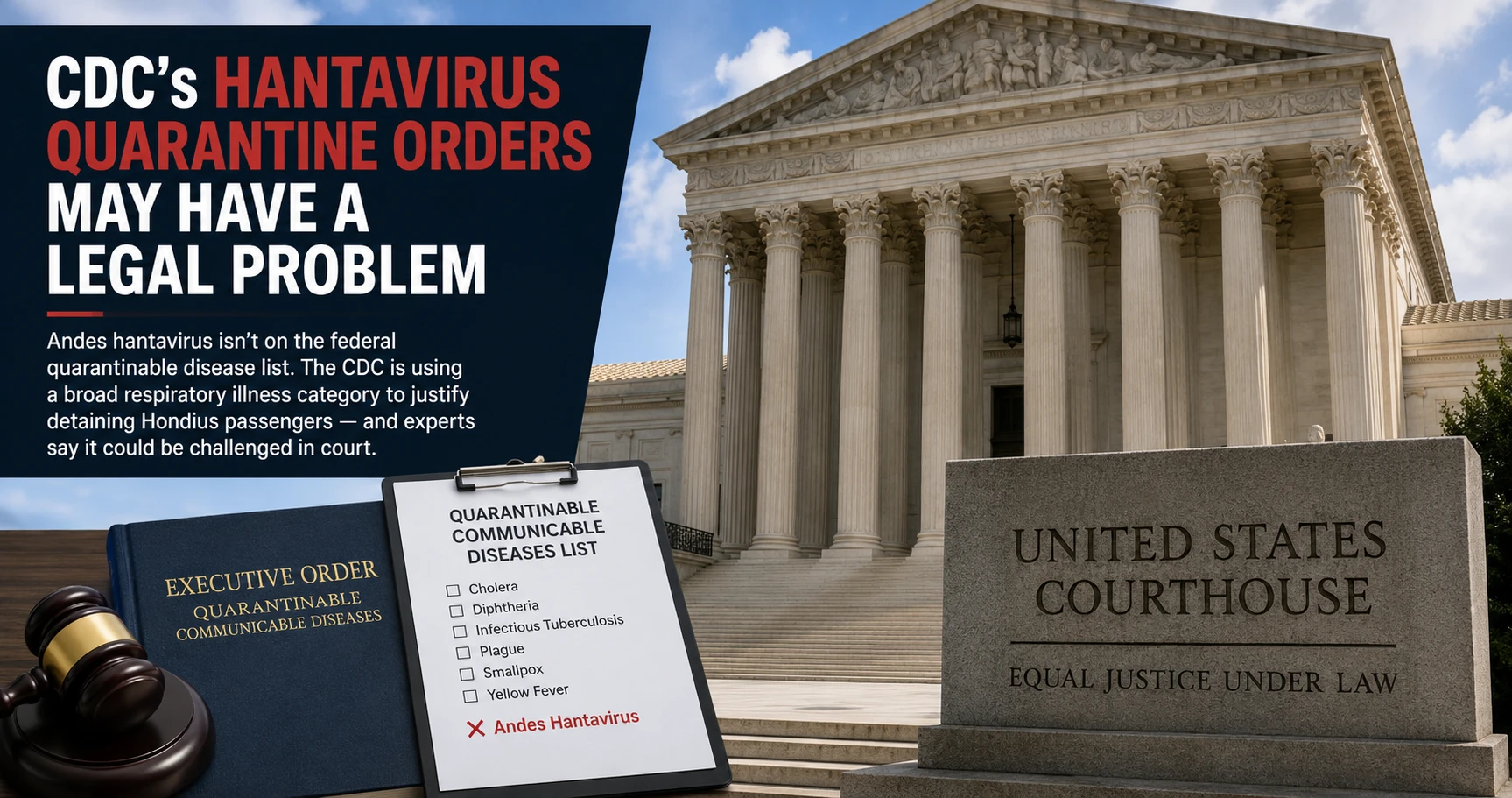
Andes hantavirus does not appear on the federal list of "quarantinable communicable diseases." That list, established and updated through presidential executive orders, is the legal foundation for the CDC's authority to detain individuals at US borders and ports of entry. Without a disease on that list, the agency's power to compel quarantine is significantly constrained.
The 2014 Executive Order Workaround
To justify its quarantine authority, the CDC is classifying Andes hantavirus under a broad catch-all category in a 2014 Obama administration executive order: "severe acute respiratory syndromes."
It's a plausible stretch. Hantavirus pulmonary syndrome does produce severe respiratory failure — that's what makes it so dangerous, with a case fatality rate exceeding 35%. But the category was written to cover illnesses like SARS and novel influenza strains, not a rodent-borne hemorrhagic fever that primarily spreads through contact with rodent droppings.
James Hodge Jr., director of the public health law program at Arizona State University, described the CDC's approach as novel — and potentially vulnerable. "We might see that quarantine order being significantly challenged," he told HealthBeat. Passengers, he noted, could argue that "you've never previously called hantavirus Andes strain a severe acute respiratory condition."
Passengers Held Against Their Will
The legal question has immediate human stakes. As of May 22, at least two passengers are confined at the Nebraska facility against their wishes — one of them identified as Angela Perryman.
So far, the quarantine has proceeded without a formal court challenge. Public compliance has held, in part because the disease itself is severe enough to make the medical logic of containment hard to dispute, and in part because the 18 exposed US passengers have not yet developed symptoms — meaning most have reason to hope they won't need to test the CDC's authority in court.
But the situation is not stable. A 42-day quarantine is a long time, and the voluntary nature of compliance could shift if conditions at the Nebraska facility become more difficult, or if a passenger with strong legal representation decides to push back.
The Fix Is Simple — If Someone Acts
Hodge indicated that the current legal uncertainty could be resolved quickly. President Trump could sign an executive order explicitly adding Andes hantavirus — or hantavirus broadly — to the federal quarantinable disease list. That would give the CDC unambiguous authority and close the legal gap before it becomes a court case.
Whether that action will come before a legal challenge does is unclear. The outbreak remains active: 11 people infected, 3 dead, and dozens of exposed passengers still in the monitoring window.
What This Means for the Broader Hantavirus Response
This is a narrow legal issue specific to the Hondius outbreak and to Andes hantavirus. It has no bearing on how US health authorities handle the more common North American hantavirus strains — Sin Nombre virus, carried by deer mice, has no documented person-to-person transmission and does not trigger quarantine protocols.
For anyone whose hantavirus concern is domestic — cleaning up after a mouse infestation, spending time in a cabin or rural area — the legal debate over the Hondius quarantine is irrelevant to their actual risk. The precautions for Sin Nombre exposure are unchanged.
The legal question matters because it reveals a gap in the regulatory infrastructure: the US has no established framework for handling a novel hantavirus outbreak with person-to-person transmission potential, and the current response is being improvised within a legal structure that was never designed for it.
Sources & References
- CDC — Centers for Disease Control and Prevention
Hantavirus: Prevention, Symptoms & Control
- healthbeat.org — Cdc Hantavirus Quarantine Order Could Face Legal Challenge Expert Says
https://www.healthbeat.org/2026/05/22/cdc-hantavirus-quarantine-order-could-face-legal-challenge-expert-says/
All health claims on this page are verified against the primary sources listed above. View our Editorial Policy
Frequently Asked Questions
Medical Disclaimer
The information on this page is for educational purposes only and is not medical advice. If you believe you may have been exposed to hantavirus or are experiencing symptoms, contact a qualified healthcare professional or local health authority immediately.