Who Is Most at Risk for Hantavirus? High-Risk Groups Explained
Risk Is Not Random
The US averages about 29 hantavirus cases per year — a small number for a country of 330 million. But those cases are not spread evenly across the population. They concentrate in specific groups of people who share one common factor: direct exposure to spaces where infected deer mice live, feed, or nest.
Understanding which groups actually appear in the case data — and why — allows individuals to assess their own risk accurately, rather than treating it as an abstract, unpredictable threat.
Geographic Risk: The Western US Is Different
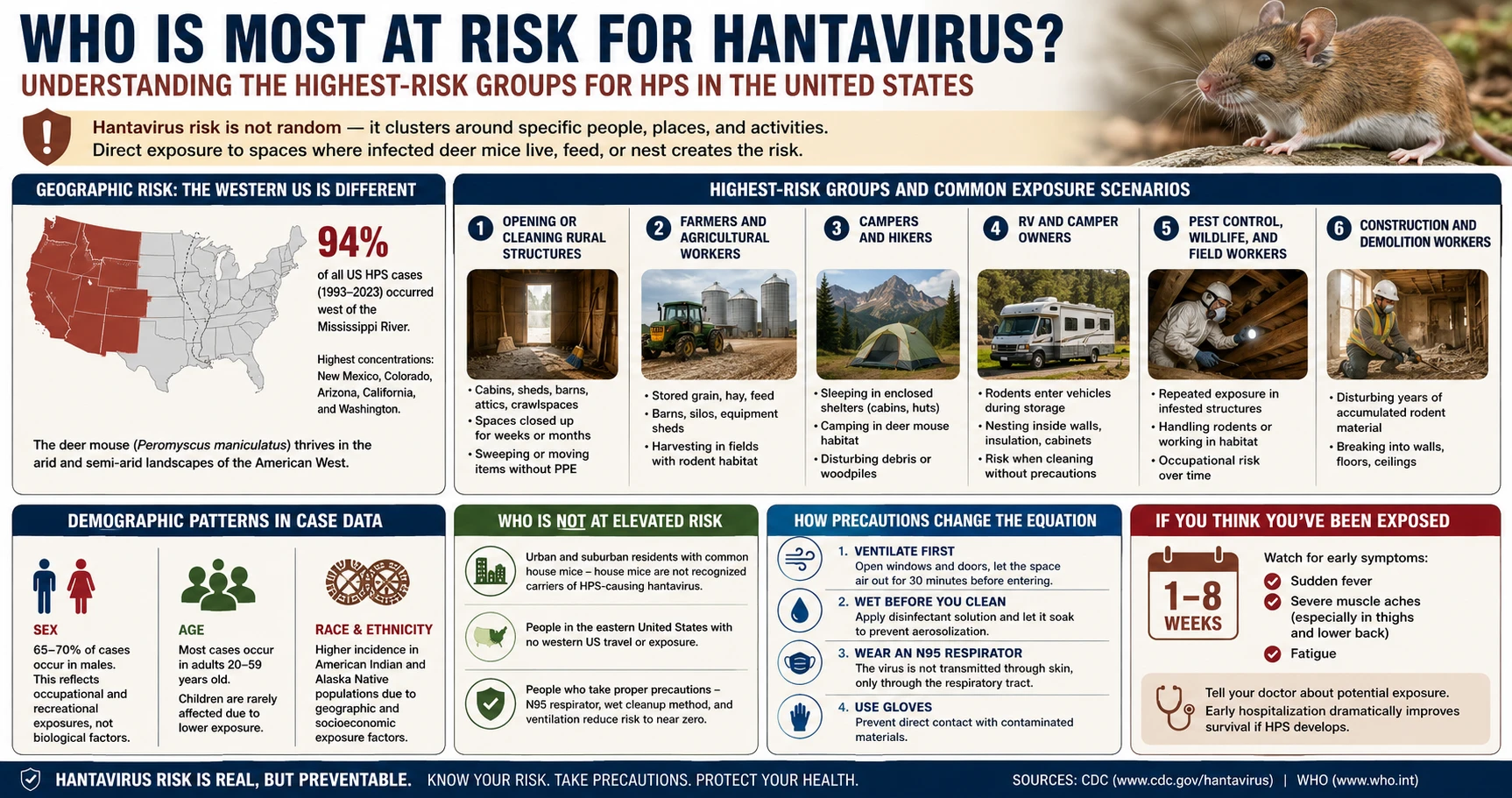
The most powerful predictor of hantavirus risk is location. 94% of all US HPS cases between 1993 and 2023 were reported west of the Mississippi River, with the highest concentrations in New Mexico, Colorado, Arizona, California, and Washington.
This geographic pattern reflects the distribution of the deer mouse (Peromyscus maniculatus), the primary carrier of Sin Nombre virus — the strain responsible for most US HPS cases. Deer mice are widespread across North America but are most densely concentrated in the arid and semi-arid landscapes of the American West, where they thrive in open grasslands, shrublands, and woodland edges.
If you live east of the Mississippi with no travel to the western US, your hantavirus risk is genuinely near zero. If you live in or frequently visit rural western states, the risk calculation is different — particularly if your activities bring you into contact with enclosed structures where deer mice shelter.
For a full state-by-state breakdown, see Hantavirus Cases by State.
Highest-Risk Groups
1. People Who Open or Clean Rural Structures
The single most common exposure scenario in documented HPS cases is cleaning or entering an enclosed space — a cabin, shed, barn, attic, crawlspace, or garage — that has had rodent activity, especially after sitting unused.
When a space sits empty for weeks or months, deer mice may nest inside, leaving behind droppings, urine, and nesting material that dries and accumulates. When a person enters and disturbs that material — by sweeping, moving boxes, or simply walking through — particles become airborne and are inhaled.
This is why opening a cabin after winter is a well-documented risk scenario. The combination of an enclosed space, prolonged absence, accumulated rodent waste, and a person stirring everything up creates ideal exposure conditions.
Highest risk activities:
- Sweeping or cleaning without an N95 respirator
- Moving stored boxes, wood piles, or furniture in infested spaces
- Entering crawlspaces or attics without ventilation
2. Farmers and Agricultural Workers
Agricultural workers are overrepresented in HPS case data. Farms provide abundant food (grain, seeds, stored feed) and shelter (barns, silos, equipment sheds) for deer mice — exactly the conditions that support large, dense rodent populations with high hantavirus infection rates.
Specific agricultural activities associated with cases:
- Handling stored grain or hay
- Working inside barns and feed storage buildings
- Clearing rodent-contaminated equipment sheds
- Harvesting in fields where deer mice nest in crop residue
3. Campers and Hikers
Recreational users in the western US — particularly those who sleep in enclosed shelters — account for a meaningful portion of HPS cases. The Yosemite 2012 outbreak killed three people who had stayed in insulated tent cabins, which had allowed deer mice to nest inside the insulation over time.
Risk is higher for:
- Sleeping in enclosed structures (tent cabins, backcountry huts, rustic shelters) vs. open tents
- Camping in areas with active deer mouse populations
- Disturbing ground debris or woodpiles at campsites
4. People Cleaning RVs and Campers
Recreational vehicles and campers in storage are another documented risk category. If a vehicle is parked for weeks or months in an area with deer mice, rodents may enter through small gaps and nest inside. When the owner returns and starts cleaning — particularly if they sweep or vacuum — exposure can occur.
See the full RV contamination guide for safe cleaning protocols.
5. Pest Control, Wildlife, and Field Workers
Professionals who regularly work in rodent-infested structures or wildlife habitats face repeated exposure risk:
- Pest control workers entering infested structures
- Wildlife biologists and field researchers handling rodents or working in rodent habitat
- Forestry workers in areas with high deer mouse populations
- Military personnel training in rural western environments
Occupational exposure — repeated contact over time — is different from a single cleanup event. Appropriate PPE protocols are particularly important for workers in these categories.
6. Construction and Demolition Workers
Renovation or demolition of old rural structures can disturb years of accumulated rodent material. Workers who break open walls, floors, or ceilings without appropriate respiratory protection may inhale large quantities of aerosolized dust containing hantavirus.
Demographic Patterns in Case Data
Sex
Approximately 65–70% of US HPS cases occur in males. This is an occupational and behavioral pattern, not a biological one. Males in the affected age groups are more likely to perform the specific activities — clearing sheds, agricultural work, field work — that create exposure opportunities.
Age
Most cases occur in adults between 20 and 59 years old. This reflects working-age adults in the high-risk occupations and recreational activities described above. Children rarely appear in HPS case data — not because they are biologically immune, but because they are far less likely to be performing cleanup tasks in rodent-infested rural structures.
Race and Ethnicity
CDC surveillance data shows higher HPS incidence in American Indian and Alaska Native populations compared to the general US population. This reflects geographic and socioeconomic factors — higher proportions of these communities live in rural western areas where deer mice are most common, and in housing types or work settings with greater rodent contact. This is a structural exposure disparity, not a biological one.
Who Is Not at Elevated Risk
Knowing who is at risk is most useful when paired with knowing who isn't:
- Urban and suburban residents with common house mice (Mus musculus) — house mice are not recognized carriers of HPS-causing hantavirus. A mouse in a city apartment is a hygiene and property concern, but not a hantavirus risk in the way a deer mouse in a rural shed is.
- People in the eastern United States with no western US travel or exposure
- People who take proper precautions — an N95 respirator, wet-wipe cleanup method, and ventilation before entering enclosed spaces reduces risk to near zero even in high-exposure scenarios
How Precautions Change the Equation
Hantavirus transmission has a specific and interruptible pathway: aerosolized particles from rodent waste, inhaled in an enclosed space. Interrupting any point in that chain eliminates the risk:
- Ventilate first — open windows and doors, let enclosed spaces air out for 30 minutes before entering
- Wet droppings before touching them — apply a disinfectant solution and let it soak; this prevents aerosolization
- Wear an N95 respirator — the virus is not transmitted through skin, only through the respiratory tract
- Use gloves — prevents direct contact with contaminated material
See the full PPE guide for specific recommendations by task.
Being in a high-risk group — a farmer, a cabin owner, a western US camper — does not mean becoming infected is inevitable. The risk is real but preventable. The people who develop HPS are typically those who didn't know they were at risk, or who didn't take precautions when they were.
If You Think You've Been Exposed
If you're in a high-risk group and have been in a rodent-contaminated environment in the past 1–8 weeks, watch for early symptoms: sudden fever, severe muscle aches (especially in the thighs and lower back), and fatigue. These appear identical to influenza.
Tell your doctor about the potential exposure. Early hospitalization dramatically improves survival if HPS develops — see When to See a Doctor After Rodent Exposure.
Official Sources
- CDC Hantavirus Surveillance Data — case demographics, geographic distribution, exposure scenarios
- WHO Hantavirus Fact Sheet — global risk population overview
Sources & References
- CDC — Centers for Disease Control and Prevention
Hantavirus: Prevention, Symptoms & Control
- cdc.gov — Index
https://www.cdc.gov/hantavirus/php/surveillance/index.html
- WHO — World Health Organization
Hantavirus Disease: Fact Sheet
All health claims on this page are verified against the primary sources listed above. View our Editorial Policy
Frequently Asked Questions
Medical Disclaimer
The information on this page is for educational purposes only and is not medical advice. If you believe you may have been exposed to hantavirus or are experiencing symptoms, contact a qualified healthcare professional or local health authority immediately.