How Likely Are You to Get Hantavirus? Risk Statistics Explained
The Numbers in Context
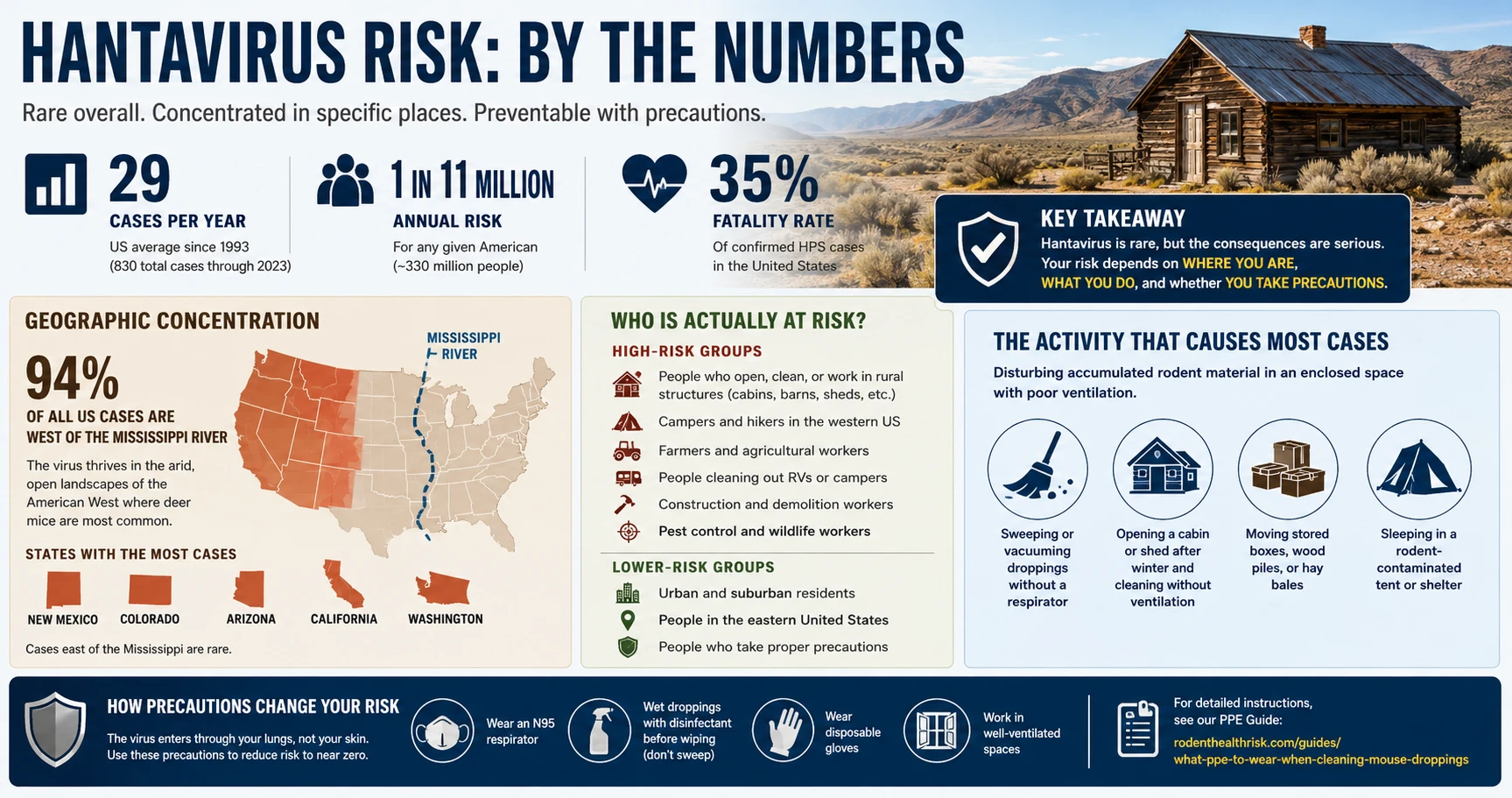
Hantavirus is rare. The US Centers for Disease Control and Prevention has recorded an average of 29 cases per year since national surveillance began in 1993. By the end of 2023, 830 total cases had been reported across more than three decades.
To put that in perspective: in a country of 330 million people, fewer than 30 develop hantavirus pulmonary syndrome in a typical year. By raw probability, the annual risk for any given American is roughly 1 in 11 million.
But that average obscures enormous variation. Hantavirus risk is not evenly distributed across the population. It clusters tightly around specific geographies, activities, and environments. Understanding where the risk actually lives — and whether your situation falls inside or outside those clusters — gives a much more accurate picture than the national average alone.
Geographic Concentration
94% of all US hantavirus cases are west of the Mississippi River.
The virus thrives in the arid, open landscapes of the American West, where deer mice — the primary carrier — are most densely distributed. States with the highest case counts include New Mexico, Colorado, Arizona, California, and Washington.
East of the Mississippi, hantavirus cases exist but are uncommon. Different rodent species carry different hantavirus strains in the eastern US, and while those strains can cause illness, the disease pattern is less severe.
For a full breakdown of cases by state, see hantavirus cases by state.
If you live in an eastern US city and have no exposure to rural western environments, your personal risk is near zero.
Who Is Actually at Risk
The CDC data shows that cases are not randomly distributed across the population. They cluster around specific exposure scenarios:
High-risk groups:
- People who open, clean, or work in rural structures that have been unused — cabins, barns, sheds, crawlspaces, attics — especially after winter
- Campers and hikers in the western US who sleep in enclosed shelters or disturb ground debris in rodent habitat
- Farmers and agricultural workers who handle grain, hay, or stored materials in rodent-accessible areas
- People cleaning out RVs or campers that have been in storage
- Construction and demolition workers in rural western areas
- Pest control and wildlife workers with regular contact with rodent-infested structures
Lower-risk groups:
- Urban and suburban residents with standard mouse problems (house mice are a different species from deer mice and carry different viruses — see deer mouse vs. house mouse)
- People in the eastern United States
- People who take proper precautions (N95 respirator, wet-wipe method, gloves) when dealing with rodent evidence
The Activity That Causes Most Cases
The most common exposure scenario in documented HPS cases is disturbing accumulated rodent material in an enclosed space with poor ventilation — particularly after a period when the space sat unused. This creates conditions where dried droppings and urine are stirred into the air and inhaled.
Specific activities linked to cases:
- Sweeping or vacuuming rodent droppings without a respirator
- Opening a cabin or shed after winter and cleaning without ventilation
- Moving stored boxes, wood piles, or hay bales in infested areas
- Sleeping in a rodent-contaminated tent or shelter
The common thread is inhalation of aerosolized particles from dried rodent waste in an enclosed space. This is also why vacuuming mouse droppings without proper filtration is dangerous — standard vacuums can aerosolize particles rather than capture them.
The Fatality Rate: High, but Context-Dependent
The 35% case fatality rate for HPS is significantly higher than most common infectious diseases. It reflects the nature of the illness — rapid respiratory deterioration that requires intensive hospital care — and the historical reality that many patients arrived at hospitals late, after the disease had already reached a critical stage.
Factors that affect survival:
- Time to hospitalization — the most important factor; patients hospitalized before respiratory symptoms begin have substantially better outcomes
- Access to ICU-level care — survival in severe cases depends on availability of ventilators and ECMO
- Age and baseline health — though HPS can affect any age group, younger patients generally fare better
The fatality rate has improved modestly over the decades as awareness has increased and medical teams have become more experienced with the disease.
How Precautions Change Your Risk
The single most effective risk-reduction measure is respiratory protection during potential exposure. The virus is not transmitted through skin contact — it enters the body through the respiratory tract when contaminated particles are inhaled.
An N95 respirator, properly fitted, blocks the aerosol particles that carry the virus. Combined with:
- Wetting droppings with disinfectant before wiping (not sweeping)
- Wearing disposable gloves
- Working in ventilated spaces
...the risk of infection during routine cleanup of a rodent-contaminated space drops to near zero. See the full PPE guide for specific recommendations.
CDC Surveillance Data: What the Numbers Show
The CDC maintains active surveillance on HPS cases dating back to 1993. Key statistics from that data, compiled from CDC HPS surveillance reports:
| Metric | Figure |
|---|---|
| Total confirmed US HPS cases (1993–2023) | ~890 |
| Annual average | ~29 cases/year |
| Case fatality rate | ~35% |
| Cases west of the Mississippi River | 94% |
| States with highest cumulative case counts | New Mexico, Colorado, Arizona, California, Washington |
| Peak exposure season | April–June (cabin opening season) |
Why the number fluctuates year to year: HPS case counts are tied directly to deer mouse population cycles, which respond to precipitation and food availability. Wet years produce abundant plant seeds → deer mouse populations boom → more virus in the environment → more human cases the following year or two. Dry years suppress deer mouse populations and typically result in fewer cases. The 2012 peak (which included the Yosemite cluster) coincided with elevated deer mouse activity in the Sierra Nevada following favorable conditions.
East vs. West: The 94% western concentration is not arbitrary. Sin Nombre virus, carried by deer mice, is the dominant strain in the US. Deer mice are most abundant in the arid and semi-arid landscapes of the American West — shrub-steppe, rangeland, dryland farming areas. East of the Mississippi, white-footed mice carry New York virus and similar strains, which cause fewer documented cases but remain capable of causing HPS.
The exposure window: Documented cases cluster around April through June nationally — the cabin-opening season. A secondary cluster appears in fall, corresponding to hunting season in states like Michigan, Minnesota, and Colorado.
The 2026 Hondius Outbreak: A Different Risk Profile
The hantavirus outbreak aboard the MV Hondius cruise ship in 2026 involved the Andes strain — a South American variety that is the only hantavirus capable of person-to-person transmission. This is fundamentally different from the North American risk picture.
For US residents with no connection to the ship, the Hondius outbreak did not change their personal hantavirus risk. The virus responsible for North American HPS (primarily Sin Nombre virus) has no documented human-to-human transmission. The precautions for North American hantavirus — avoiding rodent exposure, using PPE during cleanup — remain unchanged.
Practical Risk Assessment
Ask yourself three questions:
- Am I in the western US, or do I visit rural western environments?
- Do I spend time in enclosed spaces — cabins, sheds, barns, campers — that may have rodent activity?
- When I'm in those spaces, do I take precautions (respirator, wet-wipe method)?
If your answers are No / No / N/A — your hantavirus risk is genuinely very low.
If your answers are Yes / Yes / No — you are in the population where cases actually occur. The absolute risk is still low, but it is real, and precautions are worth taking.
Official Sources
- CDC Hantavirus Case Data — surveillance statistics and case counts by state
- WHO Hantavirus Fact Sheet — global epidemiology
Sources & References
- CDC — Centers for Disease Control and Prevention
Hantavirus: Prevention, Symptoms & Control
- cdc.gov — Index
https://www.cdc.gov/hantavirus/php/surveillance/index.html
- WHO — World Health Organization
Hantavirus Disease: Fact Sheet
All health claims on this page are verified against the primary sources listed above. View our Editorial Policy
Frequently Asked Questions
Medical Disclaimer
The information on this page is for educational purposes only and is not medical advice. If you believe you may have been exposed to hantavirus or are experiencing symptoms, contact a qualified healthcare professional or local health authority immediately.