How Do Mice Get Hantavirus? Transmission Between Rodents Explained
The Short Answer
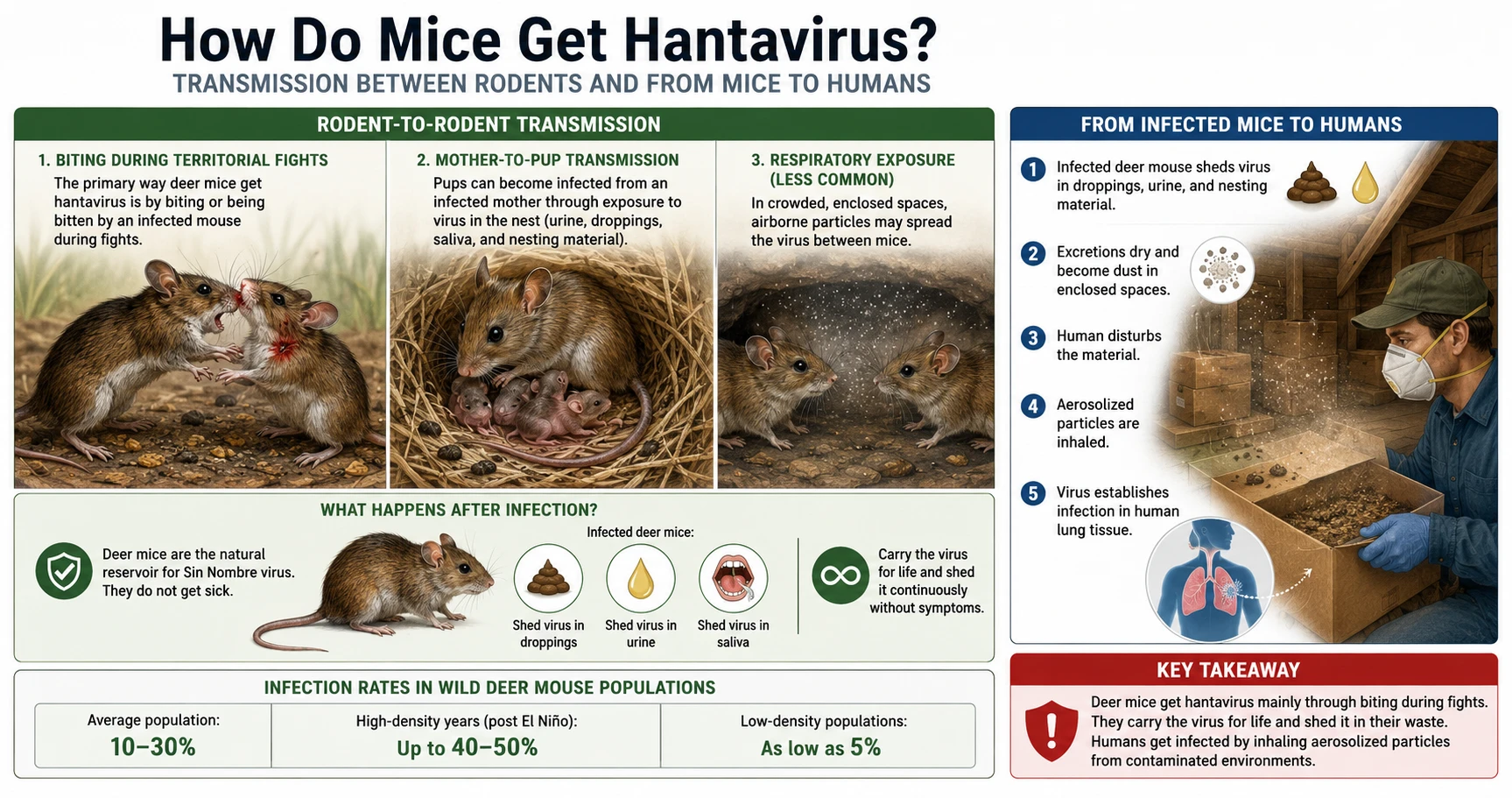
Mice — specifically deer mice — get hantavirus primarily by biting or being bitten by another infected deer mouse. Territorial fights, which are common in the species, are the main transmission route. Once a deer mouse is infected, it carries the virus for the rest of its life, shedding it continuously in droppings, urine, and saliva — without ever becoming visibly ill.
This persistent infection in deer mouse populations is the reason hantavirus exists as a human health risk at all. The mouse is not harmed by the virus. But everything it leaves behind — every dropping, every puddle of urine — can carry live virus that remains dangerous to humans long after the mouse has moved on.
How Mice Become Infected
Biting During Territorial Fights
The primary route of hantavirus transmission between rodents is direct contact through biting. Deer mice are territorial and fight frequently, especially over food, mates, and nesting sites. When an infected mouse bites another mouse — or is bitten — the virus passes through saliva.
This mode of transmission has been confirmed in multiple field studies. Researchers tracking hantavirus infection in wild deer mouse populations found that:
- Adult male deer mice have significantly higher infection rates than juveniles or females — consistent with the higher rate of wounding from fights in adult males
- Prevalence increases with population density — when deer mice are crowded into shared habitat, fighting frequency rises, and infection spreads faster
- Seasonal spikes in infection correlate with mating season, when territorial competition peaks
Mother-to-Pup Transmission
Infected female deer mice can transmit hantavirus to their pups, though this route is less well characterized than bite transmission. Newborn mice sharing a nest with an infected mother are exposed to viral particles in the nest material — urine and droppings accumulate where pups spend their first weeks of life.
Whether this represents direct infection in the womb, transmission through nursing, or environmental exposure in the nest is still studied. What is clear is that juvenile deer mice in some populations test positive for infection before they could have received bite wounds.
Respiratory Exposure (Rare in Rodents)
In high-density conditions, researchers have documented apparent airborne transmission between rodents in enclosed spaces — mirroring the human exposure route. This route is considered less significant than biting in wild populations but may contribute to infection spread in den sites and burrows where multiple mice live in close quarters.
What Happens After a Mouse Is Infected
Unlike humans, deer mice do not get sick from hantavirus. The infection is persistent, asymptomatic, and lifelong. The immune response in deer mice does not clear the virus — it tolerates it.
An infected deer mouse:
- Sheds virus in all excretions — urine, droppings, and saliva all contain live virus throughout the animal's life
- Remains fully functional — no weight loss, behavioral changes, or reduced survival compared to uninfected mice
- Does not become immune to reinfection in the sense that matters for humans — the virus is simply maintained at a stable, ongoing level
The term for this relationship is reservoir host — the deer mouse is the permanent natural home for Sin Nombre virus, the hantavirus strain responsible for most US cases of Hantavirus Pulmonary Syndrome (HPS).
Infection Rates in Wild Deer Mouse Populations
Not all deer mice carry hantavirus. Infection rates in wild populations vary considerably:
| Condition | Typical infection rate |
|---|---|
| Average deer mouse population | 10–30% |
| High-density population year (post El Niño) | Up to 40–50% in some studies |
| Isolated rural populations with low density | As low as 5% |
The variation matters because it affects actual human exposure risk. In years following heavy rainfall — particularly El Niño events in the western US — plant seed production surges, deer mouse populations boom, density increases, fighting increases, and hantavirus infection rates climb. These "rodent boom years" are associated with elevated HPS case counts in humans.
The 1993 Four Corners outbreak, which led to the discovery of hantavirus as a US disease, occurred during exactly this kind of environmental spike.
Why Only Specific Mouse Species
Hantaviruses are highly species-specific. Each hantavirus strain evolved alongside a particular rodent host over thousands to millions of years. Sin Nombre virus is adapted to the deer mouse. New York virus is adapted to the white-footed mouse. Bayou virus to the rice rat.
This means:
- House mice (Mus musculus) — the common mouse found in homes and cities — are not natural hosts for Sin Nombre virus or any HPS-causing strain. Lab experiments have shown house mice can be infected under artificial conditions, but they do not sustain infection in the wild and no confirmed US HPS case has been traced to a house mouse. See Can House Mice Carry Hantavirus?
- Norway rats and roof rats do not carry Sin Nombre virus. They are the reservoir for Seoul hantavirus, a distinct strain that causes a milder form of illness.
- Squirrels, chipmunks, and rabbits are not hantavirus reservoir hosts. See the full breakdown at Which Animals Carry Hantavirus?
The practical implication: a mouse infestation in a rural or semi-rural western US structure is a different risk profile from a mouse infestation in a city apartment. Identifying the species matters.
The Link From Infected Mouse to Human
Mice do not transmit hantavirus directly to humans through bites (though this is theoretically possible, it is not the documented exposure route). The pathway is indirect:
- Infected deer mouse sheds virus in droppings, urine, and nesting material
- Excretions dry and become dust in enclosed spaces — cabins, sheds, attics, crawlspaces
- Human disturbs the material — sweeping, moving boxes, opening a space after winter
- Aerosolized particles are inhaled
- Virus establishes infection in human lung tissue
This is why how long hantavirus survives outside a host matters: the virus remains viable in dried material for hours to days in indoor conditions. A mouse that contaminated a shed last month and then left may have created a hazard that persists.
What This Means for Risk Reduction
Understanding that deer mice are the source — not house mice, not rats, not squirrels — allows for more accurate risk assessment:
- If you're in the western US and have evidence of small, large-eared mice with bi-colored tails (deer mice) in an enclosed structure, treat as a real hantavirus risk
- Before entering a space with rodent evidence, ventilate for 30 minutes, then wet droppings with disinfectant before wiping — never dry-sweep
- Wear an N95 respirator — the aerosol route is how humans get infected, and proper respiratory protection stops it
The mouse's persistent, asymptomatic infection is what makes it an effective reservoir. But understanding exactly how that works — biting transmission, lifelong shedding, population-density dynamics — gives a clearer picture of when and where human risk is elevated.
Official Sources
- CDC Hantavirus: Transmission — rodent reservoir hosts and human exposure pathways
- CDC Hantavirus: Rodents — recognized carrier species
- NIH: Hantavirus Ecology — rodent infection dynamics and population studies
Sources & References
- CDC — Centers for Disease Control and Prevention
Hantavirus: Prevention, Symptoms & Control
- WHO — World Health Organization
Hantavirus Disease: Fact Sheet
- NIH — National Institutes of Health
PubMed: Hantavirus Research
All health claims on this page are verified against the primary sources listed above. View our Editorial Policy
Frequently Asked Questions
Medical Disclaimer
The information on this page is for educational purposes only and is not medical advice. If you believe you may have been exposed to hantavirus or are experiencing symptoms, contact a qualified healthcare professional or local health authority immediately.