Is It Safe to Live in a Home With Mouse Droppings?
The Honest Answer
It depends on the situation — but "it depends" doesn't mean the risk is imaginary.
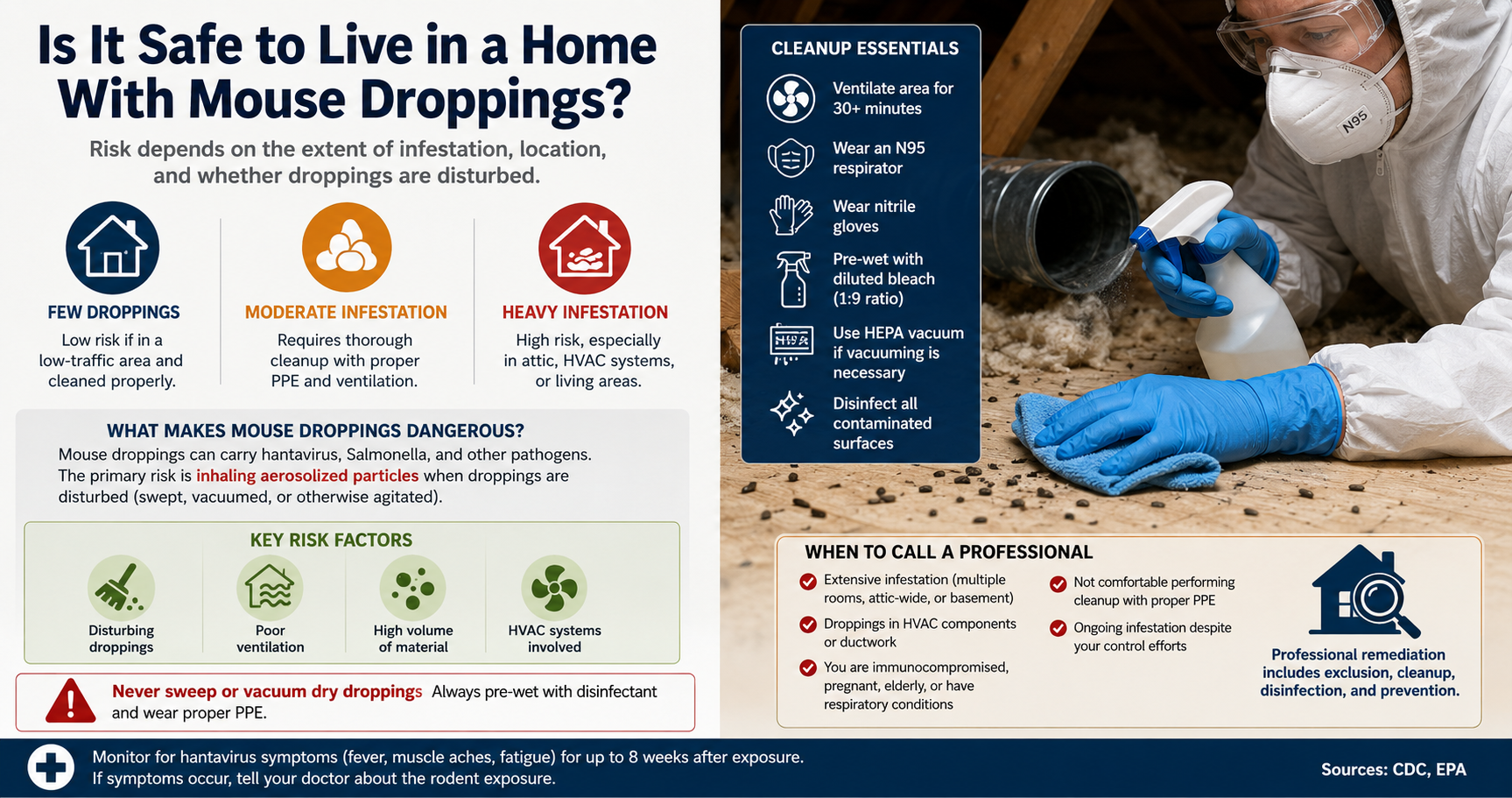
Mouse droppings can carry hantavirus, Salmonella, and other pathogens. Whether those droppings are actually dangerous to live around depends on three things: how much material is present, where it is, and what you do with it.
A couple of droppings found under a kitchen cabinet, cleaned properly, does not put you at serious risk. An attic carpeted with droppings and nesting material, with an active HVAC connection, is a different situation that warrants professional remediation.
Most people who find mouse evidence in their home are somewhere in between. Here's how to read your situation accurately.
What Makes Mouse Droppings Dangerous
The primary health mechanism is inhalation of aerosolized particles — tiny fragments of dried feces or urine that become airborne when disturbed. This is how hantavirus is transmitted in the vast majority of US cases.
Droppings sitting undisturbed on a surface in a ventilated room present relatively low immediate inhalation risk. The risk increases substantially when:
- Droppings are swept, vacuumed, or disturbed — dry material breaks into particles and enters the air
- An enclosed space has poor ventilation — particles accumulate rather than disperse
- Volume is high — more material means more particles per disturbance
- HVAC ducts or air handlers are involved — the system can distribute contaminated particles throughout the home
Skin contact with droppings is a secondary concern for bacterial pathogens (Salmonella can transfer to hands and then to food or mouth), but hantavirus specifically requires inhalation.
Assessing Your Risk Level
Work through these questions to gauge how serious your situation is:
How much material is present?
- A few isolated droppings: low volume, manageable with standard precautions
- Droppings along baseboards, in multiple drawers, concentrated in one room: moderate infestation, requires thorough cleanup with PPE
- Droppings throughout the attic, basement, or multiple rooms, visible nesting material: heavy infestation, professional remediation worth considering
Where are the droppings located?
- Kitchen counters, food storage areas, drawers: direct contamination risk for food and food-contact surfaces; priority cleanup
- Living areas, bedrooms: lower risk unless actively disturbed; normal ventilation helps
- Attic or crawlspace: higher risk during cleanup due to enclosed, poorly ventilated conditions; connected HVAC is a concern
- Inside HVAC ducts or near air handlers: professional assessment recommended — contaminated air can circulate through living areas
Is the infestation active or resolved?
Active infestations (fresh droppings appearing regularly, live mice seen or heard) present ongoing risk of new contamination, including food contamination. Resolved infestations (no new activity) still require cleanup but do not carry the same risk of ongoing accumulation.
Who lives in the home?
Immunocompromised individuals, pregnant women, young children, and elderly residents face higher consequences from infection. If any of these apply, a lower threshold for professional remediation is appropriate.
The HVAC Question
Droppings in an attic or basement become a more serious concern when the home's heating and cooling system draws air through or near infested spaces. If you have:
- Return air vents in an infested attic
- Ductwork running through an infested crawlspace
- Visible mouse activity near air handlers or duct openings
...particles from dried droppings can be picked up and distributed to every room in the house. This is the scenario where professional HVAC inspection and remediation is most clearly warranted — and where living with the infestation unaddressed poses the clearest ongoing risk.
What "Safe" Actually Requires
Living safely in a home with a history of mouse activity requires two things: stopping the infestation and cleaning up the evidence correctly.
Cleaning up correctly means:
- Establishing ventilation before entering infested areas (30+ minutes)
- Wearing an N95 respirator and nitrile gloves — not a dust mask
- Pre-wetting droppings with diluted bleach (1 part bleach to 9 parts water) before touching
- Never dry-sweeping or vacuuming without a true HEPA vacuum — standard vacuums can aerosolize particles rather than contain them
- Disinfecting all surfaces that may have been contaminated with droppings or urine
The full cleanup protocol covers each step in detail.
Stopping the infestation means:
Cleanup without exclusion just means the droppings will return. Seal entry points (steel wool, caulk, hardware cloth at openings larger than ¼ inch), eliminate food sources (sealed containers, no pet food left out), and address conditions that attract mice (clutter, warmth, accessible water).
When to Call a Professional
DIY cleanup with proper PPE is safe and effective for limited infestations. Call a licensed pest control or remediation professional when:
- The infestation is extensive (multiple rooms, attic-wide, or throughout the basement)
- You find evidence of droppings in HVAC components
- You are immunocompromised, pregnant, elderly, or have respiratory conditions
- You're not comfortable performing cleanup with proper protective equipment
- The infestation appears to be ongoing despite your own control efforts
Professional rodent remediation typically includes exclusion work (sealing entry points), cleanup with commercial disinfection, and disposal of heavily contaminated insulation or nesting material.
After Cleanup: Monitoring for Symptoms
If you have cleaned up a significant rodent infestation, monitor for hantavirus symptoms for up to 8 weeks after the last potential exposure. Early symptoms are non-specific — fever, severe muscle aches, fatigue — and easy to dismiss as flu.
If those symptoms appear within 8 weeks of rodent cleanup, tell your doctor about the exposure. Early hospitalization significantly improves outcomes if hantavirus pulmonary syndrome develops.
For more on when medical attention is warranted, see when to see a doctor after rodent exposure.
Official Sources
- CDC: Cleaning Up After Rodents — step-by-step guidance for safe cleanup
- CDC Hantavirus — transmission, risk, and prevention
- EPA: Integrated Pest Management — rodent control guidance
Sources & References
- CDC — Centers for Disease Control and Prevention
Hantavirus: Prevention, Symptoms & Control
- EPA — Environmental Protection Agency
Registered Disinfectants for Emerging Viral Pathogens
All health claims on this page are verified against the primary sources listed above. View our Editorial Policy
Frequently Asked Questions
Medical Disclaimer
The information on this page is for educational purposes only and is not medical advice. If you believe you may have been exposed to hantavirus or are experiencing symptoms, contact a qualified healthcare professional or local health authority immediately.