Can Pet Mice Give You Hantavirus?
The Direct Answer
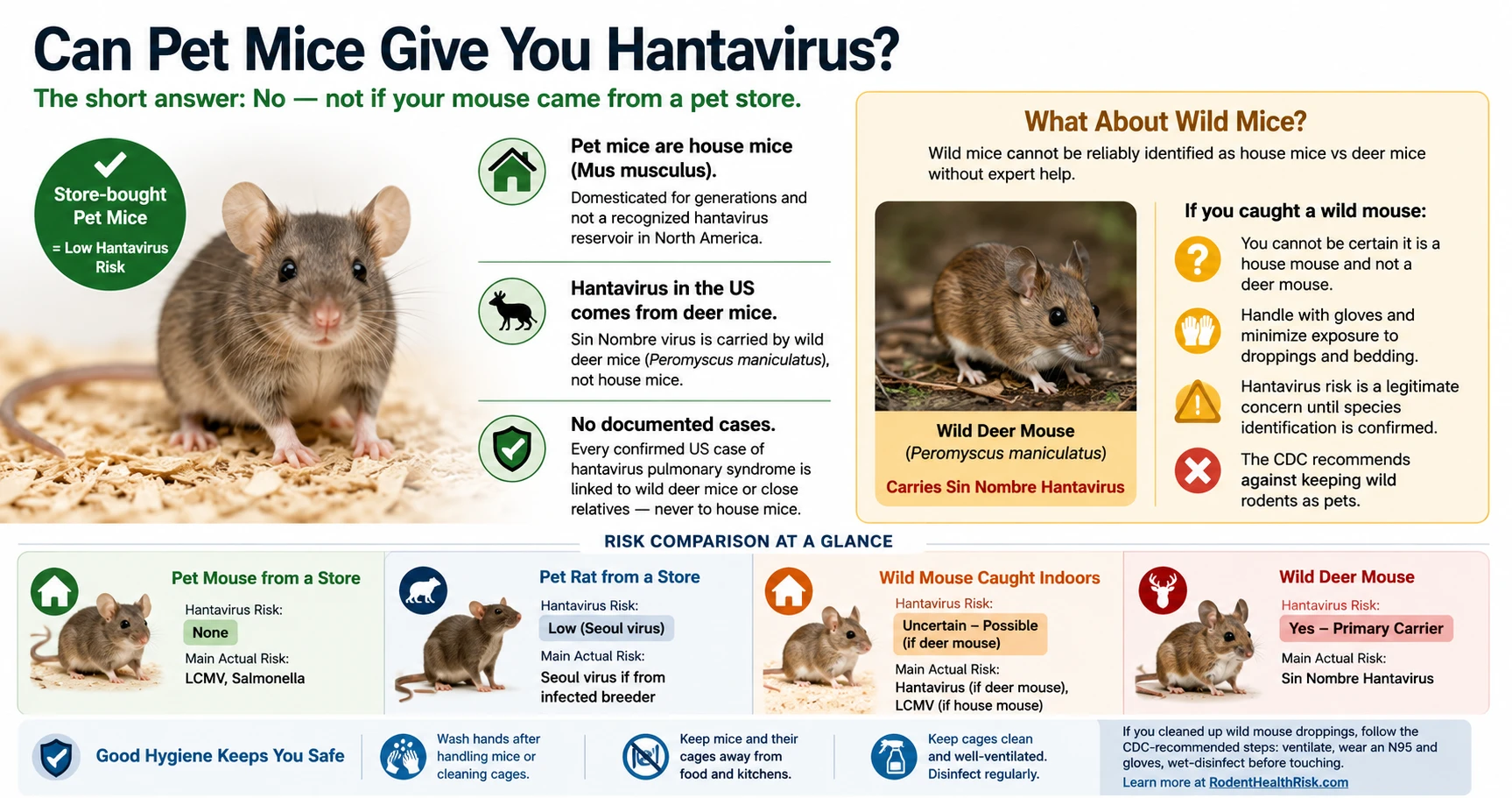
Pet mice from a pet store do not give you hantavirus.
The hantavirus strain responsible for most serious illness in the United States — Sin Nombre virus — is carried by wild deer mice (Peromyscus maniculatus). Pet mice sold in stores are domesticated house mice (Mus musculus), a completely different species with a very different disease profile. House mice are not a recognized hantavirus reservoir in North America. If you own a pet mouse and are worried about hantavirus after reading about the Hondius outbreak or another news event, you can stop worrying about that specific risk.
That said, pet mice are not risk-free. The virus actually associated with house mice is something else — and there is one important exception worth knowing about.
Why Pet Mice Don't Carry Hantavirus
Hantavirus transmission is not random across rodent species. Each hantavirus strain co-evolved with a specific rodent host over thousands of years. Sin Nombre virus — the strain responsible for Hantavirus Pulmonary Syndrome in the American West — evolved with deer mice specifically. Deer mice carry it permanently without getting sick, shedding the virus in urine, droppings, and saliva throughout their lives.
House mice (Mus musculus) have no established relationship with Sin Nombre virus. Laboratory studies have tested whether house mice can be infected under controlled conditions, but even in those studies, the virus doesn't replicate or shed in a meaningful way. In wild populations, there is no Sin Nombre transmission cycle involving house mice. Every confirmed US case of hantavirus pulmonary syndrome traces back to wild deer mice or a closely related species — never to house mice or their domesticated descendants.
Pet store mice are domesticated house mice that have been bred in captivity for generations. Their disease profile reflects that — they share risks with house mice generally, not with wild deer mice.
The Actual Virus Risk From Pet Mice: LCMV
The virus that public health agencies flag for pet mouse owners is lymphocytic choriomeningitis virus (LCMV), not hantavirus.
House mice are the natural reservoir for LCMV. The virus can be present in wild house mouse populations and has been detected in hamsters and other small rodents that share supply chains with pet mice. LCMV is transmitted through:
- Direct contact with mouse urine, droppings, or saliva
- Bites from infected mice
- Breathing in dust from dried droppings or bedding in poorly ventilated spaces (similar mechanism to hantavirus)
In healthy adults, LCMV typically causes a flu-like illness — fever, headache, muscle aches — that resolves on its own. In some cases it progresses to viral meningitis, which requires medical attention. The critical group is pregnant women: LCMV infection during pregnancy can cause severe fetal abnormalities including hydrocephalus, and miscarriage. The CDC specifically advises pregnant women to avoid handling pet rodents including mice.
LCMV is not hantavirus, and the overall risk to healthy non-pregnant adults is low. But it is a real consideration for pet mouse owners that hantavirus headlines tend to obscure.
Other Diseases Pet Mice Can Carry
Beyond LCMV, pet mice — like any animal — can carry:
- Salmonella: shed in droppings, can contaminate surfaces and cause gastroenteritis if transferred to food or mouth
- Rat-bite fever (Streptobacillus moniliformis): can occur from bites, though more commonly associated with pet rats than mice
- Ringworm (a fungal infection, not a worm): can transmit through direct contact with skin or fur of infected animals
None of these approach the severity of hantavirus pulmonary syndrome, but they are real reasons to practice basic hygiene when handling pet mice — wash hands after contact, don't let mice near food preparation areas, and keep cages clean.
The Exception: Wild-Caught Mice
This is where the reassuring answer changes.
Some people catch a wild mouse and attempt to keep it as a pet. This is a meaningfully different situation from owning a store-bought pet mouse. Wild rodents cannot be reliably identified as house mice vs deer mice by appearance alone without expert examination — the differences are subtle and require close inspection of belly color, tail banding, and ear size that most people are not equipped to assess confidently.
If you caught a wild mouse:
- You cannot be certain it is a house mouse and not a deer mouse
- You should not handle it without gloves and should minimize exposure to its droppings and bedding
- Hantavirus risk is a legitimate concern until species identification is confirmed
- The CDC recommends against keeping wild rodents as pets
If a wild mouse entered your home and you are concerned about exposure from its droppings before you removed it, follow the same cleanup protocol as any wild rodent situation: ventilate the space, wear an N95 and gloves, wet-disinfect before touching.
What About Pet Rats and Hantavirus?
Seoul virus — a hantavirus strain carried by roof rats (Rattus rattus) and Norway rats (Rattus norvegicus) — has caused documented outbreaks among pet rat breeders and owners. In 2017, a multi-state Seoul virus outbreak in the US was traced to infected rat breeding facilities. Seoul virus causes a milder illness than Sin Nombre, but it is a genuine hantavirus risk from rats that doesn't apply to mice.
This is sometimes the source of confusion: people see news about hantavirus in pet rodents and assume it applies to all small pets. Pet rats have a documented hantavirus risk through Seoul virus; pet mice do not have an established equivalent.
Practical Summary
| Scenario | Hantavirus Risk | Main Actual Risk |
|---|---|---|
| Pet mouse from a store | None | LCMV, Salmonella |
| Pet rat from a store | Low (Seoul virus) | Seoul virus if from infected breeder |
| Wild mouse caught indoors | Uncertain — possible if deer mouse | Hantavirus (if deer mouse), LCMV (if house mouse) |
| Wild deer mouse | Yes — primary carrier | Sin Nombre hantavirus |
If you own a pet mouse, practice normal hygiene and take the LCMV risk seriously if you are pregnant. If you are wondering about hantavirus specifically, you can direct that concern toward situations involving wild rodents in enclosed spaces — not your pet.
Official Sources
- CDC: Hantavirus Rodent Hosts — reservoir species and strain data
- CDC: Lymphocytic Choriomeningitis (LCMV) — pet mouse disease risk
- CDC: Seoul Virus — pet rat hantavirus risk
Sources & References
- CDC — Centers for Disease Control and Prevention
Hantavirus: Prevention, Symptoms & Control
- WHO — World Health Organization
Hantavirus Disease: Fact Sheet
All health claims on this page are verified against the primary sources listed above. View our Editorial Policy
Frequently Asked Questions
Medical Disclaimer
The information on this page is for educational purposes only and is not medical advice. If you believe you may have been exposed to hantavirus or are experiencing symptoms, contact a qualified healthcare professional or local health authority immediately.