How Long Do Rat and Mouse Droppings Remain Dangerous?
The Direct Answer
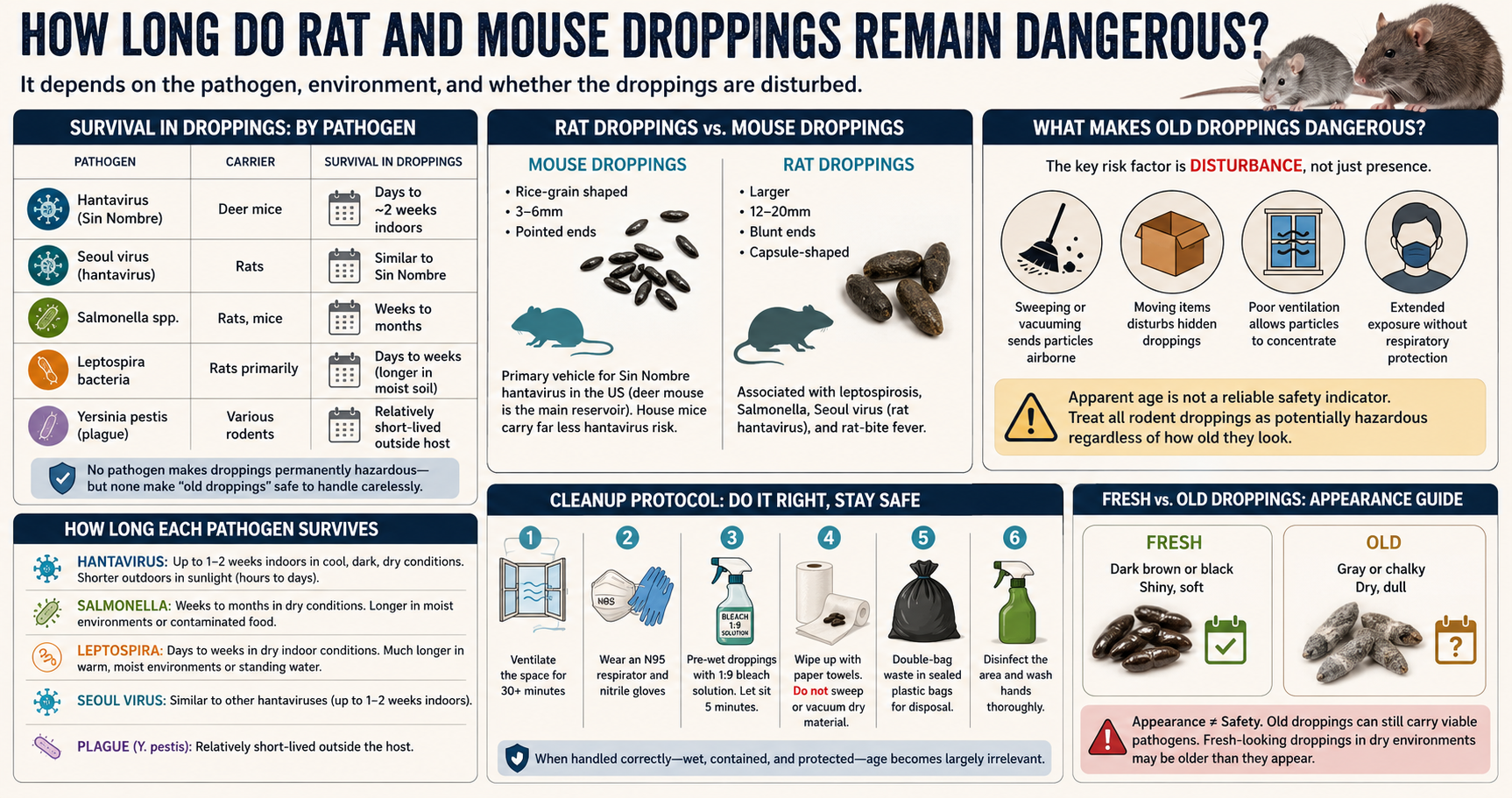
Rodent droppings don't have a clear expiration date. How long they remain dangerous depends on which pathogen is present, the environmental conditions, and critically, whether the droppings are disturbed.
The rough timelines by pathogen type:
| Pathogen | Carrier | Survival in Droppings |
|---|---|---|
| Hantavirus (Sin Nombre) | Deer mice | Days to ~2 weeks indoors |
| Seoul virus (hantavirus) | Rats | Similar to Sin Nombre |
| Salmonella spp. | Rats, mice | Weeks to months |
| Leptospira bacteria | Rats primarily | Days to weeks (longer in moist soil) |
| Yersinia pestis (plague) | Various rodents | Relatively short-lived outside host |
None of these pathogens make droppings permanently hazardous — but none of them make "old droppings" safe to handle carelessly.
Rat Droppings vs. Mouse Droppings: Different Risk Profiles
These two types of rodent waste carry overlapping but distinct risks. Knowing which type you're dealing with shapes how concerned to be about specific diseases.
Mouse droppings (rice-grain shaped, 3–6mm, pointed ends) are the primary vehicle for Sin Nombre hantavirus in the US — the strain responsible for most North American cases of hantavirus pulmonary syndrome. The deer mouse is the main reservoir; house mice carry far less hantavirus risk.
Rat droppings (larger, 12–20mm, blunt ends, capsule-shaped) are more associated with:
- Leptospirosis — a bacterial infection from rat urine and feces that can cause liver and kidney failure; transmitted through contact with contaminated water or wet surfaces
- Salmonellosis — from ingesting food or water contaminated by rat droppings
- Seoul virus — a hantavirus strain carried by roof rats and Norway rats worldwide; causes a milder illness than Sin Nombre but has produced outbreaks in rat breeders and pet owners
- Rat-bite fever — from Streptobacillus moniliformis, found in rat secretions including feces
The hantavirus most feared in the American West — the one associated with the 35% case fatality rate — is a mouse disease, not a rat disease. But this doesn't make rat droppings benign.
How Long Each Pathogen Survives
Hantavirus
Hantavirus has a lipid envelope that makes it vulnerable to UV radiation, heat, and disinfectants — but also protects it in cool, dark indoor conditions.
In enclosed spaces like attics, basements, storage sheds, and sealed vehicles, hantavirus in dried droppings can remain viable for up to 1–2 weeks under optimal conditions (cool, dark, dry). Outdoors in direct sunlight, survival is significantly shorter — hours to a few days.
Cold temperatures don't necessarily kill the virus. A cabin or shed left closed over winter can preserve viral viability in accumulated droppings until spring cleaning begins.
Salmonella
Salmonella bacteria are hardier in the environment than hantavirus. In dry indoor conditions, Salmonella from rodent feces can persist for weeks to months. In moist environments or contaminated food, survival can extend further.
Infection typically comes from ingesting contaminated food or water, or touching contaminated surfaces and then touching the mouth — not inhalation.
Leptospira
Leptospira bacteria are shed primarily in rat urine but contaminate droppings as well. They survive best in warm, moist environments — wet soil, standing water, flooded areas. In dry indoor conditions, survival is shorter, measured in days to a couple of weeks. In outdoor environments with standing water, leptospirosis risk can persist much longer.
This is why flooding events, which spread rat urine through water, cause spikes in leptospirosis cases in affected areas.
Seoul Virus (Rat Hantavirus)
Seoul virus, carried by roof rats (Rattus rattus) and Norway rats (Rattus norvegicus), behaves similarly to other hantaviruses in the environment. It has caused outbreaks primarily among people who handle rats directly — pet rat owners and rat breeders — but can also spread through exposure to rat droppings and urine in infested buildings.
What Makes Old Droppings Dangerous
The key risk factor is disturbance, not just presence. Droppings sitting undisturbed on a floor or shelf have limited inhalation risk. The hazard escalates when:
- Droppings are swept, vacuumed, or knocked off surfaces — sending particles airborne
- Stored items are moved, disturbing accumulated droppings behind or beneath them
- Droppings are in a poorly ventilated space where particles concentrate
- Someone works in the space for extended periods without respiratory protection
This is why the protocol for cleaning mouse droppings safely specifically prohibits dry sweeping or vacuuming without a HEPA filter — both actions aerosolize particles that should stay wet and contained.
The Practical Safe Threshold
There is no validated "safe after X days" figure that applies across all conditions. The CDC's position is to treat all rodent droppings as potentially hazardous regardless of apparent age, and this is the operationally correct approach because:
- Environmental conditions during the droppings' time in place are usually unknown
- Multiple pathogens with different survival curves may be present simultaneously
- The cost of precautions (N95, gloves, bleach solution) is trivial compared to the cost of infection
When droppings are handled correctly — pre-wet with disinfectant, picked up with gloves, ventilation established — age becomes largely irrelevant. The protocol is the same for fresh and old droppings alike.
Cleanup Protocol
Regardless of whether you're dealing with rat or mouse droppings:
- Ventilate the space for 30+ minutes before entering (open windows and doors, use a fan if available)
- Wear an N95 respirator and nitrile gloves — see full PPE guidance
- Pre-wet droppings with a 1:9 bleach-to-water solution or EPA-registered disinfectant; let sit 5 minutes
- Wipe up with paper towels — do not sweep or vacuum dry material
- Double-bag waste in sealed plastic bags for disposal
- Disinfect the surrounding area and wash hands thoroughly
For large accumulations, professional pest control remediation may be appropriate. See our full guide on how to clean mouse droppings safely.
Official Sources
- CDC Hantavirus Transmission — rodent reservoir and survival data
- CDC Leptospirosis — environmental survival of Leptospira
- CDC Salmonella — environmental persistence
Sources & References
- CDC — Centers for Disease Control and Prevention
Hantavirus: Prevention, Symptoms & Control
- WHO — World Health Organization
Hantavirus Disease: Fact Sheet
All health claims on this page are verified against the primary sources listed above. View our Editorial Policy
Frequently Asked Questions
Medical Disclaimer
The information on this page is for educational purposes only and is not medical advice. If you believe you may have been exposed to hantavirus or are experiencing symptoms, contact a qualified healthcare professional or local health authority immediately.