Mouse Poop vs Rat Poop: How to Tell the Difference
Why Correct Identification Matters
Most people searching this found something in a kitchen cabinet, garage, or storage area and aren't sure if they're looking at a mouse problem or something bigger. The distinction matters more than it seems. Mice and rats behave differently, enter through different gaps, and require different trapping and exclusion approaches. And from a disease standpoint, it's worth knowing that the primary hantavirus carrier in North America is the deer mouse — not rats — which changes the risk picture significantly depending on where you are.
Size Comparison at a Glance
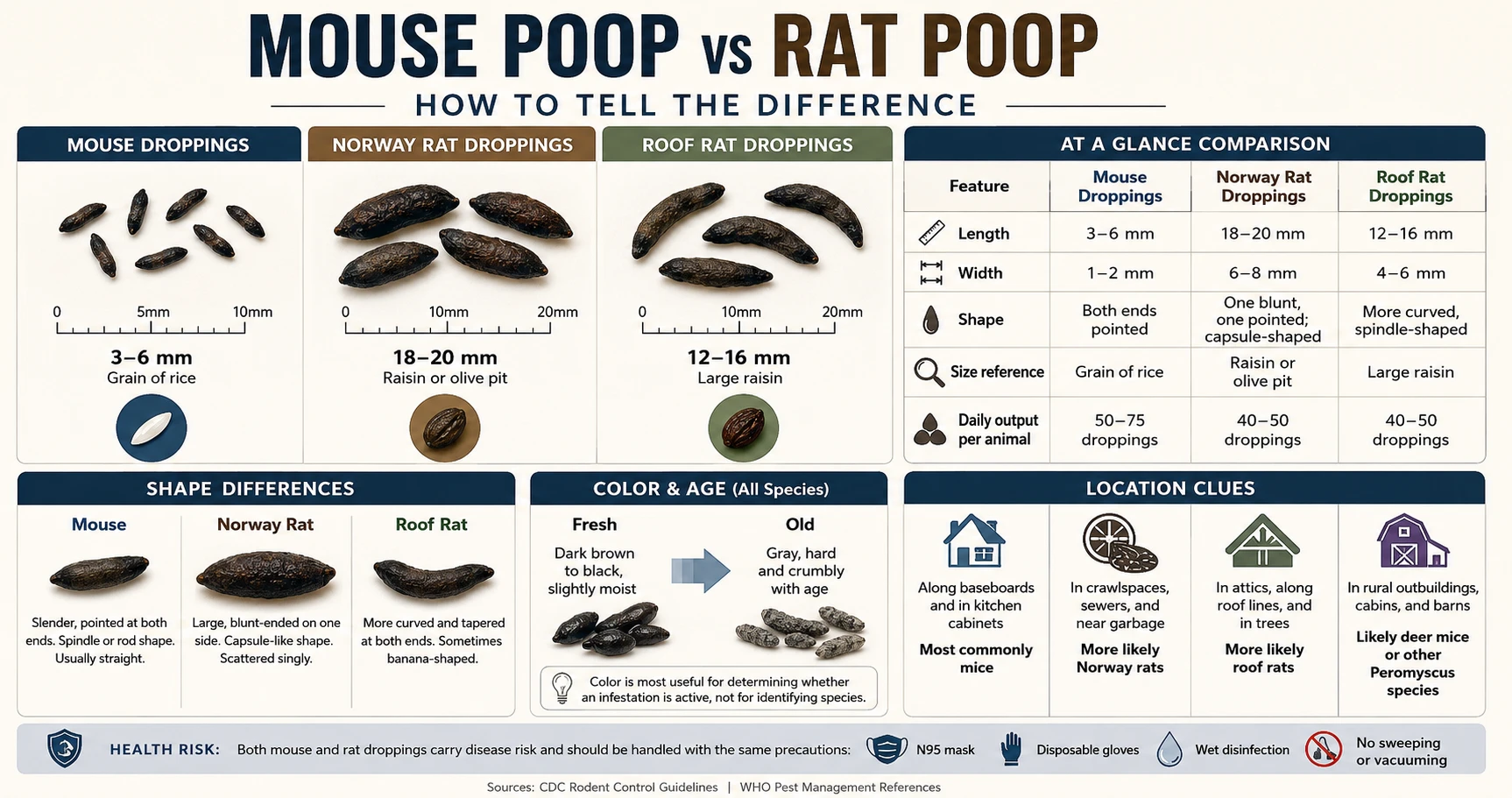
| Feature | Mouse Droppings | Norway Rat Droppings | Roof Rat Droppings |
|---|---|---|---|
| Length | 3–6 mm | 18–20 mm | 12–16 mm |
| Width | 1–2 mm | 6–8 mm | 4–6 mm |
| Shape | Both ends pointed | One blunt, one pointed; capsule-shaped | More curved, spindle-shaped |
| Size reference | Grain of rice | Raisin or olive pit | Large raisin |
| Daily output per animal | 50–75 droppings | 40–50 droppings | 40–50 droppings |
Shape Differences
Mouse Droppings
Mouse droppings are slender and elongated with both ends coming to a point. This gives them a spindle or rod shape. They are typically straight or very slightly curved.
Norway Rat Droppings
Norway rat (Rattus norvegicus) droppings are the largest common rodent droppings you will encounter. They are blunt-ended on at least one side, often with a capsule-like silhouette. They are scattered singly rather than in clusters, because rats tend to defecate while moving rather than in one fixed latrine area.
Roof Rat Droppings
Roof rat (Rattus rattus) droppings are smaller than Norway rat droppings but still 2–3 times larger than mouse droppings. They are more curved and tapered at both ends, sometimes described as banana-shaped. Roof rats are more common in warm coastal regions and tend to nest in elevated locations (attics, trees, roof spaces).
Color and Age
Fresh droppings — mouse and rat alike — start dark, often shiny when the moisture hasn't dried yet. As they age they fade to gray and turn hard and crumbly. This aging pattern is similar regardless of species, so color tells you whether the infestation is current, not which animal you're dealing with. If they crumble when you nudge them with something (not your finger), they've been there a while.
Location Clues
Where you find droppings can help confirm species identification:
- Along baseboards and in kitchen cabinets: most commonly mice
- In crawlspaces, sewers, and near garbage: more likely Norway rats
- In attics, along roof lines, and in trees: more likely roof rats
- In rural outbuildings, cabins, and barns: likely deer mice or other Peromyscus species
People often misidentify roof rat droppings as oversized mouse droppings. If you're in a warm coastal area and droppings are appearing in the attic, near roof lines, or in upper cabinets — roof rats are the more likely culprit, not a large mouse.
Infestation Severity Implications
Mouse Infestation Indicators
A single mouse produces 50–75 droppings per day. Finding more than 100 fresh droppings in a concentrated area suggests multiple mice or a well-established nest site. Mice defecate frequently and somewhat randomly along travel paths, so droppings are typically scattered in thin trails along walls.
Rat Infestation Indicators
Rats produce fewer droppings per day (40–50) but the droppings are significantly larger and easier to spot. Finding rat droppings at multiple locations throughout a building suggests an established colony, as rats maintain home ranges. Fresh rat burrows (smooth-edged holes 5–8 cm diameter) near the droppings confirm active Norway rat presence.
Cleanup Protocol for Both Species
The same precautions apply regardless of species. Do not sweep or vacuum. Ventilate the space, wear an N95 respirator and disposable gloves, wet-disinfect all droppings with a bleach solution (1 part bleach to 9 parts water) or an EPA-registered disinfectant, wait 5 minutes, then pick up with paper towels and double-bag the waste.
For infestations spanning more than one room, or for any infestation in an enclosed space (attic, cabin, crawlspace) that has been shut for weeks or months, consider professional remediation.
Official Sources
- CDC Rodent Control — rodent identification and droppings guidance
- CDC Hantavirus: Rodents — disease risk by species
Sources & References
- CDC — Centers for Disease Control and Prevention
Hantavirus: Prevention, Symptoms & Control
- WHO — World Health Organization
Hantavirus Disease: Fact Sheet
All health claims on this page are verified against the primary sources listed above. View our Editorial Policy
Frequently Asked Questions
Medical Disclaimer
The information on this page is for educational purposes only and is not medical advice. If you believe you may have been exposed to hantavirus or are experiencing symptoms, contact a qualified healthcare professional or local health authority immediately.