What Do Mouse Droppings Look Like?
Why Correct Identification Matters
If you found tiny dark pellets under the sink, behind the stove, in a cabinet, or inside a storage area, you're probably dealing with mice. Most people spot droppings in one of those spots first — and the immediate questions are always the same: what exactly is this, and how bad is it?
Getting the identification right matters because mouse droppings carry disease risk including hantavirus, salmonella, and leptospirosis — and the cleanup approach depends on knowing what you're dealing with before you touch anything.
The Short Answer
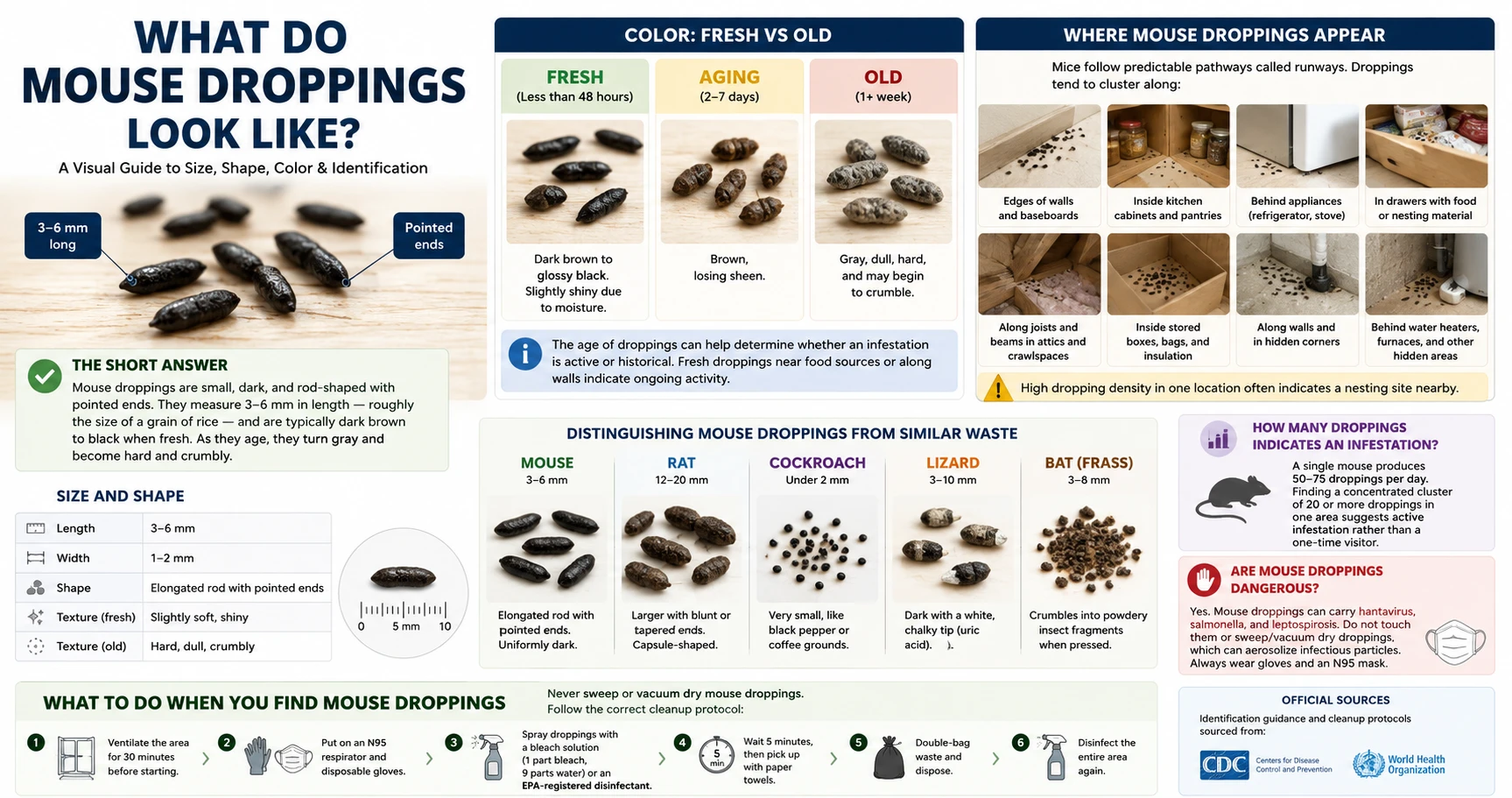
Mouse droppings are small, dark, and rod-shaped with pointed ends. They measure 3–6 mm in length — roughly the size of a grain of rice — and are typically dark brown to black when fresh. As they age, they turn gray and become hard and crumbly.
Size and Shape
| Characteristic | Mouse Droppings |
|---|---|
| Length | 3–6 mm |
| Width | 1–2 mm |
| Shape | Elongated rod with pointed ends |
| Texture (fresh) | Slightly soft, shiny |
| Texture (old) | Hard, dull, crumbly |
The pointed ends on both sides are one of the most reliable distinguishing features of mouse droppings. This differentiates them from cockroach droppings (which have ridges or blunt ends) and from rat droppings (which are larger and may have one blunt end).
Color: Fresh vs Old
- Fresh (less than 48 hours): Dark brown to glossy black. Slightly shiny due to moisture content.
- Aging (2–7 days): Brown, losing sheen.
- Old (1+ week): Gray, dull, hard, and may begin to crumble.
The age of droppings tells you whether you have an active problem or a historical one. Shiny and dark means recent activity. Gray and dull means the mice have been gone for a while — or the droppings are old accumulation. If they crumble when you nudge them with a pen or tool (not your finger), they're probably weeks or months old. Either way, the cleanup protocol is the same.
Where Mouse Droppings Appear
Mice tend to travel the same routes repeatedly, hugging walls and edges. This predictable movement is why droppings cluster in the same spots across different homes — and once you know where to look, you'll find them quickly:
- Edges of walls and baseboards
- Inside kitchen cabinets and pantries
- Behind appliances (refrigerator, stove)
- In drawers containing food or nesting material
- Along joists and beams in attics and crawlspaces
- Inside stored boxes, bags, and insulation
High dropping density in one location often indicates a nesting site nearby.
Distinguishing Mouse Droppings from Similar Waste
Mouse vs Rat Droppings
Rat droppings are 12–20 mm — two to three times the size of mouse droppings. Norway rat droppings have one blunt end and one tapered end, or may be capsule-shaped. Roof rat droppings are slightly smaller and more curved. See the dedicated comparison article for a full breakdown.
Mouse vs Cockroach Droppings
Cockroach droppings are similar in size but have a different texture and shape. German cockroach droppings look like black pepper grains or coffee grounds — they are very small (under 2 mm), uniform, and granular. Larger cockroach species leave droppings that have visible ridges running lengthwise, which mouse droppings do not have.
Mouse vs Lizard Droppings
Lizard droppings are easily confused with mouse droppings in warm climates and garages. The key difference: lizard droppings have a white, chalky tip (uric acid deposits) at one end. Mouse droppings are uniformly dark with no white portion.
Mouse vs Bat Droppings (Frass)
Bat droppings (guano) are similar in size to mouse droppings but crumble into powdery insect fragments when pressed. Mouse droppings do not crumble in the same way. Bat guano is typically found directly below roosting sites in attics or rafters.
How Many Droppings Indicates an Infestation?
A single mouse produces 50–75 droppings per day. Finding a concentrated cluster of 20 or more droppings in one area suggests active infestation rather than a one-time visitor. Scattered droppings along multiple rooms indicate a larger or longer-term infestation.
What To Do When You Find Mouse Droppings
Never sweep or vacuum dry mouse droppings. This can send infectious particles into the air. The correct protocol:
- Ventilate the area for 30 minutes before starting.
- Put on an N95 respirator and disposable gloves.
- Spray droppings with a bleach solution (1 part bleach, 9 parts water) or an EPA-registered disinfectant.
- Wait 5 minutes, then pick up with paper towels.
- Double-bag waste and dispose.
- Disinfect the entire area again.
Official Sources
- CDC Rodent Control — rodent dropping identification guidance
- CDC: Cleaning Up After Rodents — safe handling and cleanup protocol
Sources & References
- CDC — Centers for Disease Control and Prevention
Hantavirus: Prevention, Symptoms & Control
- WHO — World Health Organization
Hantavirus Disease: Fact Sheet
All health claims on this page are verified against the primary sources listed above. View our Editorial Policy
Frequently Asked Questions
Medical Disclaimer
The information on this page is for educational purposes only and is not medical advice. If you believe you may have been exposed to hantavirus or are experiencing symptoms, contact a qualified healthcare professional or local health authority immediately.