WHO Convenes Global Experts on Hantavirus Clinical Management After Hondius Outbreak
Why the WHO Convened This Session
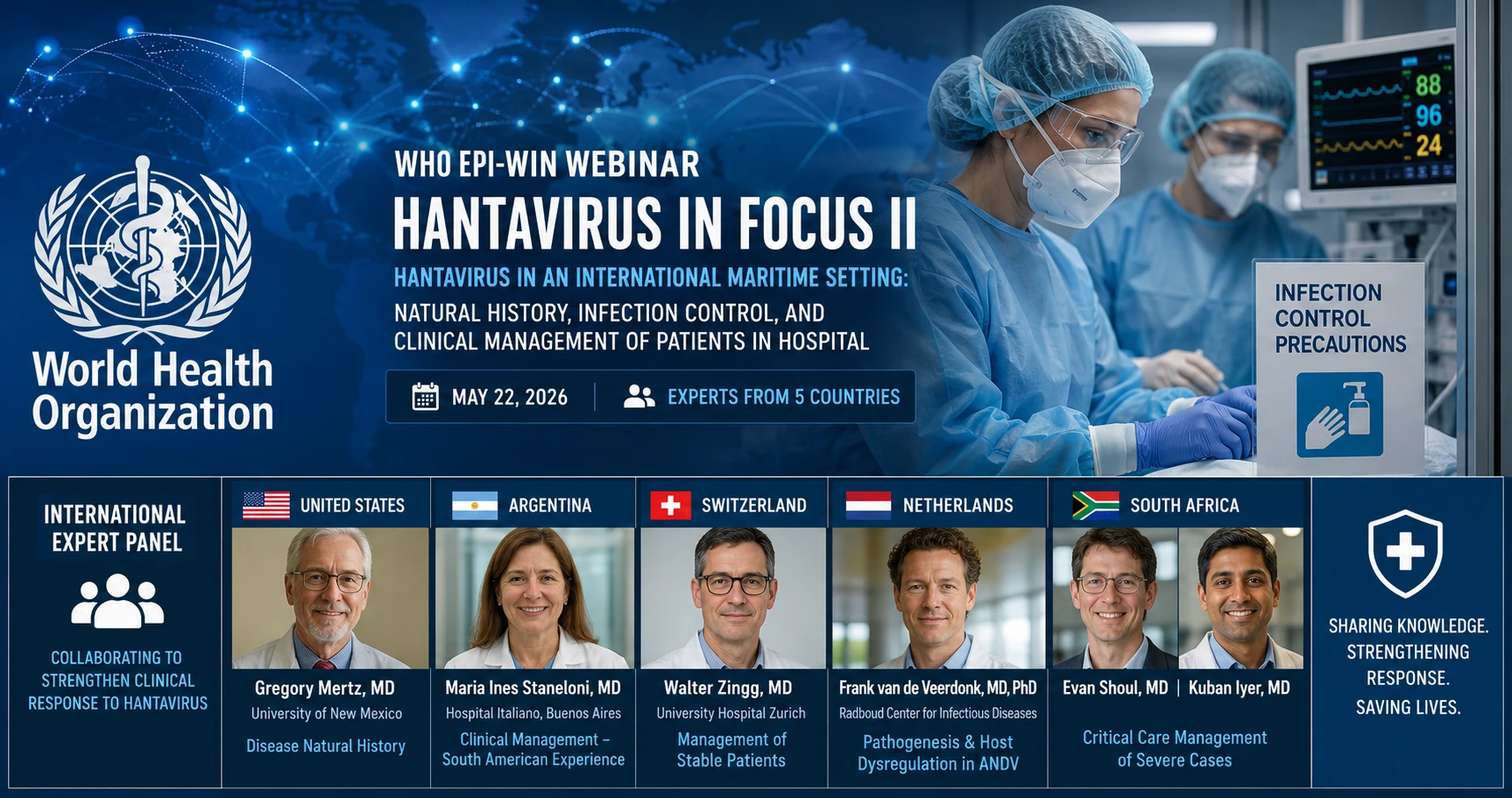
On May 22, 2026 — one month after the MV Hondius outbreak first drew global attention — the World Health Organization's EPI-WIN (Epidemic Intelligence for New Events) network convened an international expert panel specifically on hantavirus. It was the second in a series, titled "Hantavirus in Focus II," with an explicit focus on what the Hondius event exposed: the gaps in clinical knowledge, infection control protocols, and disease understanding that arise when a South American strain of hantavirus appears in an international, human-to-human transmission scenario.
The session brought together physicians and researchers from the United States, Argentina, Switzerland, the Netherlands, and South Africa — a range that reflects how widely the Hondius cases dispersed and how many hospital systems were suddenly confronted with a pathogen most had never treated.
What the Experts Addressed
The webinar organized its content around three areas where the Hondius outbreak surfaced practical questions.
Disease natural history — what the virus actually does in the body over time — was led by Gregory Mertz of the University of New Mexico. Mertz is among the most experienced North American clinicians on hantavirus pulmonary syndrome, having been involved in research since the Sin Nombre virus discovery in the 1990s. The focus was Andes virus specifically, which behaves somewhat differently from the Sin Nombre strain predominant in North American cases and remains less thoroughly characterized in clinical settings.
Clinical management — the part most hospital physicians treating Hondius patients needed most urgently — covered supportive care approaches and potential therapeutics. Maria Ines Staneloni from Hospital Italiano in Argentina contributed case experience with South American hantavirus that most European and North American hospitals simply don't have. Walter Zingg of University Hospital Zurich addressed management of stable patients, and Evan Shoul and Kuban Iyer from South Africa presented on critical care management of patients who deteriorated severely — the population where outcomes are worst and clinical decisions are most difficult.
Infection prevention and control — particularly how hospital staff should manage suspected and confirmed hantavirus patients — drew on WHO guidance that was updated in response to the Hondius outbreak. The Dutch healthcare worker quarantine at Radboudumc after a protocol deviation underscored that this wasn't a theoretical concern.
The Mechanism Behind Severe Cases
One of the more scientifically significant contributions in the session came from Frank van de Veerdonk of the Radboud Center in the Netherlands, who addressed what makes Andes hantavirus so dangerous at a biological level.
The focus was on "severe host dysregulation" — the process by which the virus triggers the patient's own immune and vascular systems to cause harm disproportionate to direct viral damage. Van de Veerdonk's work centers on how ANDV infection drives vascular dysfunction: the virus infects the endothelial cells lining blood vessels throughout the body, and the resulting inflammation and permeability changes explain the characteristic lung flooding, kidney failure, and cardiovascular collapse seen in severe hantavirus pulmonary syndrome cases.
This distinction matters clinically because it shifts the therapeutic goal. In many viral infections, antiviral medications targeting the virus directly are the primary intervention. In severe hantavirus disease, modulating the host's dysregulated response — the inflammation, the vascular permeability — is equally or more important. The research context explains why treatment has historically been supportive rather than specific: we are not just waiting for antiviral drugs, we are still characterizing which host pathways to target.
What This Means for the Hondius Response
The WHO session occurred while multiple countries were still managing Hondius-linked patients, and the US quarantine of exposed passengers at the University of Nebraska Medical Center was ongoing.
The gathering of expertise from five countries on one call represents something that was not available when the first US hantavirus cases were diagnosed in 1993: an internationally coordinated clinical knowledge-sharing mechanism that can operate in real time during an active event. The EPI-WIN format — a rapid-turnaround expert briefing series — was developed partly in response to the fragmented information environment during early COVID-19.
For physicians who found themselves treating hantavirus patients with no prior clinical experience, that matters. The Netherlands had a situation where hospital staff needed to know immediately how to handle the bodily fluids of a Hondius patient. Argentina had decades of Andes virus experience. The webinar was a mechanism for transferring that experience across systems that would otherwise have had no connection.
The Gap the Outbreak Exposed
The Hondius outbreak did not discover that hantavirus is dangerous. It surfaced a more specific problem: that the institutions most likely to receive severe hantavirus cases in Europe and North America — tertiary-care hospitals in major cities — had almost no clinical experience with Andes virus and limited infrastructure for managing it safely.
The UNMC in Nebraska is an exception precisely because it has a biocontainment unit built for exactly this kind of high-consequence pathogen. Most hospitals don't. When a Hondius passenger deteriorated in Paris and required ECMO support, the clinical team at Bichat Hospital was managing a disease that North American and European infectious disease training programs rarely cover in depth.
The WHO webinar is partly a response to that gap — accelerating the transfer of clinical knowledge before the next Hondius-type event creates another hospital system improvising with a pathogen they've never seen.
What Remains Uncertain
The session acknowledged areas where the science is still unsettled. The incubation period for Andes virus in human-to-human transmission is not as precisely characterized as it is for rodent-to-human transmission, which is why quarantine timelines for Hondius contacts were set conservatively at 42 days rather than the shorter windows used for Sin Nombre exposure.
The question of whether infected individuals are contagious before symptom onset — relevant to the protocols for home-quarantined contacts — remains one of the more contested points in Andes virus biology. The mask and distancing requirements even for asymptomatic contacts reflect the precautionary response to that uncertainty, not resolved evidence.
And the potential therapeutics discussed during the session are not yet approved treatments. Ribavirin, which has been studied for hantavirus, showed limited benefit in clinical trials. Newer candidates are at various stages of investigation. The honest clinical picture for severe ANDV disease remains: early aggressive supportive care is the primary intervention, and ECMO availability may determine survival in the most serious cases.
For People Following the US Situation
The Hondius outbreak and the WHO response it generated are specific to Andes hantavirus — a strain not established in North America. For people in the US whose hantavirus concern relates to rodent exposure at home, in garages, or in rural settings, the relevant strain remains Sin Nombre virus, which spreads through contact with infected rodent droppings, not between people.
The clinical complexity discussed in the WHO session — vascular dysregulation, potential pre-symptomatic transmission, ECMO management — does not apply to typical domestic hantavirus exposure in North America. Sin Nombre virus cases are also severe, with a case fatality rate around 35%, but they follow a different transmission route and a different clinical trajectory.
The WHO session matters for the global response to the Hondius event and for building institutional readiness for the next international outbreak. It does not change the risk calculus for someone cleaning out a rodent-contaminated shed in Arizona.
Sources & References
- WHO — World Health Organization
Hantavirus Disease: Fact Sheet
- who.int — Who Health Emergencies Epi Win Webinar Hantavirus In Focus Ii Hantavirus In An International Maritime Setting Natural History Infection Control And Clinical Management Of Patients In Hospital
https://www.who.int/news-room/events/detail/2026/05/22/default-calendar/who-health-emergencies-epi-win-webinar-hantavirus-in-focus-ii-hantavirus-in-an-international-maritime-setting-natural-history-infection-control-and-clinical-management-of-patients-in-hospital
All health claims on this page are verified against the primary sources listed above. View our Editorial Policy
Medical Disclaimer
The information on this page is for educational purposes only and is not medical advice. If you believe you may have been exposed to hantavirus or are experiencing symptoms, contact a qualified healthcare professional or local health authority immediately.