Genetic Sequencing of Hondius Hantavirus Confirms Andes Strain, No Evidence of New Mutations
What the Sequencing Found
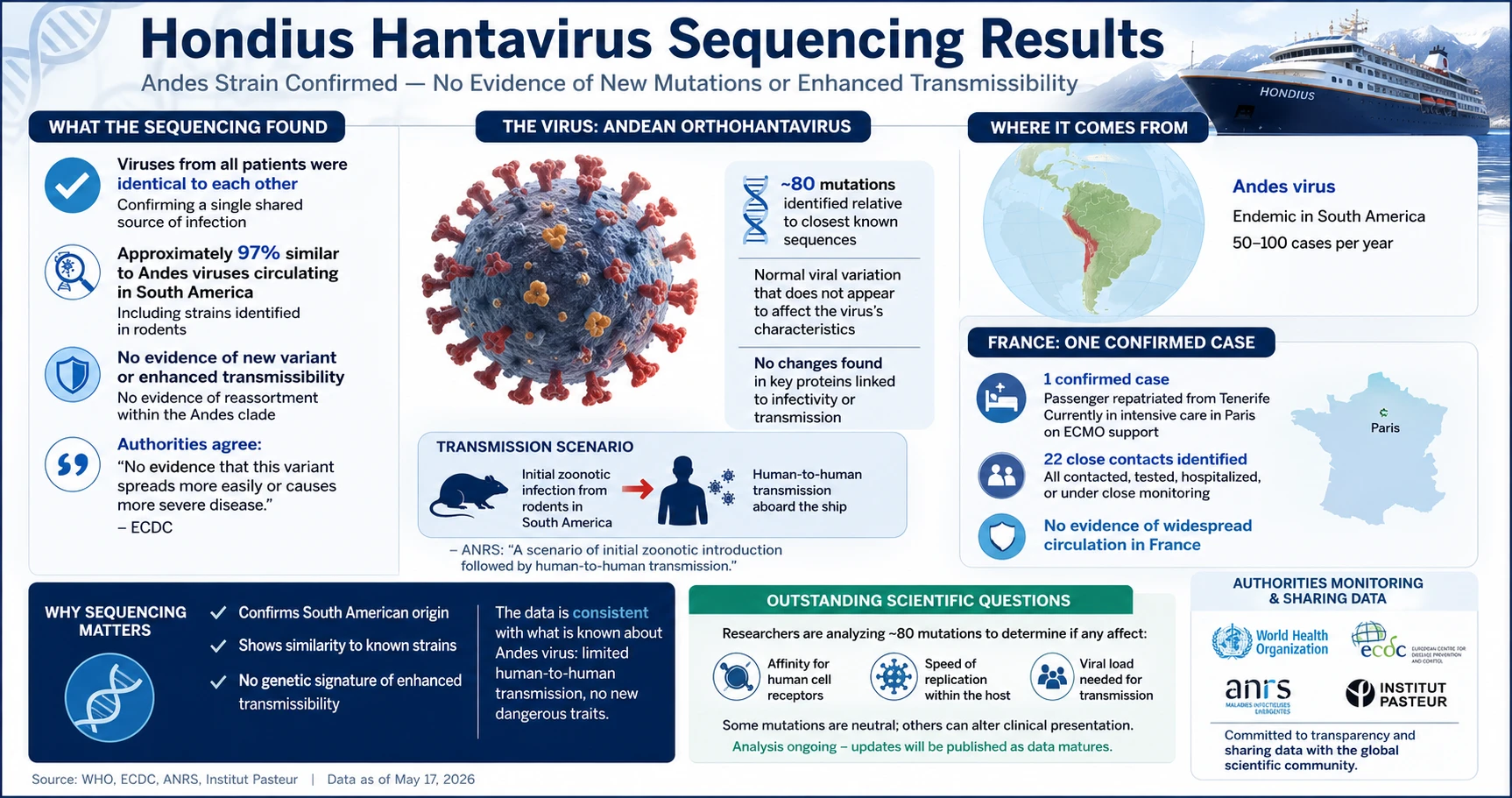
One of the most consequential questions raised by the MV Hondius outbreak has been whether the Andes hantavirus responsible for the cases had mutated in ways that might make it more transmissible or more lethal than previously known strains. France's Institut Pasteur, which conducted a full genomic analysis of the virus detected in the French passenger, provided the clearest answer yet on May 16.
Pasteur's analysis found that the viruses detected in patients from the ship were identical to each other — confirming a single shared source of infection — and approximately 97% similar to Andes viruses already circulating in South America, including strains identified in rodents. Jean-Claude Manuguerra, who heads Pasteur's Environment and Infectious Risk unit, said the remaining variation appeared to reflect normal viral variation and did not seem to affect the characteristics of the virus detected among travelers.
French Health Minister Stéphanie Rist announced the results on social media: "The analyzed virus corresponds to the viruses already known and monitored in South America. At this stage, no element suggests the emergence of a form of the virus that could be more transmissible or more dangerous."
An earlier genomic analysis published on May 8 by virologist Gustavo Palacios — drawing on sequencing work conducted across laboratories in South Africa, Switzerland, and the Netherlands — found the Hondius genomes approximately 99% similar to Andes virus strains detected in humans in Argentina in 1997 and 2018. (The difference between the two figures reflects different reference datasets: Pasteur compared against a broader set of South American strains including rodent samples, while the earlier analysis compared specifically to known human cases.) Both analyses point in the same direction: a familiar pathogen with no evidence of dangerous new traits.
The ECDC stated plainly: "Genomic information shows that the virus involved in the outbreak is similar to Andes viruses already known to circulate in South America, and is not a new variant. There is currently no evidence that this variant spreads more easily or causes more severe disease than other Andes viruses."
The sequencing also confirms the virus's classification within the Andes clade, with no evidence of reassortment — a process by which viruses can swap genetic segments to produce new combinations.
What "No Mutations" Does and Does Not Mean
The scientific picture is reassuring but not yet complete.
French researchers note approximately 80 mutations relative to the closest known sequences — a number that sounds large but is not unusual for a circulating virus. The critical scientific question is not whether mutations exist, but whether any of them alter the virus's behavior: its ability to infect cells, replicate, transmit between people, or cause severe disease.
Etienne Decroly, a virologist and CNRS research director at Aix-Marseille University, put it precisely: "The question is whether these small differences, these mutations, have a virological and epidemiological impact, and it is too early to know."
His assessment of what the data does support: "There is no obvious element allowing us to predict, on the basis of sequences, an increase in infectivity or a modification of the cells or tissues the virus can infect. But this will need to be examined carefully, and it will take as long as research requires."
Mircea Sofonea, an epidemiologist at the University of Montpellier, offered the reassuring summary: "We are not dealing with a mutant virus that has acquired favorable properties for human-to-human transmission. We are dealing with a virus that is endemic to this region, where there are 50 to 100 cases per year, and which encountered a tourist who unfortunately spread it."
The data also support a specific transmission scenario: initial infection of the first patient through contact with infected rodents in South America before boarding, followed by human-to-human transmission aboard the ship. The ANRS (France's National Agency for Research on AIDS and Emerging Infectious Diseases) characterized this as "a scenario of initial zoonotic introduction followed by human-to-human transmission."
France: One Confirmed Case, 22 Contacts Monitored
France confirmed one hantavirus case linked to the Hondius — a passenger who developed acute symptoms during the repatriation flight from Tenerife. She is being treated in intensive care at Bichat Hospital in Paris, connected to an ECMO device (an artificial lung that oxygenates blood externally) to relieve pressure on her heart and lungs. Dr. Xavier Lescure, the infectious disease specialist treating her, has described this as "the final stage of supportive care."
French Health Minister Stéphanie Rist confirmed that 22 close contacts had been identified within France. All had been contacted and either tested, hospitalized, or placed under close monitoring. "There is no evidence to suggest widespread circulation of the virus within the country," Rist said.
Rist's statement on Friday — following Pasteur's completed sequencing — was notably more definitive than her language earlier in the week. On May 12, before the full analysis was available, she had told the National Assembly: "There are things we do not know about this virus. We do not yet have the complete sequencing of the virus which allows us to say with certainty today — even if we are rather reassured to date — that this virus has not yet mutated." The Pasteur results have since provided that certainty: the virus matches known South American strains, and "this sequencing work allows us to better understand the virus and to ensure close health monitoring," Rist added. France has committed to sharing the sequencing data with the international scientific community.
Why Sequencing Matters for Risk Assessment
Virologists treat genomic sequencing as the equivalent of a genealogy for a pathogen. For the Hondius outbreak, it answers several key questions simultaneously: Where did this virus come from? Is it meaningfully different from known strains? And does the spread pattern on the ship suggest anything unusual about how this particular strain moves between people?
The answers emerging from the analysis are consistent with prior knowledge of the Andes virus: South American origin, prior history of limited human-to-human transmission, and no identifiable genetic signature of enhanced transmissibility. That last point matters most for assessing whether the outbreak on the Hondius represents something fundamentally new, or a known virus operating within its established parameters.
The ECDC's conclusion reflects this: "Recent genetic sequencing of the virus strongly suggests that the confirmed tested passenger samples are linked to the same original source of infection."
One critical distinction for anyone following this outbreak: the Andes virus involved in the Hondius cases is geographically and biologically distinct from the hantavirus strains endemic to North America. The Sin Nombre virus — responsible for the majority of US cases of hantavirus pulmonary syndrome — has no documented human-to-human transmission. It spreads through contact with infected deer mouse droppings, urine, and nesting material. The sequencing results from the Hondius outbreak do not change the risk picture for people in the United States who have no connection to the cruise ship or travel to South America.
Outstanding Scientific Questions
Functional analysis of the ~80 mutations identified in the Hondius strain is ongoing. Researchers are specifically examining whether any mutations affect:
- The virus's affinity for human cell receptors
- The speed of replication within the host
- The threshold of viral load required to transmit between individuals
As Decroly noted, some mutations are neutral; others can alter clinical presentation. Until those analyses are complete, the reassuring current assessment — a known virus, no new variant, consistent with prior South American strains — remains an interim finding rather than a final one. The WHO, ECDC, and national health authorities across affected countries have committed to publishing updates as sequencing data matures.
For a full picture of how the outbreak has developed, see the initial Hondius outbreak report and the latest WHO case update.
Sources & References
- WHO — World Health Organization
Hantavirus Disease: Fact Sheet
- ECDC
- ANRS
- Institut Pasteur
All health claims on this page are verified against the primary sources listed above. View our Editorial Policy
Medical Disclaimer
The information on this page is for educational purposes only and is not medical advice. If you believe you may have been exposed to hantavirus or are experiencing symptoms, contact a qualified healthcare professional or local health authority immediately.