Hantavirus Update 2026: What's Actually Happening
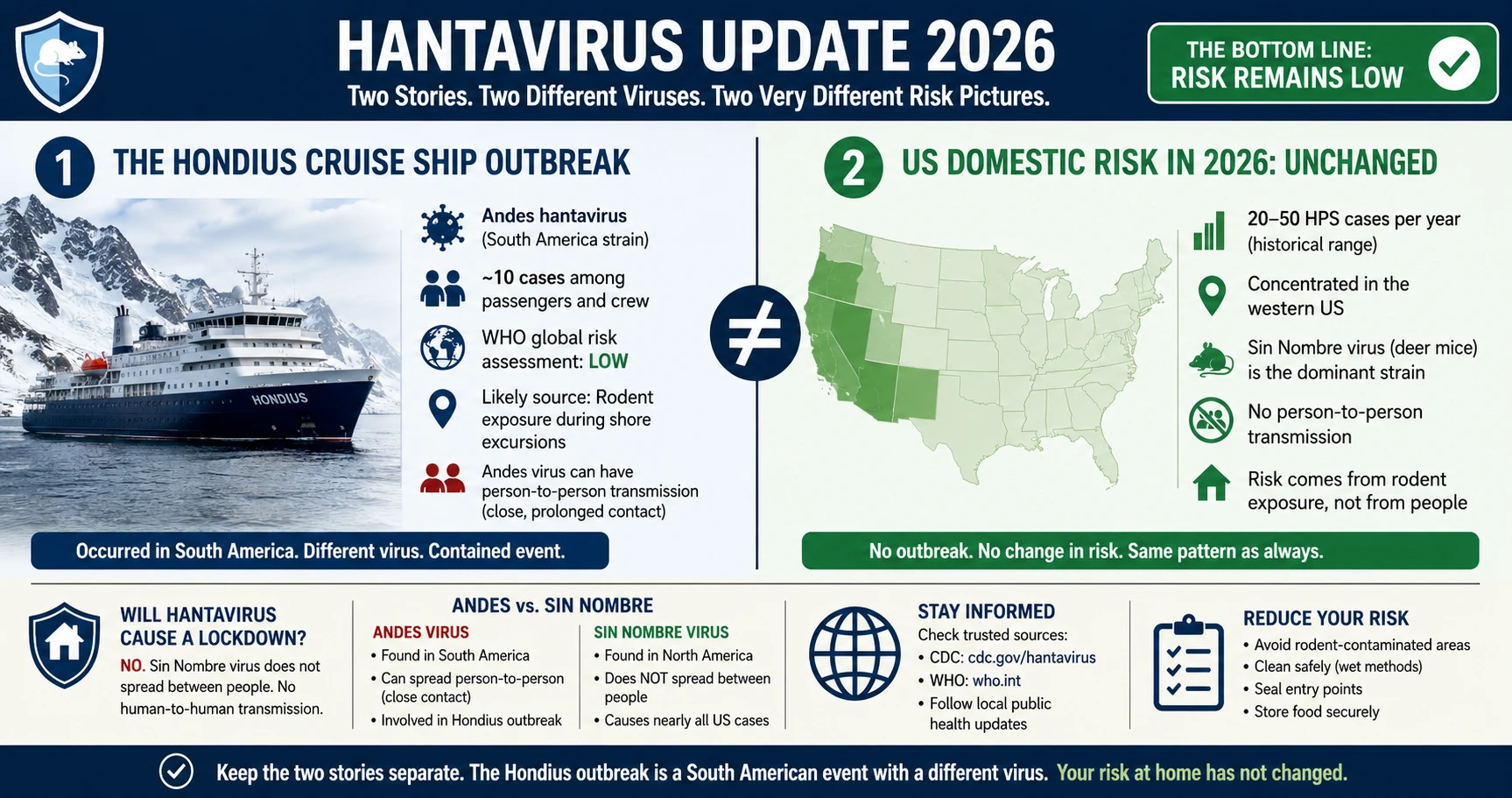
Two separate stories are driving hantavirus searches in 2026, and conflating them creates unnecessary fear. The first is the MV Hondius cruise ship outbreak — a real, contained event involving a South American hantavirus strain with unusual transmission properties. The second is the ongoing background of hantavirus in the United States, which has not changed. Here is what each story actually means.
Where the 2026 Hantavirus Coverage Started
Hantavirus did not emerge somewhere new in 2026. The disease has been present in North America since at least the 1993 Four Corners outbreak, and US case counts have remained in the range of 20–50 per year for decades.
What changed is the volume of public attention, and it came from two separate triggers:
February 2025: Betsy Arakawa, wife of actor Gene Hackman, died from hantavirus in New Mexico — a standard Sin Nombre exposure in rural western terrain. The case received extensive media coverage, kept alive by the celebrity connection and subsequent discovery of Gene Hackman's death from unrelated causes days earlier. That coverage created a baseline of public interest that carried into 2026.
Early 2026: The MV Hondius cruise ship reported a hantavirus cluster. Passengers from the US and Canada were aboard, and the Andes strain involved has unusual person-to-person transmission properties. That combination — international passengers, an unusual strain, WHO involvement — generated a second wave of media attention.
The result: large numbers of people searching "where did hantavirus start 2026" or "hantavirus outbreak 2026" who are essentially asking whether something new is happening. The answer is no — the stories driving 2026 search interest are a sustained media cycle around two events, not a new domestic outbreak.
The Hondius Cruise Ship Outbreak
The MV Hondius, a cruise ship operating in Antarctic and South American waters, reported a hantavirus outbreak in 2026. Approximately 10 passengers and crew were confirmed infected with the Andes hantavirus, a strain found in South America — not in North America.
The World Health Organization reviewed the event and classified the global risk as low. Passengers from multiple countries were aboard, including individuals from Canada and the United States, which is part of why the story generated international coverage.
The outbreak is significant for one reason that deserves close attention: the Andes strain is unusual. Unlike nearly every other hantavirus, Andes virus has documented capacity for person-to-person transmission. This is what set off alarm bells in public health circles. That said, transmission is not efficient or airborne in the way influenza is — close, prolonged contact with an infected person is the documented route, and the outbreak remained contained.
Health authorities investigating the Hondius outbreak identified rodent exposure during shore excursions in Ushuaia, Argentina as the likely index source, consistent with how Andes virus typically initiates a cluster.
That context matters. Argentina has recorded 101 hantavirus cases and 32 deaths since July 2025 — significantly higher than the 64 cases and 14 deaths in the prior year. Researchers link the surge to a climate-driven rodent population boom: a drought in 2023–2024 was followed by increased rainfall, producing more vegetation, more food for reservoir rodents, and higher rodent population densities. The Hondius passengers who went ashore in Patagonia encountered an environment where hantavirus-infected rodents were present at elevated levels.
What About US Domestic Hantavirus Risk in 2026?
There is no new hantavirus outbreak in the United States in 2026.
Annual cases of Hantavirus Pulmonary Syndrome (HPS) in the US have historically ranged from roughly 20 to 50 per year. That pattern has not changed. The geographic distribution remains the same: the western United States — particularly the Four Corners region, the Pacific Northwest, and parts of the Southwest — accounts for the large majority of cases.
The dominant strain in the US is Sin Nombre virus, carried primarily by deer mice. New York virus and Bayou virus are regional variants in the Northeast and Southeast respectively. None of these strains are associated with person-to-person transmission.
The February 2025 death of Betsy Arakawa, wife of actor Gene Hackman, from hantavirus in New Mexico generated sustained public attention. That case was a standard Sin Nombre exposure — tragic and serious, but not an outbreak signal. It reflects the baseline risk that has always existed in the rural western US.
Will Hantavirus Cause a Lockdown?
No. This question is circulating online and the answer is straightforward.
A lockdown or shelter-in-place order is a public health tool used when a pathogen is spreading person to person in communities. Sin Nombre virus — the strain responsible for virtually all US hantavirus cases — does not spread between people. You cannot catch it from another person. You can only contract it through direct exposure to infected rodent droppings, urine, or saliva, or through bites.
Without person-to-person transmission, there is no chain of community spread to interrupt. Lockdowns are not a relevant response to Sin Nombre, and no public health authority has suggested otherwise.
The Andes vs. Sin Nombre Difference
This distinction is the key to understanding why the Hondius outbreak, alarming as it sounds, does not change the risk picture for Americans at home.
Sin Nombre and the other North American hantaviruses are transmitted through a simple, well-understood route: disturb rodent-contaminated material, inhale the aerosolized particles. That is the beginning and end of the transmission chain. The virus does not pass between humans.
Andes virus is a different pathogen with a different, more troubling profile. Its capacity for person-to-person spread is documented but appears limited to close contact. It is geographically restricted to South America — primarily Argentina and Chile. It is not present in North American rodent populations.
The Hondius outbreak is an Andes story. If you live in the United States and are not traveling to South America, it does not alter your hantavirus risk.
Where to Find Current CDC Data
The CDC maintains up-to-date case data, maps, and prevention guidance at cdc.gov/hantavirus. That is the authoritative source for US case counts, geographic distribution, and current recommendations. CDC data is updated as new cases are reported and confirmed.
For the Hondius outbreak and global risk assessment, the WHO situation reports are the primary source.
The bottom line: hantavirus deserves respect and basic precautions, particularly if you live in or travel to the rural western US, clean out structures that may harbor rodents, or work in environments with rodent activity. But 2026 has not brought a new domestic threat. The Hondius story is a South American outbreak involving a different virus. Keep the two stories separate, and the actual risk picture becomes much clearer.
Sources & References
- CDC — Centers for Disease Control and Prevention
Hantavirus: Prevention, Symptoms & Control
- WHO — World Health Organization
Hantavirus Disease: Fact Sheet
All health claims on this page are verified against the primary sources listed above. View our Editorial Policy
Frequently Asked Questions
Medical Disclaimer
The information on this page is for educational purposes only and is not medical advice. If you believe you may have been exposed to hantavirus or are experiencing symptoms, contact a qualified healthcare professional or local health authority immediately.