Is Climate Change Making Hantavirus Worse? What the Science Shows
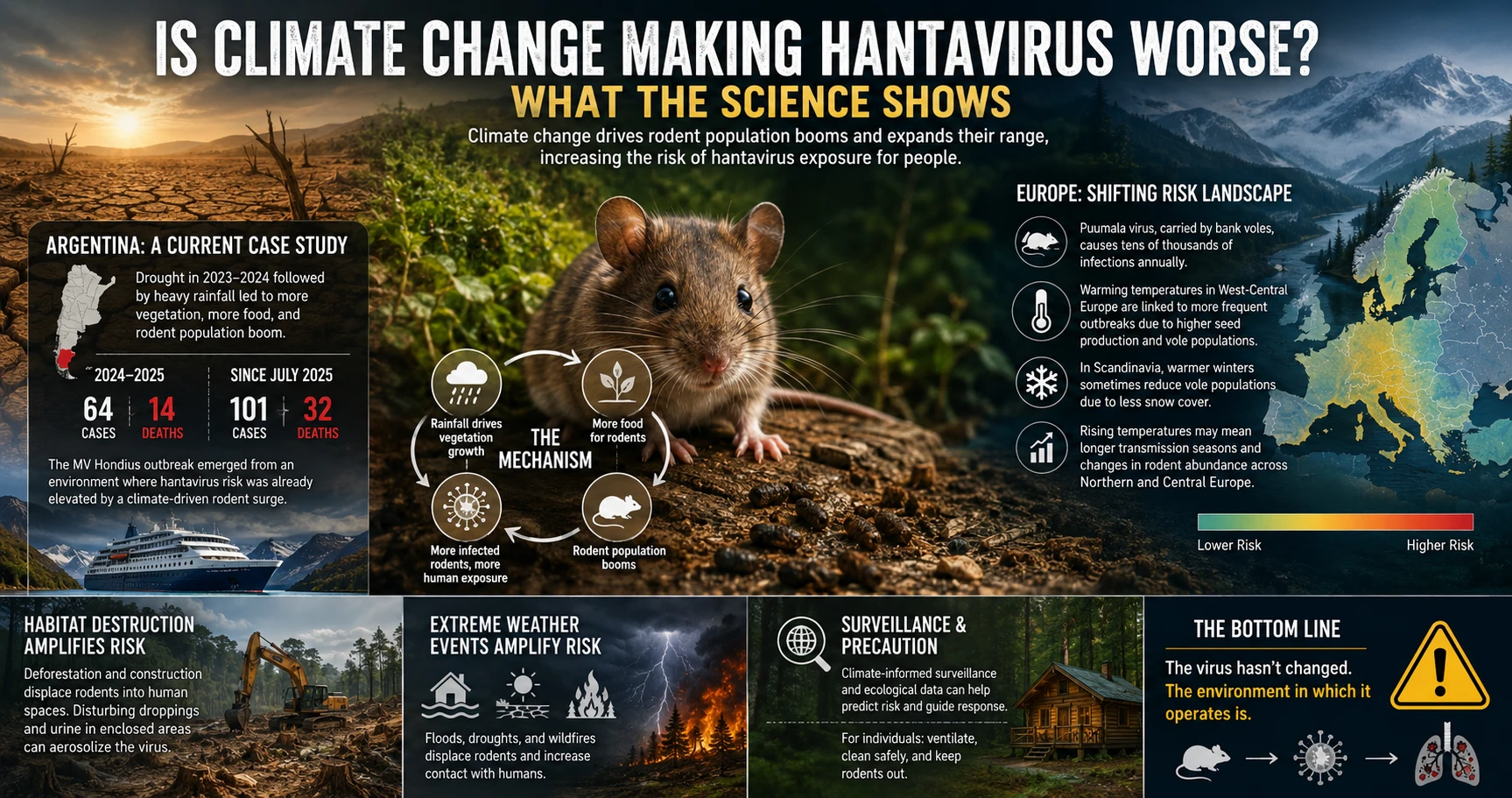
A 2022 study published in Nature found that more than half of all human infectious diseases are climate sensitive. Hantavirus is on that list — and the mechanism is more direct than most people realize. It isn't that warming temperatures affect the virus itself. It's that climate conditions shape the populations of the rodents that carry it, and those populations determine how often humans get exposed.
The Rodent Population Link
Hantavirus does not spread through the air from person to person. In North America, it spreads almost exclusively through contact with the droppings, urine, or saliva of infected rodents — primarily deer mice carrying Sin Nombre virus. The same basic mechanism applies to virtually every hantavirus strain globally: an infected rodent sheds the virus, a human disturbs contaminated material in an enclosed space, and particles become airborne.
This means that the primary variable in human exposure risk is rodent population density. More infected rodents in more places means more opportunities for human exposure.
Climate is one of the most powerful forces governing rodent population dynamics.
"In the case of hantavirus, climate characteristics and climate change may directly influence the presence or abundance of hantavirus host species, such as numerous rodent species," says Kris Murray, a professor at Medical Research Council Unit The Gambia at the London School of Hygiene & Tropical Medicine.
The mechanism runs through food supply. Rainfall drives vegetation growth, which produces seeds and insects that rodents eat. A wet year following a drought can trigger what ecologists call a "masting event" — a sudden abundance of food that allows rodent populations to reproduce rapidly and at higher rates than they could otherwise sustain. The resulting population boom elevates the number of infected individuals in the environment, and the elevated contact between rodents also increases within-population virus transmission.
"A change in rainfall patterns, for example, can influence the reproductive timing and success of rodent host species," Murray explains. "This can have downstream impacts on human exposure."
Argentina as a Current Case Study
The connection between climate and hantavirus is not theoretical. Argentina is living through it now.
Argentina experienced a significant drought in 2023 and 2024. That drought was followed by increased rainfall in subsequent years, producing more vegetation cover, more food, and better conditions for rodent reproduction. The result: Argentina has recorded 101 hantavirus cases and 32 deaths since July 2025 — significantly higher than the 64 cases and 14 deaths reported in the 2024–2025 period.
This is the context behind the MV Hondius outbreak. The cruise ship departed from Ushuaia in southern Argentina, and the leading hypothesis from WHO and Argentine health authorities is that the index case contracted Andes virus during a shore excursion — likely through contact with rodents or their droppings in the Patagonian environment. Argentina's elevated rodent populations, driven by the post-drought vegetation surge, meant more infected animals in more places at the moment those passengers went ashore.
The Hondius outbreak did not come from nowhere. It emerged from an environment where hantavirus risk had already been elevated by a climate-driven rodent surge.
How Habitat Destruction Amplifies Risk
Climate is one driver. Land use is another, and the two interact.
Deforestation, construction, and other forms of habitat disturbance displace rodents from their natural environments and push them toward human-occupied spaces. When infected rodents move into homes, barns, sheds, and vacation cabins, the probability of human exposure increases.
Habitat disturbance also creates direct exposure risk through a mechanism specific to hantavirus: the pathogen is shed in rodent droppings and urine, which dry and accumulate in enclosed spaces. When that material is disturbed — by construction, cleaning, or simply by an animal or human moving through — the dried particles become aerosolized. Someone in the vicinity who breathes the contaminated air can become infected without ever touching a rodent.
"In areas where zoonotic hosts occur, removal of vegetation or other destructive activities can mobilise infectious pathogens," Murray explains. "Hantavirus for instance is often caused by people disturbing areas where rodents occur, since hantavirus is shed in their droppings and urine, which can persist in the environment for some time."
Professor Jörg Schelling, former Director of the Institute of General Medicine at the University Hospital of LMU Munich, adds that the ecological dynamic of fragmented landscapes favors rodents specifically.
"Fragmented ecosystems often favour adaptable reservoir species such as rodents, bats or ticks, while reducing the natural ecological balances that help regulate pathogen transmissions," he says.
Generalist species — animals that can live in a wide range of conditions and eat a wide variety of foods — tend to thrive in disturbed habitats where specialist species cannot. Deer mice, the primary North American hantavirus reservoir, are generalists. Fragmentation that eliminates their predators and competitors while leaving food sources intact produces the worst possible outcome: more rodents, fewer natural checks on their populations, and closer contact with humans.
The European Picture
Hantavirus is not a disease of the Americas alone. It has circulated in Europe for nearly a century — the first documented European outbreak occurred in Sweden in 1934 — and European strains are responding to climate shifts in measurable ways.
The most common hantavirus in Europe is Puumala virus, carried by bank voles. It causes hemorrhagic fever with renal syndrome — characterized by sudden fever, headache, and back and abdominal pain — but is rarely fatal and does not spread between people. It is a milder disease profile than the Andes or Sin Nombre strains, but it still causes tens of thousands of infections annually across Scandinavia, central Europe, and Russia.
Research published in the National Library of Medicine found that elevated temperatures in West-Central Europe have been associated with more frequent Puumala hantavirus outbreaks, driven by higher seed production and higher bank vole population densities. The warming temperatures that promote vegetation productivity in central Europe are feeding the same rodent population dynamics seen in Argentina.
The picture in Scandinavia is more complex: warm winters there have reduced vole populations in some areas because the loss of protective snow cover exposes voles to cold stress and predation. Climate effects on hantavirus risk are not uniformly upward in every region — they depend on which specific mechanisms dominate in a given ecosystem.
Looking forward, Schelling argues that the geographic risk landscape for Europe is likely to change substantially.
"Regions that historically experienced colder climates — including parts of Scandinavia, the Baltic region, and higher-altitude areas in Central Europe — may see longer transmission seasons and changing patterns of rodent abundance as temperatures rise," he says.
Extreme Weather Events as Amplifiers
Beyond gradual trends, individual climate events can create acute spikes in hantavirus exposure risk.
Floods displace rodents from their normal habitats and bring them into contact with human structures. Droughts concentrate rodents around water sources and can push them into basements and outbuildings in search of moisture. Wildfires displace entire rodent communities from their territories. Each of these events is becoming more frequent and more intense.
Schelling frames these events in terms of their systemic effects: "Climate-related extreme events such as floods, droughts and wildfires can disrupt ecosystems and human infrastructure alike, creating conditions that facilitate the spread of infectious diseases and increase human exposure."
The practical implication is that hantavirus risk is not constant across time. Years following extreme weather events — particularly drought-to-wet transitions that drive rodent population booms — carry meaningfully higher exposure risk than baseline years. Argentina's 2025–2026 case surge is a visible example of this dynamic.
Surveillance and Precaution
Several expert groups are calling for climate-informed hantavirus surveillance systems that integrate ecological, epidemiological, and climate data. Some European countries already use climate forecasting for tick-borne encephalitis and West Nile virus; the same methodology could be applied to rodent-borne pathogens.
Nature restoration has also been proposed as a direct public health intervention. A 2021 study in Science Direct found that restoring tropical forest landscapes could reduce populations of two major reservoir rodent species, lowering hantavirus transmission risk for nearly 2.8 million people in vulnerable regions. The mechanism is ecological balance: intact forests support predator communities that keep rodent populations in check.
For individuals, the practical precautions do not change based on climate projections. Hantavirus remains a disease of enclosed spaces and disturbed rodent droppings. Safe cleanup protocols, proper ventilation, and rodent exclusion reduce exposure risk regardless of what the climate is doing to rodent population dynamics. What climate change does alter is the baseline level of risk in those situations — more infected rodents in the environment means that the same encounter with rodent droppings in a shed or cabin carries a higher probability of exposure.
The disease is the same. The environment in which it operates is changing.
Sources & References
- CDC — Centers for Disease Control and Prevention
Hantavirus: Prevention, Symptoms & Control
- WHO — World Health Organization
Hantavirus Disease: Fact Sheet
- euronews.com — Is Hantavirus A Threat To Europe Climate Change And Habitat Destruction Are Increasing The
https://www.euronews.com/2026/05/23/is-hantavirus-a-threat-to-europe-climate-change-and-habitat-destruction-are-increasing-the
- nature.com — S41558 022 01426 1
https://www.nature.com/articles/s41558-022-01426-1
All health claims on this page are verified against the primary sources listed above. View our Editorial Policy
Frequently Asked Questions
Medical Disclaimer
The information on this page is for educational purposes only and is not medical advice. If you believe you may have been exposed to hantavirus or are experiencing symptoms, contact a qualified healthcare professional or local health authority immediately.