Hantavirus in Minnesota: What Cabin Owners and Residents Should Know
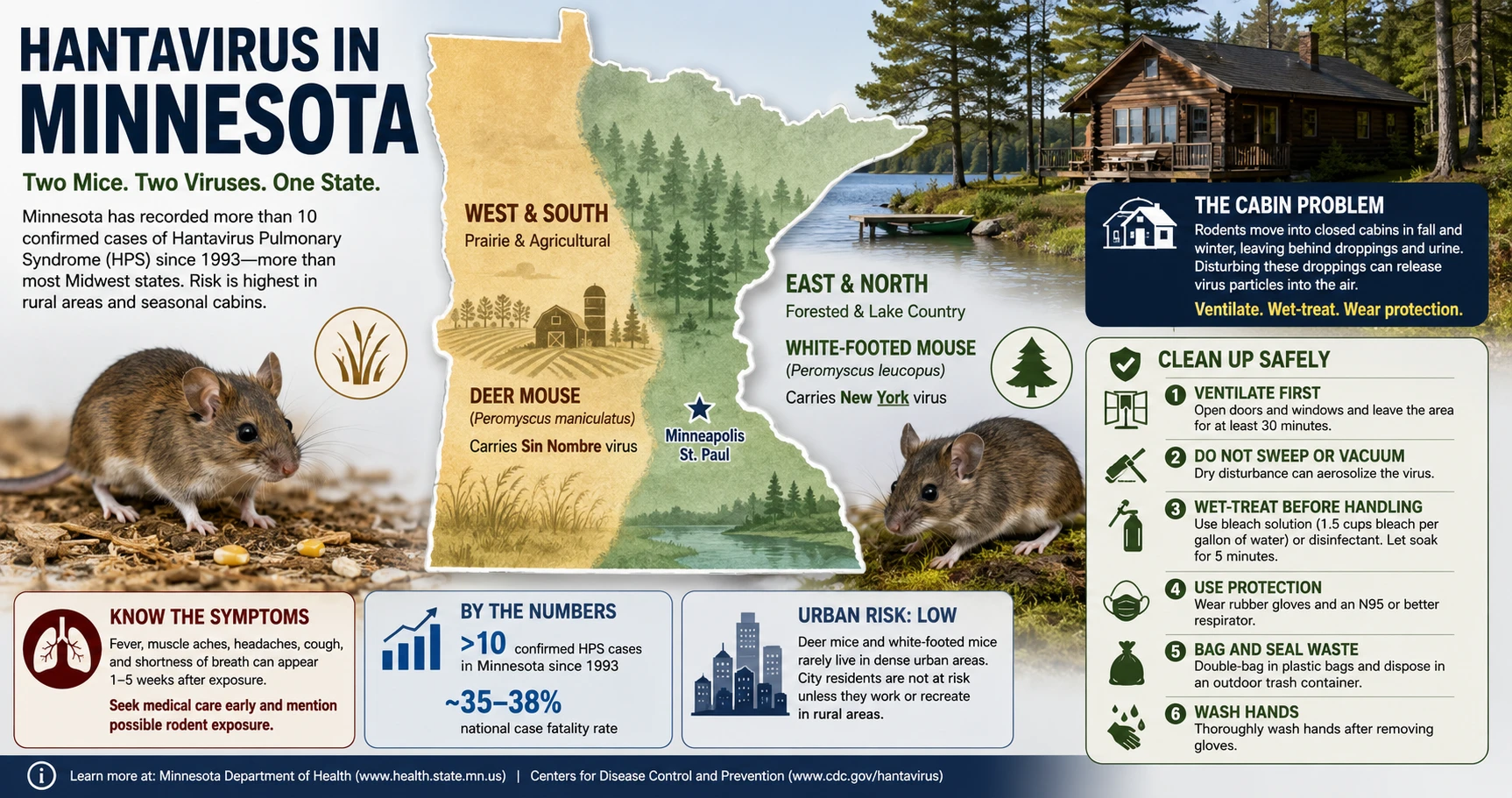
Hantavirus is widely associated with the American Southwest — New Mexico, Colorado, Arizona. That reputation is accurate, but it leads many people in the upper Midwest to underestimate their own exposure risk. Minnesota has recorded more than 10 confirmed cases of Hantavirus Pulmonary Syndrome (HPS) since national tracking began in 1993, placing it among the higher-risk states east of the Rockies. The Minnesota Department of Health monitors these cases, and the pattern is consistent: the risk is real, it is concentrated in rural areas, and the state's cabin culture creates a specific and recurring exposure scenario that residents should understand.
Minnesota's Two Risk Zones
Minnesota sits at an ecological transition that matters for hantavirus risk. The state is not uniform — the western and southern prairie and agricultural regions are biologically distinct from the forested north and east.
Western and southern Minnesota is deer mouse country. The deer mouse (Peromyscus maniculatus) is the primary reservoir for Sin Nombre virus, the strain responsible for the majority of U.S. HPS cases. Deer mice thrive in open grasslands, crop fields, and edge habitats — exactly the landscape that defines the western half of the state. Rural properties, farm outbuildings, and seasonal structures in this zone carry the highest risk.
Eastern and northern Minnesota hosts a different species: the white-footed mouse (Peromyscus leucopus), which carries New York virus. While New York virus cases are less common nationally than Sin Nombre, it is still capable of causing HPS. The forested lake country of northern Minnesota is white-footed mouse habitat.
Neither of these is the common house mouse (Mus musculus) you might trap in a city kitchen. House mice are not known to carry HPS-causing hantavirus. The distinction matters: the species that pose hantavirus risk look similar to casual observers, but they favor rural and semi-rural habitats rather than urban ones.
The Cabin Problem
Minnesota has roughly 10,000 lakes and a deep-rooted cabin culture. Hundreds of thousands of Minnesotans own or rent access to seasonal properties — lake cabins, hunting shacks, ice fishing houses, rural family land. Many of these structures sit empty from October through April.
That dormant period is when rodents move in. Deer mice and white-footed mice seek shelter as temperatures drop, and a closed cabin is an ideal overwintering site. They nest in mattresses, inside walls, under furniture, and in kitchen cabinets. By the time a family arrives to open the place in May, months of droppings, nesting material, and urine have accumulated in an enclosed space.
Opening a cabin after a long winter without proper precautions is a documented HPS risk factor. The hazard comes from disturbing dried rodent waste — sweeping, vacuuming, or moving contaminated materials can aerosolize virus particles. This is the transmission route HPS cases in Minnesota and neighboring states have followed.
The precautions are straightforward. Before entering a cabin that has been closed all winter, open doors and windows and let the space ventilate for at least 30 minutes before spending time inside. Do not sweep or vacuum rodent droppings dry. Instead, wet them down with a bleach solution (1.5 cups bleach per gallon of water) or a commercial disinfectant, let it soak for five minutes, then wipe up with paper towels and dispose of them in a sealed bag.
How Many Cases Has Minnesota Had?
Minnesota has reported more than 10 confirmed HPS cases since 1993 — a count that exceeds most states in the eastern half of the country. Case numbers fluctuate year to year and do not follow a predictable seasonal spike. The Minnesota Department of Health publishes case data and investigates each confirmed case for exposure circumstances.
For context: nationally, HPS has a case fatality rate of roughly 35 to 38 percent. It is rare — fewer than 50 cases are confirmed in the U.S. in most years — but it is serious when it occurs. Minnesota's case count, modest in absolute terms, still represents meaningful risk relative to many neighboring states.
If you encounter news coverage of hantavirus in 2026, the increase in search interest reflects national media attention rather than any new outbreak or change in the disease's behavior in Minnesota.
Minneapolis and Urban Areas
The Twin Cities metro and other urban areas in Minnesota carry substantially lower hantavirus risk. Deer mice and white-footed mice are not well adapted to dense urban environments and are rarely found in city neighborhoods, apartment buildings, or suburban homes. The rodents most common in urban areas — Norway rats and house mice — are not known HPS carriers.
This does not mean urban residents face zero risk. Someone who owns a cabin in greater Minnesota, hunts on rural land, or works in agriculture can encounter hantavirus-carrying rodents regardless of where they live the rest of the year. The risk is tied to the activity and location, not the home zip code.
What to Do If You Find Rodent Evidence in a Minnesota Cabin or Property
If you find droppings, nesting material, or signs of rodent activity in a cabin or rural structure:
- Ventilate first. Open all windows and doors and leave the area for at least 30 minutes before beginning any cleanup.
- Do not sweep or vacuum. Dry disturbance of droppings is the primary transmission risk.
- Wet-treat before handling. Apply a bleach disinfectant solution to droppings and nesting material and let it soak for five minutes.
- Use gloves and a respirator. Rubber gloves and an N95 or better respirator reduce exposure during cleanup. Ordinary dust masks are not sufficient.
- Bag and seal waste. Double-bag contaminated material in plastic bags and dispose in an outdoor trash container.
- Wash hands thoroughly after removing gloves.
If you develop fever, muscle aches, or breathing difficulty within one to five weeks of a potential rodent exposure, contact a healthcare provider and mention the exposure. Early medical attention matters — HPS progresses quickly once respiratory symptoms begin.
Official Sources
- Minnesota Department of Health: Hantavirus — state surveillance, case data, and guidance
- CDC Hantavirus Pulmonary Syndrome — national disease information and prevention
Sources & References
- CDC — Centers for Disease Control and Prevention
Hantavirus: Prevention, Symptoms & Control
- cdc.gov — Index
https://www.cdc.gov/hantavirus/php/surveillance/index.html
- health.state.mn.us — Index
https://www.health.state.mn.us/diseases/hantavirus/index.html
All health claims on this page are verified against the primary sources listed above. View our Editorial Policy
Frequently Asked Questions
Medical Disclaimer
The information on this page is for educational purposes only and is not medical advice. If you believe you may have been exposed to hantavirus or are experiencing symptoms, contact a qualified healthcare professional or local health authority immediately.