Hantavirus in New York: What Residents Need to Know
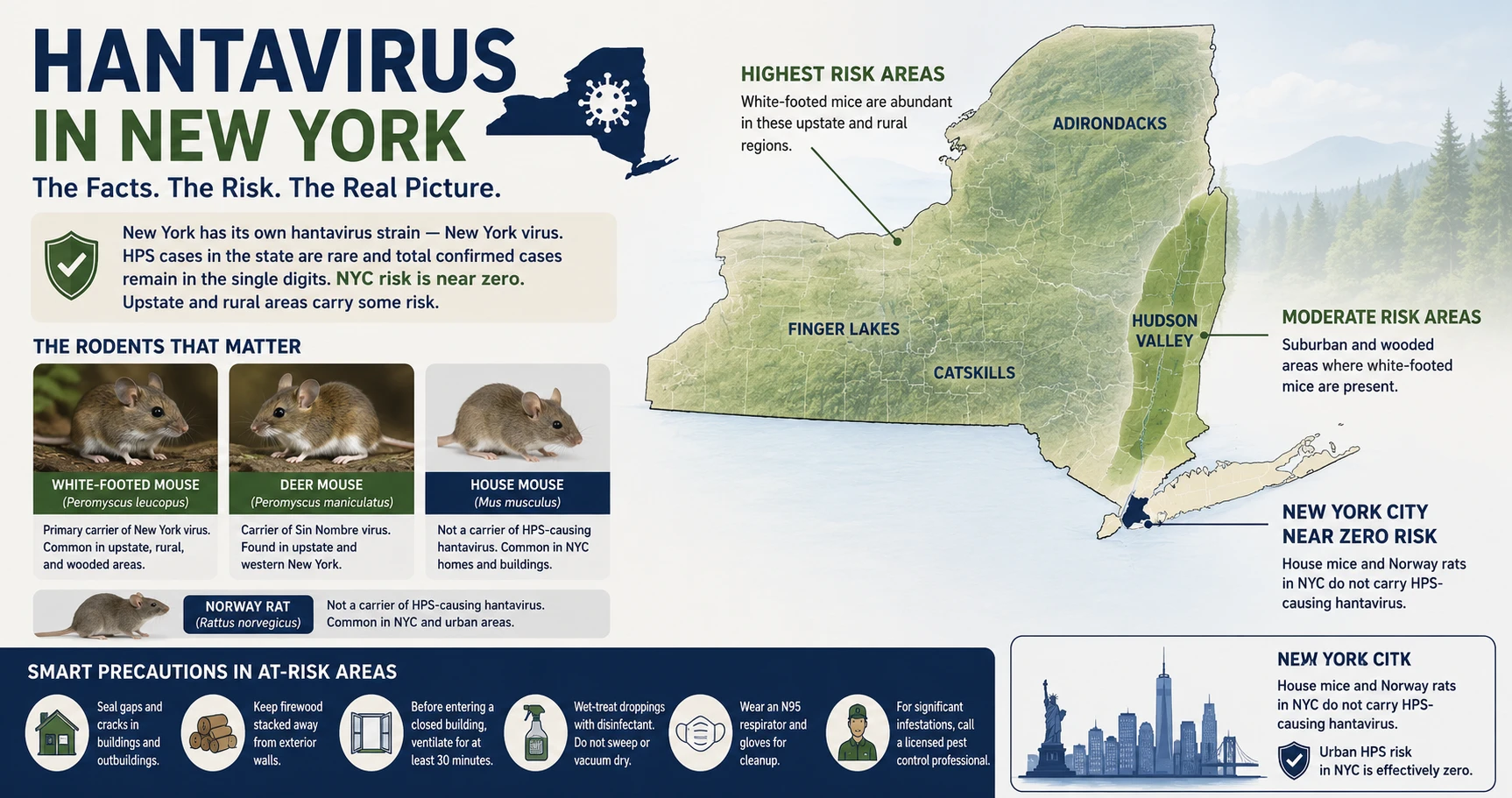
New York has its own hantavirus strain — literally named after the state. That's not a warning; it's a fact worth knowing before you spiral. Hantavirus pulmonary syndrome (HPS) cases in New York are rare, total confirmed cases over the full surveillance period remain in the single digits, and risk in New York City proper is effectively zero. Upstate and rural areas are a different story, and that distinction matters.
New York Virus: The Strain Named Here
In the early 1990s, researchers isolated a previously unknown hantavirus strain from white-footed mice (Peromyscus leucopus) in New York State. They called it New York virus. It belongs to the same family as Sin Nombre virus — the strain responsible for most HPS deaths in the American Southwest — but it's genetically distinct.
New York virus can cause HPS. Cases are rare. The virus does not make headline news the way western outbreaks do, partly because the ecological conditions that amplify rodent populations in the Southwest — desert "boom-bust" cycles — are less pronounced in New York. But the virus is here, it's in the mice, and exposure risk is real for people who spend time in certain environments.
Which Rodents Carry It
The white-footed mouse (Peromyscus leucopus) is the primary reservoir for New York virus in the state. It's common throughout wooded, semi-rural, and suburban areas — the Catskills, the Adirondacks, the Hudson Valley, Long Island's wooded interior, and rural western New York.
The deer mouse (Peromyscus maniculatus) — carrier of Sin Nombre virus — is also present in upstate and western New York. Both species look similar: tan or brown on top, white underneath, large eyes. Neither lives comfortably in dense urban environments.
The house mouse (Mus musculus) is a different animal entirely. It's the mouse in your Manhattan apartment, your Brooklyn basement, the bodega on the corner. House mice are not carriers of HPS-causing hantavirus. Neither are the Norway rats that populate the city's subway infrastructure.
Where in New York the Risk Is
Geography drives risk here more than anything else.
Upstate and rural New York — the Catskills, Adirondacks, Hudson Valley, Finger Lakes region, and rural western counties — carry the highest in-state risk. White-footed mice are abundant in these areas, particularly near forest edges, stone walls, woodpiles, and older structures. Anyone opening a long-closed cabin, clearing brush, or working in rodent-accessed outbuildings in these regions should take standard precautions.
Suburban areas on Long Island, in Westchester, Rockland, and other semi-wooded suburbs also have white-footed mouse populations. A rodent-infested storage shed or garage in Westchester is meaningfully different from an infested building in Midtown.
New York City is a different category. See the section below.
Hantavirus in Schools and Buildings
Searches for "hantavirus new york high school" spiked in spring 2026. No specific confirmed incident is available to report here — but the concern itself is legitimate and worth addressing directly.
Older school buildings, like older buildings of any kind, can develop rodent activity in storage rooms, mechanical spaces, wall voids, and seldom-used basement areas. If a school finds evidence of rodent droppings in an enclosed, poorly ventilated space, hantavirus exposure is a reasonable concern to raise — not because it's likely, but because the consequence of getting it wrong is serious.
The protocol is straightforward. Don't sweep or vacuum dry droppings. Ventilate the space for at least 30 minutes before entry. Wet-treat droppings and nesting material with a 10% bleach solution or EPA-registered disinfectant, let it soak, then wipe up with gloves and dispose of materials in sealed bags. Anyone doing the cleanup should wear an N95 respirator and gloves. If the infestation is extensive, bring in a licensed pest control professional before cleanup begins.
If a school in New York notifies families about potential rodent exposure, that notification is the system working correctly. The precautions are real, but so is the rarity of actual HPS cases.
NYC: Why Urban Risk Is Near Zero
The concern about hantavirus in New York City comes up regularly, usually tied to anxiety about the subway or visible rat populations. The facts are straightforward.
The rodent species in New York City — house mice and Norway rats — do not carry HPS-causing hantavirus strains. The white-footed mouse, which does carry New York virus, is a woodland and edge-habitat species. It does not live in subway tunnels or dense urban apartments. Studies of New York City rodents have not found evidence linking city rodent populations to HPS risk.
This is not reassurance theater. It's the biology. Urban HPS risk in New York City is not meaningfully above zero.
Precautions for New Yorkers
If you live or spend time in upstate New York, the Hudson Valley, wooded suburbs, or rural areas:
- Seal gaps and cracks in outbuildings, cabins, and storage structures before rodents can enter
- Keep firewood stacked away from exterior walls
- Before opening a cabin or storage building that's been closed for months, ventilate it first — open windows and doors for 30 minutes before going inside
- If you find droppings, do not sweep or vacuum them dry; use the wet-treatment method
- Wear an N95 respirator and disposable gloves for any cleanup involving rodent evidence in enclosed spaces
- If you find a significant infestation, call a licensed pest control professional
If you live in New York City, standard rodent-proofing practices apply — but hantavirus is not the concern driving them.
Official Sources
- New York State Department of Health: Hantavirus — state surveillance, prevention, and exposure guidance
- CDC Hantavirus Pulmonary Syndrome — national disease information and prevention
Sources & References
- CDC — Centers for Disease Control and Prevention
Hantavirus: Prevention, Symptoms & Control
- cdc.gov — Index
https://www.cdc.gov/hantavirus/php/surveillance/index.html
- health.ny.gov — Hantavirus
https://www.health.ny.gov/diseases/communicable/hantavirus/
All health claims on this page are verified against the primary sources listed above. View our Editorial Policy
Frequently Asked Questions
Medical Disclaimer
The information on this page is for educational purposes only and is not medical advice. If you believe you may have been exposed to hantavirus or are experiencing symptoms, contact a qualified healthcare professional or local health authority immediately.