Could Hantavirus Become a Pandemic? What Would Have to Change
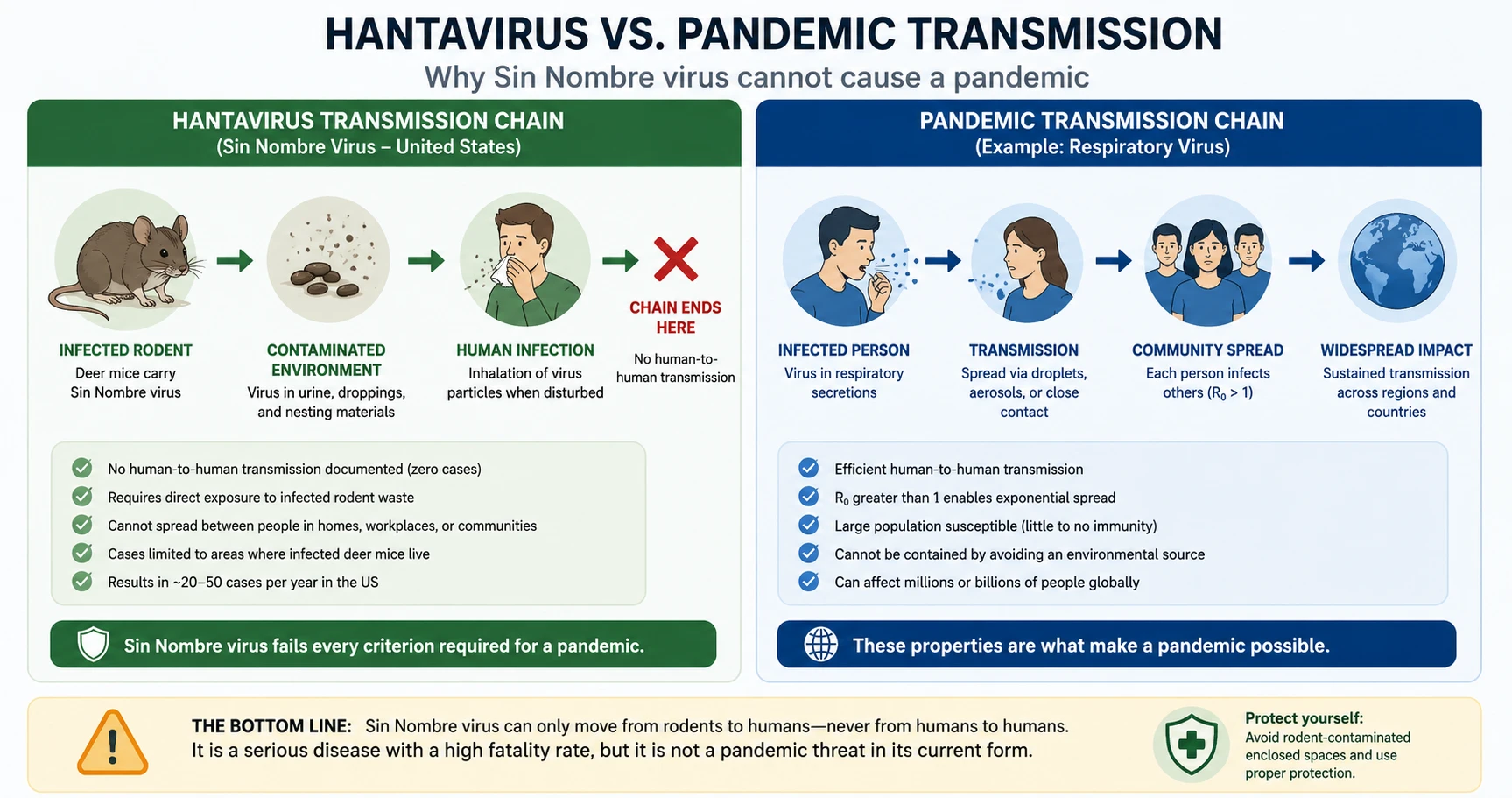
"Hantavirus pandemic" spikes as a search term every time hantavirus gets sustained news coverage. It happened after the 1993 Four Corners outbreak. It happened after the 2012 Yosemite deaths. It is happening again in 2026. Each time, the concern is understandable and the answer is the same: the virus responsible for US cases cannot produce a pandemic in its current form, and here is exactly why.
What a Pandemic Actually Requires
The word "pandemic" has a specific epidemiological meaning: sustained, widespread disease transmission across multiple countries or continents. COVID-19, the 1918 influenza, HIV — pandemics require a pathogen with certain properties:
Efficient human-to-human transmission: The pathogen must spread readily between people — through respiratory droplets, aerosols, or another route that enables community-level spread without requiring each case to contact a non-human reservoir.
Sufficient transmissibility (R₀ > 1): Each infected person must, on average, infect more than one other person, enabling exponential growth.
Wide susceptibility: A large proportion of the population must lack immunity, allowing the virus to find new hosts rapidly.
No containment at the source: The transmission chain cannot be easily broken by removing or avoiding an environmental source.
Sin Nombre virus — responsible for virtually all US hantavirus cases — fails every single one of these criteria.
Why Sin Nombre Cannot Cause a Pandemic
No human-to-human transmission: This is the decisive factor. Sin Nombre virus does not spread between people. Zero documented cases. Healthcare workers who treated HPS patients in 1993 without protective equipment did not become infected. Household contacts of HPS patients did not develop disease. Every single US HPS case has been linked to direct rodent exposure.
Without human-to-human transmission, the concept of exponential spread is simply not applicable. A pathogen that can only move from rodents to humans — never from humans to humans — cannot sustain a transmission chain at the community level. When a person gets HPS, the chain ends there.
Transmission requires a specific exposure scenario: Getting hantavirus requires being in an enclosed space with infected rodent waste, disturbing it, and inhaling the resulting particles. This is not a transmission route that scales. You cannot become a passive spreader who infects people around you at work, on public transit, or at home. The virus dead-ends in every human it infects.
Cases remain geographically constrained by rodent range: HPS only occurs where infected deer mice live. That confines the disease to certain ecological zones in the western US regardless of any other factors. A pandemic pathogen must be able to spread wherever humans go. Sin Nombre virus is tied to a specific rodent's range.
The Andes Virus Question
The Andes virus story is the part that deserves careful attention — and careful framing.
Andes virus, circulating in parts of Argentina and Chile, has documented human-to-human transmission. Several well-characterized clusters, primarily among household contacts and healthcare workers with prolonged unprotected exposure, have confirmed this. It is the only hantavirus strain known to spread between people.
This is biologically significant and the subject of active research. But several factors limit its pandemic potential in its current form:
Transmission is inefficient: Andes virus spread requires close, sustained contact — not the brief casual exposure that drives respiratory pandemics. Epidemiological analysis of clusters, including the 2026 Hondius ship outbreak, consistently shows limited secondary spread. WHO's assessment of Hondius as low global risk reflects the contained nature of the transmission.
Geographic restriction: Andes virus is not present in North American rodent populations. Travelers can be exposed in South America and carry infection elsewhere — as the Hondius cluster showed — but the reservoir that sustains the virus remains in South American rodents. Without that reservoir in a new location, sustained transmission chains cannot establish.
No evidence of increasing transmissibility: Viral genome sequencing of Hondius outbreak samples found no mutations suggesting enhanced transmissibility. The virus appears to be behaving as it has historically.
What Public Health Is Actually Monitoring
The question public health researchers track is not "will hantavirus cause a pandemic tomorrow?" It is: "could mutations in Andes virus, or a related strain, produce more efficient human-to-human transmission?"
This is a legitimate surveillance concern because:
- Andes virus already has partial P2P capability, unlike Sin Nombre
- RNA viruses accumulate mutations over time
- Enhanced transmissibility would represent a meaningful shift in pandemic risk calculus
Surveillance programs — including genomic sequencing of outbreak samples — monitor precisely for this. The Hondius cluster was sequenced rapidly for this reason. No evidence of enhanced transmissibility was found.
The scenario that would genuinely change the risk picture: a mutation that makes hantavirus transmissible via respiratory droplets or aerosols from person to person with an R₀ greater than one. There is no current evidence this has occurred or is occurring. The baseline remains the same as it has been since 1993: Sin Nombre virus is a serious disease with a high fatality rate that affects roughly 20–50 Americans per year, tied entirely to rodent exposure, and incapable of pandemic spread.
The Bottom Line
High fatality rate and pandemic potential are not the same thing. Hantavirus is extremely dangerous to the people who contract it. It is not a pandemic threat in its current form — not because virologists are being optimistic, but because it structurally cannot produce the community spread that defines a pandemic.
The searches for "hantavirus pandemic" reflect reasonable anxiety during a period of heightened media coverage. The answer from the public health community is consistent: no credible authority has identified Sin Nombre virus as a pandemic threat, the Andes virus situation is monitored but contained, and the protective actions that actually matter — avoiding rodent-contaminated enclosed spaces and using proper protection when you can't — remain unchanged.
Sources & References
- CDC — Centers for Disease Control and Prevention
Hantavirus: Prevention, Symptoms & Control
- WHO — World Health Organization
Hantavirus Disease: Fact Sheet
- cdc.gov — Index
https://www.cdc.gov/hantavirus/php/surveillance/index.html
All health claims on this page are verified against the primary sources listed above. View our Editorial Policy
Frequently Asked Questions
Medical Disclaimer
The information on this page is for educational purposes only and is not medical advice. If you believe you may have been exposed to hantavirus or are experiencing symptoms, contact a qualified healthcare professional or local health authority immediately.