How a South African Lab Cracked the Hondius Hantavirus Outbreak in 24 Hours
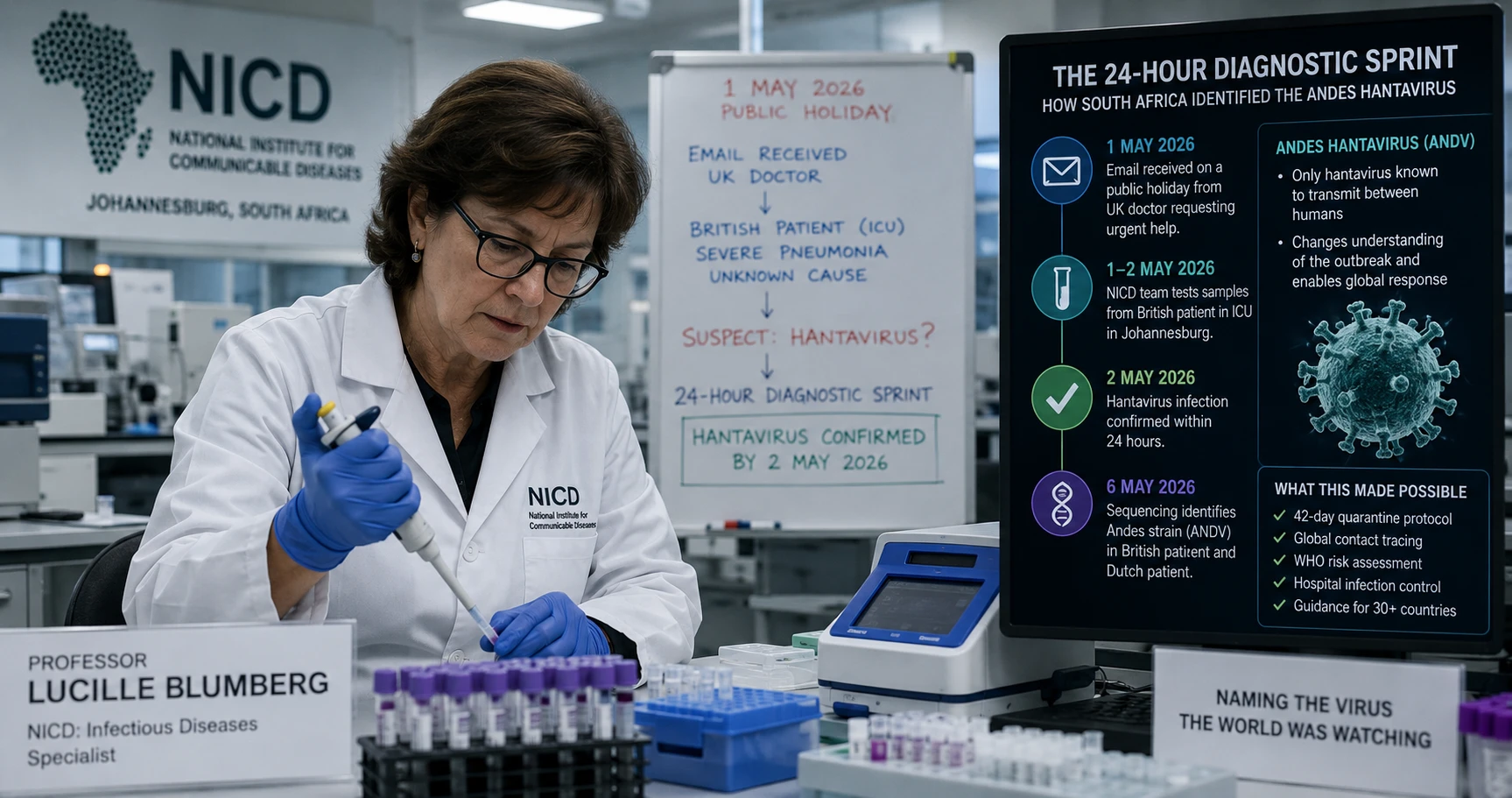
An Email on a Holiday
Friday evening, May 1, 2026. A public holiday in South Africa.
Professor Lucille Blumberg, a senior infectious disease specialist at South Africa's National Institute for Communicable Diseases (NICD) in Johannesburg, received an email from a colleague in the United Kingdom. A British patient had been medevacked from an expedition cruise ship and was now in intensive care at a private hospital in Sandton. He had severe pneumonia. Nobody knew what was causing it.
The message was a request for help from someone who suspected the answer might be something unusual — and who knew that South Africa had one of the few laboratories on the continent capable of identifying it.
By the following morning, Blumberg's team had their answer.
What the Lab Was Working With
The patient — a British man, later identified in clinical reports as Patient 3 — had first developed symptoms of shortness of breath and fever on April 21, while still aboard the MV Hondius. He was evacuated by helicopter to Ascension Island on April 27, where chest X-rays showed no concerning signs. His condition worsened on the island. He was transferred to a hospital in Johannesburg for ventilator support and intensive care.
By the time Blumberg received the email, two Dutch passengers from the same ship had already died. One — an ornithologist later identified as the likely index case — had died on April 11 while still on board. His wife had fallen ill on April 24, flown to South Africa, and collapsed at OR Tambo International Airport, where she died.
The connection between the British patient in Sandton and the two Dutch deaths had not yet been formally established. The cause of all three was unknown.
The 24-Hour Sprint
Hantavirus is not a pathogen South African clinicians typically consider. The virus is not endemic to South Africa. It does not circulate in local rodent populations. When a patient arrives with severe respiratory failure, hantavirus is not on the standard differential.
What made Blumberg's team move toward it anyway was the combination of factors: severe pulmonary syndrome in previously healthy individuals, a ship that had traveled through South America, and the specific epidemiological pattern of multiple people from the same voyage deteriorating in similar ways.
Working through the public holiday, the NICD team tested samples from the British patient in ICU. Within 24 hours of receiving the email, they had confirmed hantavirus infection.
"The pieces came together extremely quickly — it was quite remarkable to make that diagnosis," Blumberg said. "It was a most unusual pathogen in a most unusual setting."
Naming the Strain
Confirming hantavirus was the first step. The second was sequencing — determining which of the dozens of known hantavirus strains was responsible.
That answer came five days later. On May 6, the NICD announced that sequencing had identified the Andes strain (ANDV) in both the British patient in Johannesburg and, from preserved samples, in the Dutch woman who had died at OR Tambo. The two cases were connected. They were caused by the same virus.
The Andes strain is the only hantavirus known to transmit between humans. Its identification changed everything about how authorities understood the outbreak — and why. What had appeared to be a cluster of severe but possibly unrelated respiratory illnesses was now a traceable chain of transmission from a single point of origin.
On the same day, a virtual consultation was held with medical specialists from South Africa, the United Kingdom, and the Netherlands to compare findings and align on the clinical picture. The WHO was formally informed. The international response that followed — the 42-day quarantine protocol, the multi-country contact tracing operation, the US monitoring of 41 passengers — all traced back to the sequencing results that came out of the Johannesburg laboratory.
Why a Cruise Ship Had No Answer
Blumberg noted something that explains why the diagnosis took as long as it did: cruise ships have no way to test for hantavirus on board. Rapid diagnostic tools exist for influenza, COVID-19, and a handful of other pathogens common enough to justify carrying portable tests. Hantavirus is not among them.
The ship's medical staff had no mechanism to identify what was killing passengers. The deaths of the Dutch man on April 11 and his wife on April 26 went without a confirmed diagnosis while the ship continued its voyage and more passengers became ill. By the time the British patient was evacuated to Johannesburg on April 27, the outbreak had been underway for three weeks.
This gap — the absence of diagnostic capacity at sea for rare pathogens — is one of the structural vulnerabilities the Hondius outbreak exposed.
Contact Tracing From Day One
One decision the NICD team made before they even had a confirmed diagnosis was to begin contact tracing. South African health authorities identified 62 people — including flight crew and healthcare workers — who had been in contact with the two patients in Johannesburg, and began monitoring them before the pathogen had a name.
"We started contact tracing even before we were sure what we were dealing with, out of an abundance of caution," Blumberg said.
Of the 62 contacts initially identified, 42 had been located and tested negative for hantavirus as of early May. The airline that had unknowingly carried the Dutch woman — Airlink — was notified on May 3 that a passenger from the previous week's flight had died and that hantavirus was believed to be the cause.
What This Diagnosis Made Possible
Every subsequent step in the global Hondius response depended on the NICD's identification of the Andes strain.
Without knowing the specific strain, authorities could not determine whether human-to-human transmission was possible. They could not set evidence-based quarantine timelines. They could not calibrate infection control protocols for the hospitals receiving patients. They could not advise the more than 600 contacts now being monitored across 30 countries on what their actual risk was.
The 42-day quarantine that American passengers entered at the University of Nebraska Medical Center, the WHO's global risk assessment, the genetic sequencing by France's Pasteur Institute — all of it was built on a foundation established in a Johannesburg laboratory on a public holiday, by a team asked to identify something they had never had reason to test for before.
"It was quite remarkable," Blumberg said. The understatement was notable from someone who helped name the virus the world was watching.
Sources & References
- WHO — World Health Organization
Hantavirus Disease: Fact Sheet
- dailymaverick.co.za — 2026 05 10 How An Sa Team Of Scientists Hunted A Rare Hantavirus Strain
https://www.dailymaverick.co.za/article/2026-05-10-how-an-sa-team-of-scientists-hunted-a-rare-hantavirus-strain/
- businessday.co.za — 2026 05 06 Sa Identifies Rare Strain Of Hantavirus Which Spreads Among Humans
https://www.businessday.co.za/world/africa/2026-05-06-sa-identifies-rare-strain-of-hantavirus-which-spreads-among-humans/
- cidrap.umn.edu — Public Health Alerts Andes Hantavirus Cruise Ship 2026
https://www.cidrap.umn.edu/public-health-alerts/public-health-alerts-andes-hantavirus-cruise-ship-2026
All health claims on this page are verified against the primary sources listed above. View our Editorial Policy
Medical Disclaimer
The information on this page is for educational purposes only and is not medical advice. If you believe you may have been exposed to hantavirus or are experiencing symptoms, contact a qualified healthcare professional or local health authority immediately.