What Are the Odds of Getting Hantavirus?
The Short Answer
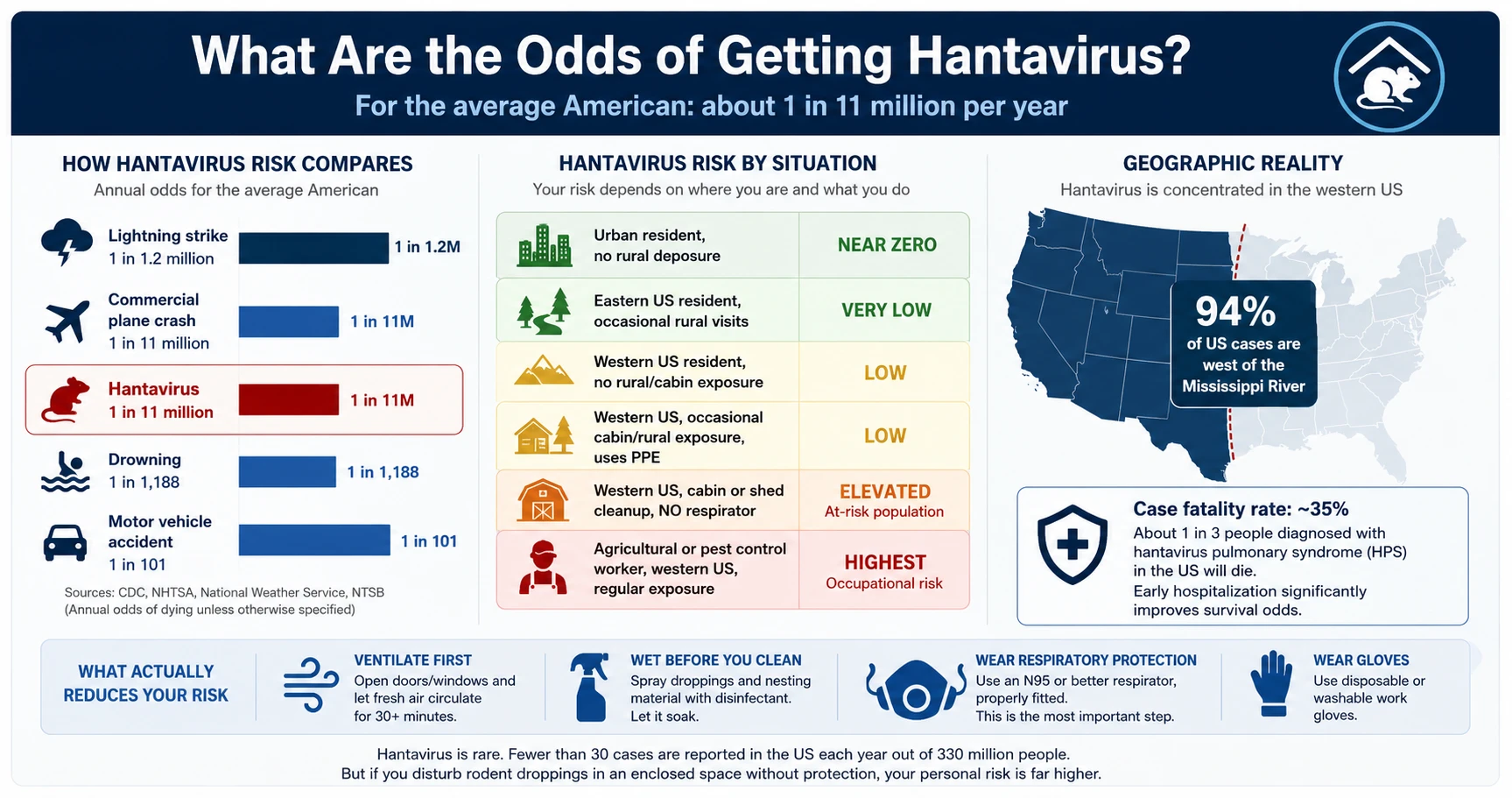
The average American's annual odds of getting hantavirus are approximately 1 in 11 million. The CDC has recorded roughly 29 cases per year since national surveillance began in 1993, in a country of 330 million people.
To put that number in context: you are statistically more likely to be struck by lightning (1 in 1.2 million annually) than to contract hantavirus in a given year. The national average makes hantavirus sound theoretical.
But national averages can mislead. Hantavirus risk is not evenly distributed. It concentrates sharply around specific environments and specific behaviors — and if you fall into the high-exposure category, the odds that matter to you are nothing like 1 in 11 million.
Why the Average Odds Don't Tell Your Story
Most Americans have near-zero annual hantavirus risk because most Americans never encounter the conditions that cause it. The vast majority of cases involve a specific combination:
- Being in or near the western United States
- Entering an enclosed space — a cabin, shed, barn, crawlspace, or RV — with evidence of rodent activity
- Disturbing dried droppings or nesting material without respiratory protection
Remove any one of those three factors and risk drops substantially. Add all three, and you have the profile that accounts for most of the 830+ cases recorded since 1993.
Odds by Situation
Rather than one number, it's more useful to think about hantavirus risk in tiers:
| Situation | Approximate Risk Category |
|---|---|
| Urban resident, no rural exposure | Near zero |
| Eastern US resident, occasional rural visits | Very low |
| Western US resident, no rural/cabin exposure | Low |
| Western US, occasional cabin/rural exposure, uses PPE | Low |
| Western US, cabin or shed cleanup, no respirator | Elevated — this is the at-risk population |
| Agricultural or pest control worker, western US, regular exposure | Highest occupational risk category |
The CDC data consistently shows that cases cluster around the "cabin cleanup without PPE" scenario. The typical case involves someone entering a structure that has been closed for months — often after winter — and sweeping or disturbing accumulated droppings without a mask.
Geographic Odds: Western vs. Eastern US
94% of US hantavirus cases are west of the Mississippi River. This is not an arbitrary line — it follows the range of the deer mouse (Peromyscus maniculatus), the primary carrier of Sin Nombre virus, which causes most North American HPS cases.
States with the highest case counts — New Mexico, Colorado, Arizona, California, Washington — all have high deer mouse population densities in rural and semi-rural settings.
If you live in a major eastern city and have no contact with rural western environments, your personal annual odds are effectively zero. The virus responsible for most US cases simply does not have a strong presence in your environment.
For a full breakdown, see hantavirus cases by state.
What Actually Moves the Needle on Your Risk
The factors with the biggest impact on individual odds:
Location: Are you in the western US, or do you regularly visit rural areas there?
Environment: Do you spend time in enclosed structures — cabins, barns, sheds, campers — that may have rodent activity?
Behavior during exposure: When you enter a space with rodent evidence, do you:
- Ventilate before working?
- Wet-wipe droppings with disinfectant before touching?
- Wear an N95 or better respirator?
An N95 respirator, properly worn, blocks the aerosol particles that carry the virus. The primary transmission route is inhalation — not touch. This is why standard cleaning without respiratory protection is the primary risk factor, and why respiratory protection is the single most effective countermeasure.
The 35% Fatality Rate in Context
The 1-in-11-million average annual odds are for contracting hantavirus. The odds of dying from hantavirus depend on two compounding factors: the probability of getting infected, and the probability of dying if infected.
The case fatality rate for HPS in the US is approximately 35% — meaning about 1 in 3 confirmed cases results in death. This is high compared to most infectious diseases. HPS causes rapid, severe respiratory distress, and outcomes depend heavily on how quickly the patient reaches appropriate hospital care.
Early hospitalization — before full respiratory failure — significantly improves survival odds. People who recognize exposure risk and seek evaluation at first symptoms have meaningfully better outcomes than those who wait.
After the Hondius and Gene Hackman News
Media coverage of hantavirus — including the 2026 Hondius cruise ship outbreak and the 2025 death of Gene Hackman's wife, Betsy Arakawa — has led many people to reassess their own risk.
For US residents who are not directly connected to those events:
- The Hondius outbreak involved the Andes strain of hantavirus, found in South America. This strain has unique person-to-person transmission capacity. The Sin Nombre virus responsible for most US cases does not transmit between people. The cruise ship outbreak does not change North American risk.
- Betsy Arakawa's case occurred in New Mexico — consistent with the established western US geographic pattern. The case is medically relevant as a reminder that HPS is a real risk in the Four Corners region, but it does not represent an outbreak or new risk pattern.
If you are based in the US and have no recent exposure to rodent-contaminated enclosed spaces in the western US, the high-profile news coverage does not change your personal odds.
Practical Bottom Line
For most Americans, hantavirus is a very rare disease that poses genuine risk only under specific circumstances. The numbers support this: fewer than 30 cases per year in a country of 330 million.
If you are in the high-risk category — spending time in rural western environments, dealing with rodent-contaminated structures — the odds are still low in absolute terms, but precautions are genuinely worth taking. An N95, gloves, and proper disinfection before cleanup cost almost nothing. The consequences of an infection are severe.
For a detailed breakdown of who specifically faces elevated risk, see who is most at risk for hantavirus.
Official Sources
- CDC Hantavirus Surveillance Data — case counts, fatality rates, and geographic distribution
- WHO Hantavirus Fact Sheet — global epidemiology and risk context
Sources & References
- CDC — Centers for Disease Control and Prevention
Hantavirus: Prevention, Symptoms & Control
- cdc.gov — Index
https://www.cdc.gov/hantavirus/php/surveillance/index.html
- WHO — World Health Organization
Hantavirus Disease: Fact Sheet
All health claims on this page are verified against the primary sources listed above. View our Editorial Policy
Frequently Asked Questions
Medical Disclaimer
The information on this page is for educational purposes only and is not medical advice. If you believe you may have been exposed to hantavirus or are experiencing symptoms, contact a qualified healthcare professional or local health authority immediately.