Does Alcohol Kill Hantavirus? What Actually Works
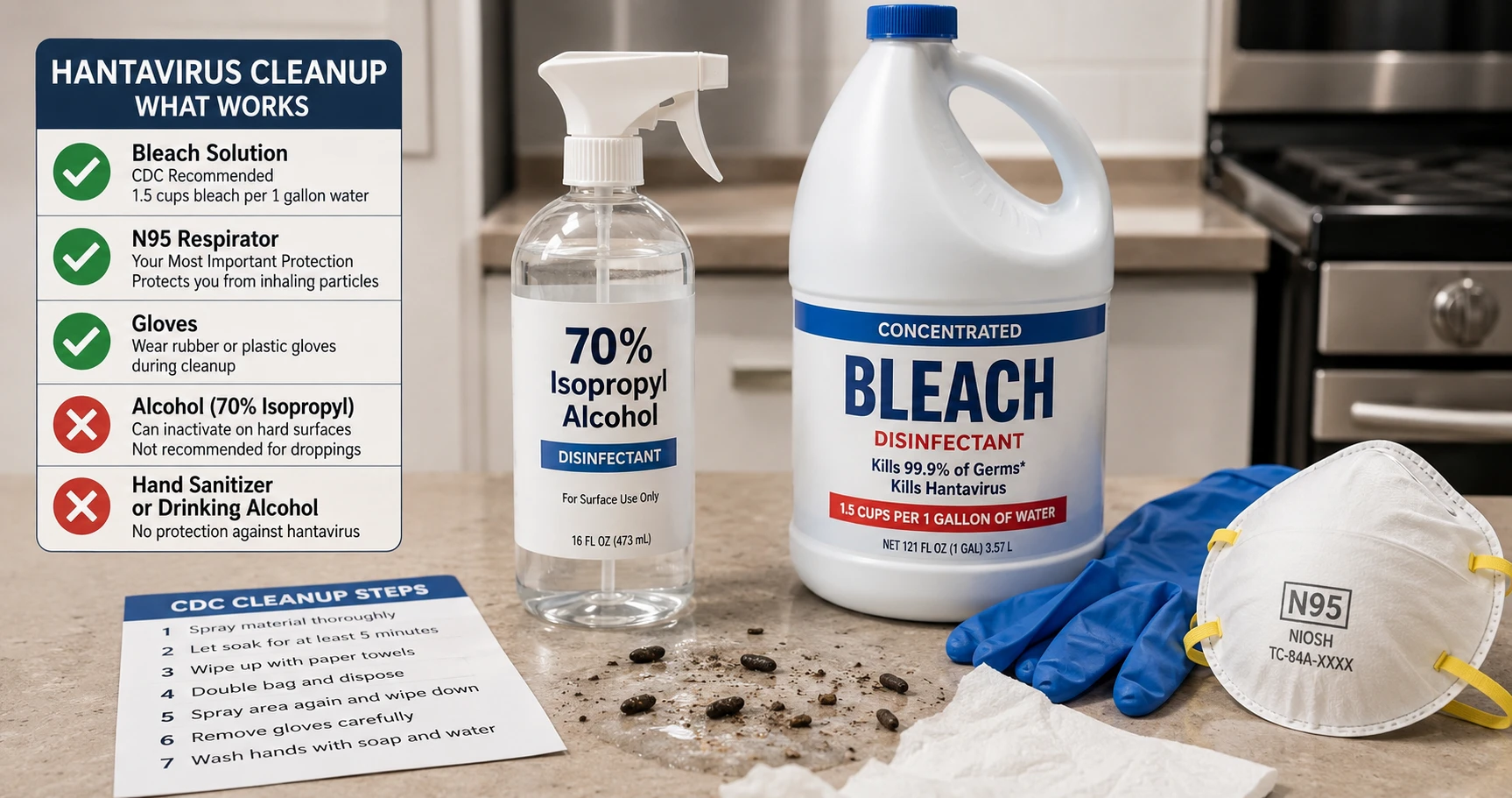
You just found mouse droppings behind the stove and you're reaching for the rubbing alcohol. Will that work?
The short answer: yes, alcohol can kill hantavirus. Hantavirus is a lipid-enveloped virus, and alcohol dissolves that fatty outer membrane — which is exactly what kills it. But whether alcohol is the right tool depends entirely on where you're using it. On surfaces, it evaporates too quickly to be reliable. On your hands in the field, it's an acceptable substitute for soap and water. For the actual rodent cleanup, bleach is what CDC recommends.
Here's what you need to know before you start cleaning.
Does Alcohol Kill Hantavirus on Surfaces?
Hantavirus — including the Sin Nombre strain responsible for most U.S. cases — is a lipid-enveloped RNA virus. That outer lipid envelope is its vulnerability. Alcohol disrupts lipid membranes, which is why 70% isopropyl alcohol is broadly effective against enveloped viruses.
So yes, isopropyl alcohol at 70% concentration can inactivate hantavirus on a hard, non-porous surface — a countertop, a tile floor, a metal shelf.
The catch is what's sitting on that surface. Alcohol doesn't penetrate organic material well. Dried rodent droppings, urine residue, and nesting debris are exactly the kind of organic matter that blocks alcohol from reaching the virus particles underneath. You'd be disinfecting the outside of a dropping while the live virus inside stays protected.
That's why alcohol alone is a poor choice for actual rodent cleanup.
Why Bleach Is the Better Choice
CDC's official guidance specifies a bleach solution for hantavirus decontamination: 1.5 cups of household bleach per gallon of water. This isn't arbitrary. Bleach is a stronger, broader disinfectant that penetrates organic matter more effectively than alcohol does.
EPA-registered disinfectants labeled for hantavirus or similar enveloped viruses are also acceptable. But if you're working from what's already in your house, bleach is the right call.
One more thing: alcohol evaporates quickly. For a disinfectant to work, it needs adequate contact time with the surface. Bleach solution, applied generously and left to sit, gives you that. Alcohol sprayed on a dry surface often evaporates before it can do the job properly.
"I Just Got Back From a Contaminated Space — Should I Spray Alcohol on Myself?"
This is one of the more common reasons people search this question. You were in a cabin, a shed, a car, or an attic where you saw signs of rodent activity. Now you're home and wondering if spraying alcohol on your skin, clothes, or body will reduce your risk.
The honest answer: it won't, and here's why.
Hantavirus infects you through inhalation — not through skin contact. The virus enters your respiratory tract when you breathe in airborne particles from disturbed droppings, urine, or nesting material. Your skin is not a route of infection. Alcohol on your skin or clothing does nothing to affect any particles you may have already inhaled while in that space.
By the time you're home, the exposure window has already passed. If you breathed in particles during the time you were in the contaminated space, that happened then. If you wore an N95 and didn't disturb anything, you're likely fine. Alcohol applied to your body afterward doesn't change either outcome.
What to do when you get home after potential exposure:
- Change out of your clothes promptly — don't shake them out (that re-aerosolizes any particles on the fabric)
- Put clothes directly into the wash on a hot cycle
- Shower normally — this removes particles from your skin and hair, though skin exposure isn't the infection route
- Monitor for symptoms over the next 1–5 weeks: fever, muscle aches, fatigue followed by shortness of breath
If you were in a heavily contaminated enclosed space without respiratory protection, read this guide on when to see a doctor after rodent exposure.
Spraying yourself with isopropyl alcohol is not on that list. It doesn't protect you — the exposure risk was in the room, not on your skin.
What About Hand Sanitizer or Drinking Alcohol?
Hand sanitizer: CDC considers it an acceptable option for hand hygiene in the field when soap and warm water aren't available — provided your hands aren't visibly soiled. Since hantavirus is a lipid-enveloped virus, alcohol does work on skin surfaces. But this is about hand hygiene only. Hand sanitizer does nothing to protect your respiratory tract, which is where the actual infection happens. If you're working around rodent material, the critical protection is an N95 respirator and gloves — not what you put on your hands afterward.
Drinking alcohol: No effect on viral infection. Consuming alcohol does not kill hantavirus or protect against it in any way.
The Step-by-Step Disinfection Protocol (CDC Method)
This is the process CDC recommends. Follow it in order.
Before you start: Put on rubber or plastic gloves. Wear an N95 respirator (not a cloth mask or surgical mask — those don't filter fine particles). If you're working in a confined space, consider eye protection as well.
Do not sweep or vacuum. This is the most common mistake. Dry-sweeping launches particles into the air. Vacuuming — even with a HEPA filter — is not recommended for initial cleanup.
- Mix your bleach solution: 1.5 cups bleach to 1 gallon of water. Or use an EPA-registered disinfectant.
- Spray the droppings, nesting material, or urine stains thoroughly. The material should be visibly wet.
- Let it soak for a minimum of 5 minutes. Don't rush this step.
- Wipe up the soaked material with paper towels. Pick up from the edges and fold inward — don't drag.
- Place used paper towels directly into a plastic bag, seal it, and put that bag inside a second plastic bag before disposal.
- After removing all material, spray the area again and wipe down.
- Remove gloves carefully — peel them off without touching the outer surface. Dispose of them the same way.
- Wash hands thoroughly with soap and water even though you wore gloves.
If the infestation area is large — entire room, attic, crawl space — or if you're immunocompromised, consider hiring a pest remediation professional trained in hantavirus protocols.
What Actually Protects You
Surface disinfection matters, but here's the reality: most hantavirus exposure happens before cleanup even starts. Entering a closed space with rodent activity, disturbing nesting material, or picking up droppings without protection — those are the moments of highest risk.
Your N95 respirator is more critical than any disinfectant you choose. The virus infects you through your respiratory tract, not through your skin. No amount of bleach or alcohol on a surface protects you if you're breathing in particles from the same area.
Before you open that cabinet, closet, or shed:
- Air the space out for at least 30 minutes before entering (open windows and doors, then leave)
- Put on your respirator and gloves before you go back in
- Move slowly and avoid creating dust
The disinfectant you choose matters. Bleach beats alcohol for this job. But the respirator you're wearing — or not wearing — matters more.
Sources & References
- CDC — Centers for Disease Control and Prevention
Hantavirus: Prevention, Symptoms & Control
- cdc.gov — Cleaning Up
https://www.cdc.gov/hantavirus/prevention/cleaning-up.html
- EPA — Environmental Protection Agency
Registered Disinfectants for Emerging Viral Pathogens
All health claims on this page are verified against the primary sources listed above. View our Editorial Policy
Frequently Asked Questions
Medical Disclaimer
The information on this page is for educational purposes only and is not medical advice. If you believe you may have been exposed to hantavirus or are experiencing symptoms, contact a qualified healthcare professional or local health authority immediately.