What Diseases Do Mice Carry? Health Risks from Rodent Infestations
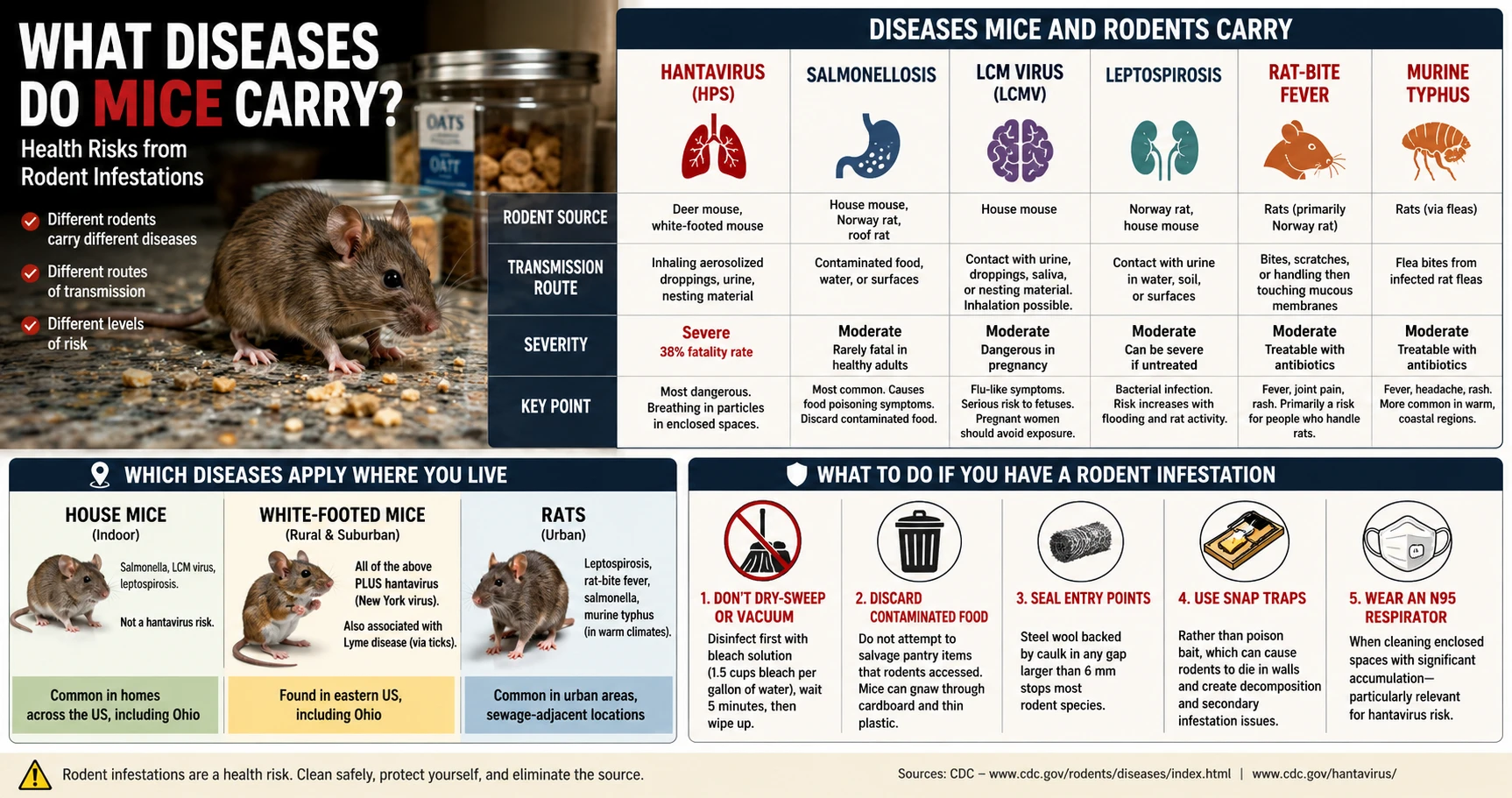
Finding mice in your home raises an immediate question: what am I actually at risk for? The answer depends on which species you have, where you live, and how the exposure happens. Not all mice carry the same diseases, and not all transmission routes are equally likely.
Here is the full picture — disease by disease, with transmission routes and actual risk levels.
At a Glance: Rodent-Borne Diseases in the US
| Disease | Rodent Source | Transmission Route | Severity |
|---|---|---|---|
| Hantavirus (HPS) | Deer mouse, white-footed mouse | Inhaling aerosolized droppings | Severe — 38% fatality |
| Salmonellosis | House mouse, rats | Contaminated food/surfaces | Moderate — rarely fatal |
| LCM virus (LCMV) | House mouse | Contact, inhalation | Moderate — dangerous in pregnancy |
| Leptospirosis | Rats, house mouse | Contact with urine in water/soil | Moderate — can be severe |
| Rat-bite fever | Rats | Bites, scratches | Moderate — treatable |
| Murine typhus | Rats (via fleas) | Flea bites | Moderate — treatable |
Hantavirus Pulmonary Syndrome (HPS)
Hantavirus is the most serious disease transmitted by mice in the United States. The case fatality rate is approximately 38% — nearly four in ten confirmed cases are fatal.
Carriers: Deer mice (Peromyscus maniculatus) in the western US carry Sin Nombre virus. White-footed mice (Peromyscus leucopus) in the eastern US carry New York virus. Neither species is the common house mouse.
How you get it: Almost exclusively through inhaling aerosolized particles from dried rodent droppings, urine, or nesting material in an enclosed space. This happens when you disturb accumulated material without protection — sweeping, moving stored items, opening a long-closed cabin or shed.
Symptoms: Begins as flu-like illness (fever, muscle aches, fatigue) 1–5 weeks after exposure, then progresses rapidly to severe breathing difficulty as fluid fills the lungs.
Why it matters for cleanup: Any enclosed space with evidence of deer mouse or white-footed mouse activity requires ventilation, N95 respirator, and wet-disinfection before cleanup begins. This is the disease where cleanup protocol is not optional.
→ How Do You Get Hantavirus? Full Transmission Guide
Salmonellosis
Salmonella is the most common rodent-borne disease in US households — far more common than hantavirus, though far less lethal in healthy adults.
Carriers: House mice, Norway rats, roof rats.
How you get it: Consuming food or water that has been contaminated by rodent droppings or urine. Mice defecate constantly while moving around — up to 80 droppings per day — and frequently contaminate food preparation surfaces, pantries, and open food containers.
Symptoms: Diarrhea, fever, stomach cramps beginning 6 hours to 6 days after infection. Usually resolves on its own in 4–7 days. Can be serious in young children, the elderly, and immunocompromised individuals.
Key action: Discard any food that rodents may have contacted. Disinfect all surfaces in affected areas with a bleach solution before resuming food preparation. Do not assume sealed packaging is safe if there is evidence of rodent activity nearby — mice can gnaw through cardboard and thin plastic.
Lymphocytic Choriomeningitis Virus (LCMV)
LCM virus is underappreciated relative to its actual prevalence. Studies suggest approximately 5% of house mice in the US carry LCMV, making it one of the more commonly acquired rodent-borne infections.
Carriers: The common house mouse is the primary reservoir. Pet rodents (hamsters, guinea pigs) have also been implicated in transmission clusters.
How you get it: Contact with infected urine, droppings, saliva, or nesting material — followed by touching your eyes, nose, or mouth. Inhalation of aerosolized particles in enclosed spaces is also a documented route.
Symptoms: Most infections cause a mild flu-like illness. However, LCMV can cause neurological complications in severe cases, and it poses a serious risk to fetuses — infection during pregnancy can cause miscarriage, stillbirth, or severe birth defects.
Key concern: Pregnant women should avoid all contact with wild mice and their droppings, and should not handle pet rodents during pregnancy without consulting their healthcare provider.
Leptospirosis
Leptospirosis is a bacterial infection spread primarily through rodent urine contaminating water, soil, or surfaces.
Carriers: Norway rats are the most significant source in the US. House mice also carry leptospira bacteria.
How you get it: Contact with water, mud, or surfaces contaminated with infected rodent urine — through skin abrasions, mucous membranes, or occasionally the mouth. Most US cases occur after flooding events that spread rodent urine through water sources, or in people who work with soil or water in rat-populated areas.
Symptoms: Ranges from mild flu-like illness to severe disease affecting the liver and kidneys (Weil's disease). Treatable with antibiotics if caught early.
Key setting: Urban flooding, sewage work, and properties with heavy rat activity carry the most risk. Ohio's urban centers — Cleveland, Columbus, Cincinnati — have Norway rat populations that sustain leptospira in the environment.
Rat-Bite Fever
Rat-bite fever is caused by Streptobacillus moniliformis, a bacterium carried in the mouths and respiratory tracts of rats.
Carriers: Rats — primarily Norway rats.
How you get it: A bite or scratch from an infected rat is the classic route. Less commonly, handling rats and then touching mucous membranes, or consuming food contaminated with rat droppings, can transmit the bacteria.
Symptoms: Fever, joint pain, rash appearing 3–10 days after exposure. Treatable with antibiotics. Can be serious if untreated.
Relevance: Primarily a risk for people who handle rats — pest control workers, laboratory workers, people who own pet rats sourced from uncertain origins. Casual contact with rat droppings does not typically transmit rat-bite fever.
Murine Typhus
Murine typhus is caused by Rickettsia typhi, a bacterium spread by fleas that feed on infected rats.
Carriers: Rats (Norway rat, roof rat) — but transmission is via rat fleas, not direct rat contact.
How you get it: A bite from an infected rat flea. The bacteria enter through flea feces rubbed into the bite wound, not through the bite itself.
Symptoms: Fever, headache, rash appearing 1–2 weeks after infection. Treatable with doxycycline. More common in warm, coastal regions and areas with heavy rat and flea activity.
Geographic note: Murine typhus cases in the US are concentrated in Texas, California, and Hawaii. It is not a significant concern in most of the Midwest or Northeast.
Which Diseases Apply Where You Live
If you have house mice in your home (the most common indoor rodent scenario, including in Ohio cities): Your primary concerns are salmonella contamination of food and food preparation surfaces, LCM virus (especially relevant if pregnant), and leptospirosis from urine contamination. Hantavirus is not a concern from house mice.
If you have white-footed mice (rural and suburban areas in the eastern US, including Ohio): Add hantavirus to the list. White-footed mice carry New York virus, which is capable of causing HPS. They are also associated with ticks that carry Lyme disease, though Lyme itself is tick-transmitted, not directly from mouse contact.
If you have rats (urban environments, sewage-adjacent areas): Leptospirosis, rat-bite fever, salmonella, and murine typhus (in warm climates) are the relevant concerns.
What to Do If You Have a Rodent Infestation
Regardless of which disease concerns apply to your situation:
- Do not dry-sweep or vacuum droppings — disinfect first with bleach solution (1.5 cups bleach per gallon of water), wait five minutes, then wipe up
- Discard contaminated food — do not attempt to salvage pantry items that rodents accessed
- Seal entry points — steel wool backed by caulk in any gap larger than 6 mm stops most species
- Use snap traps rather than poison bait, which can cause rodents to die in walls and create decomposition and secondary infestation issues
- Wear an N95 respirator if cleaning enclosed spaces with significant accumulation — particularly relevant for hantavirus risk
Sources & References
- CDC — Centers for Disease Control and Prevention
Hantavirus: Prevention, Symptoms & Control
- cdc.gov — Index
https://www.cdc.gov/rodents/diseases/index.html
- cdc.gov — Hantavirus
https://www.cdc.gov/hantavirus/
All health claims on this page are verified against the primary sources listed above. View our Editorial Policy
Frequently Asked Questions
Medical Disclaimer
The information on this page is for educational purposes only and is not medical advice. If you believe you may have been exposed to hantavirus or are experiencing symptoms, contact a qualified healthcare professional or local health authority immediately.