Hantavirus in Illinois: Risk, Rodents, and What Residents Should Know
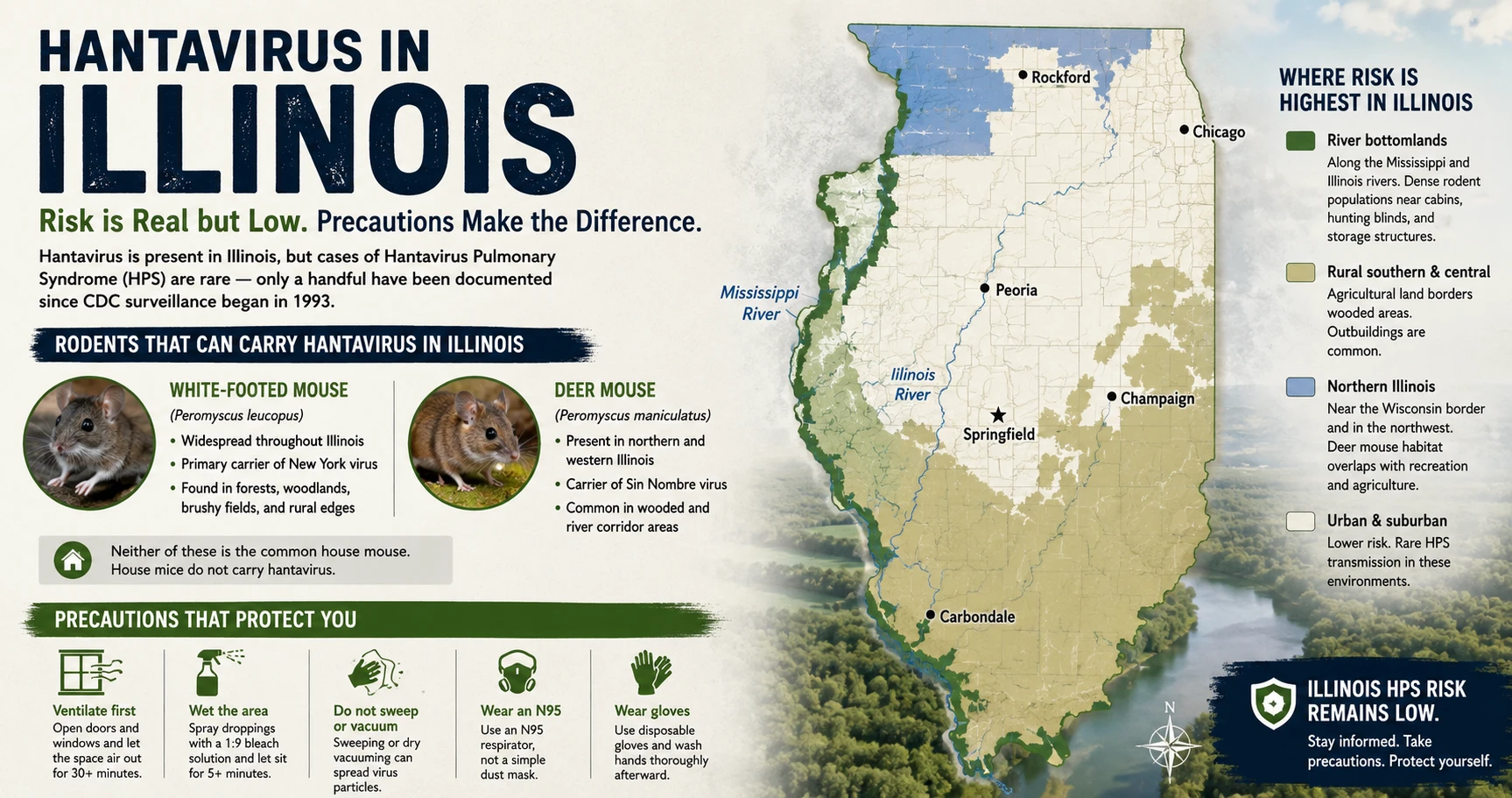
If you live in Illinois and you've seen hantavirus in the news recently, you're probably wondering whether there's any real risk where you live. The short answer: yes, hantavirus is present in Illinois — but cases of Hantavirus Pulmonary Syndrome (HPS) are rare, numbering in the single digits over three decades of CDC surveillance. This is not a state on the front lines of the hantavirus problem. That said, the risk is not zero, and the same precautions that apply everywhere else apply here.
Which Rodents Carry Hantavirus in Illinois
Illinois does not have the same rodent profile as the western United States, where hantavirus cases are concentrated.
The primary carrier in Illinois is the white-footed mouse (Peromyscus leucopus). This species is found throughout most of the state — in forests, woodlands, brushy fields, and the edges of agricultural land. It is associated with New York virus, a hantavirus strain that can cause HPS, though it appears to do so less frequently than Sin Nombre virus, the strain dominant in the West.
The deer mouse (Peromyscus maniculatus) — the main carrier of Sin Nombre virus — does extend into Illinois, particularly in the northern and western portions of the state, including areas near the Mississippi River corridor. If you spend time in rural northern or western Illinois, deer mice are a real possibility.
Neither of these is the common house mouse (Mus musculus). The house mouse does not carry hantavirus. The distinction matters because white-footed and deer mice are wild mice that tend to invade barns, cabins, sheds, and outbuildings — not typically year-round residents of urban homes.
Where in Illinois the Risk Is Highest
Risk in Illinois is not evenly distributed. The areas where exposure is most plausible are:
- River bottomlands, particularly along the Mississippi and Illinois rivers, where rodent populations are dense and people use cabins, hunting blinds, and storage structures that sit unused for months
- Rural southern and central Illinois, where agricultural land borders wooded areas and outbuildings are common
- Northern Illinois near the Wisconsin border, where deer mouse habitat overlaps with recreational and agricultural use
Urban and suburban environments carry lower risk. The white-footed mouse does live near the suburban fringe, but HPS transmission requires close contact with rodent droppings, urine, or nesting material — typically in enclosed, poorly ventilated spaces. A mouse running through your yard is not the scenario that leads to HPS.
How Many Cases Has Illinois Had?
CDC surveillance for HPS began in 1993. Since then, Illinois has recorded only a handful of confirmed cases — far fewer than western states like New Mexico, Colorado, or California, which account for the majority of the roughly 850 total U.S. cases on record.
The Illinois Department of Public Health monitors for HPS and would be the first point of contact for any suspected cases in the state. The low case count reflects both the lower prevalence of deer mice compared to the West and the fact that New York virus, carried by white-footed mice, appears to produce severe illness less often than Sin Nombre — though the evidence on this is still developing.
Low case count does not mean the disease is not diagnosable here. Physicians in Illinois are capable of recognizing HPS, and the Illinois Department of Public Health has infrastructure to investigate suspected cases.
Why Searches Spiked in 2026
If you searched for "hantavirus Illinois" recently, you're not alone. Search interest in hantavirus spiked nationally in 2026 following media coverage of individual cases — including cases connected to the Hondius expedition vessel and coverage of the death of Gene Hackman. These stories drove wide public attention to hantavirus as a disease category.
There is no known outbreak of hantavirus in Illinois in 2026. The spike in Illinois-specific searches reflects Illinoisans reading national news and asking reasonable questions about their own state — not a signal that something new is happening locally. The Illinois risk profile has not changed.
Precautions for Illinois Residents
If you are cleaning or entering a structure that has had rodent activity — a rural cabin, barn, shed, hunting blind, or storage building — the same precautions apply in Illinois as anywhere:
- Do not sweep or vacuum dry droppings. Sweeping kicks virus particles into the air. This is how most exposures happen.
- Wet the area first. Spray droppings and nesting material with a bleach solution (1 part bleach to 9 parts water) and let it sit for at least five minutes before wiping up with disposable towels.
- Wear an N95 respirator, not a simple dust mask. N95s filter particles at the size range relevant to hantavirus.
- Ventilate before entering. Open doors and windows and let the space air out for at least 30 minutes before you go in.
- Wear gloves and wash hands thoroughly afterward.
These precautions are not complicated. They are effective. If you follow them, your risk of HPS exposure during a typical cleaning job drops substantially.
If you develop fever, muscle aches, and shortness of breath within one to five weeks of cleaning out a rodent-infested space, tell your doctor about the exposure. HPS is treatable with supportive care, and early recognition matters.
Sources & References
- CDC — Centers for Disease Control and Prevention
Hantavirus: Prevention, Symptoms & Control
- cdc.gov — Index
https://www.cdc.gov/hantavirus/php/surveillance/index.html
- dph.illinois.gov — Hantavirus
https://dph.illinois.gov/topics-services/diseases-and-conditions/diseases-a-z-list/diseases/hantavirus.html
All health claims on this page are verified against the primary sources listed above. View our Editorial Policy
Frequently Asked Questions
Medical Disclaimer
The information on this page is for educational purposes only and is not medical advice. If you believe you may have been exposed to hantavirus or are experiencing symptoms, contact a qualified healthcare professional or local health authority immediately.