Can Lysol Kill Hantavirus?
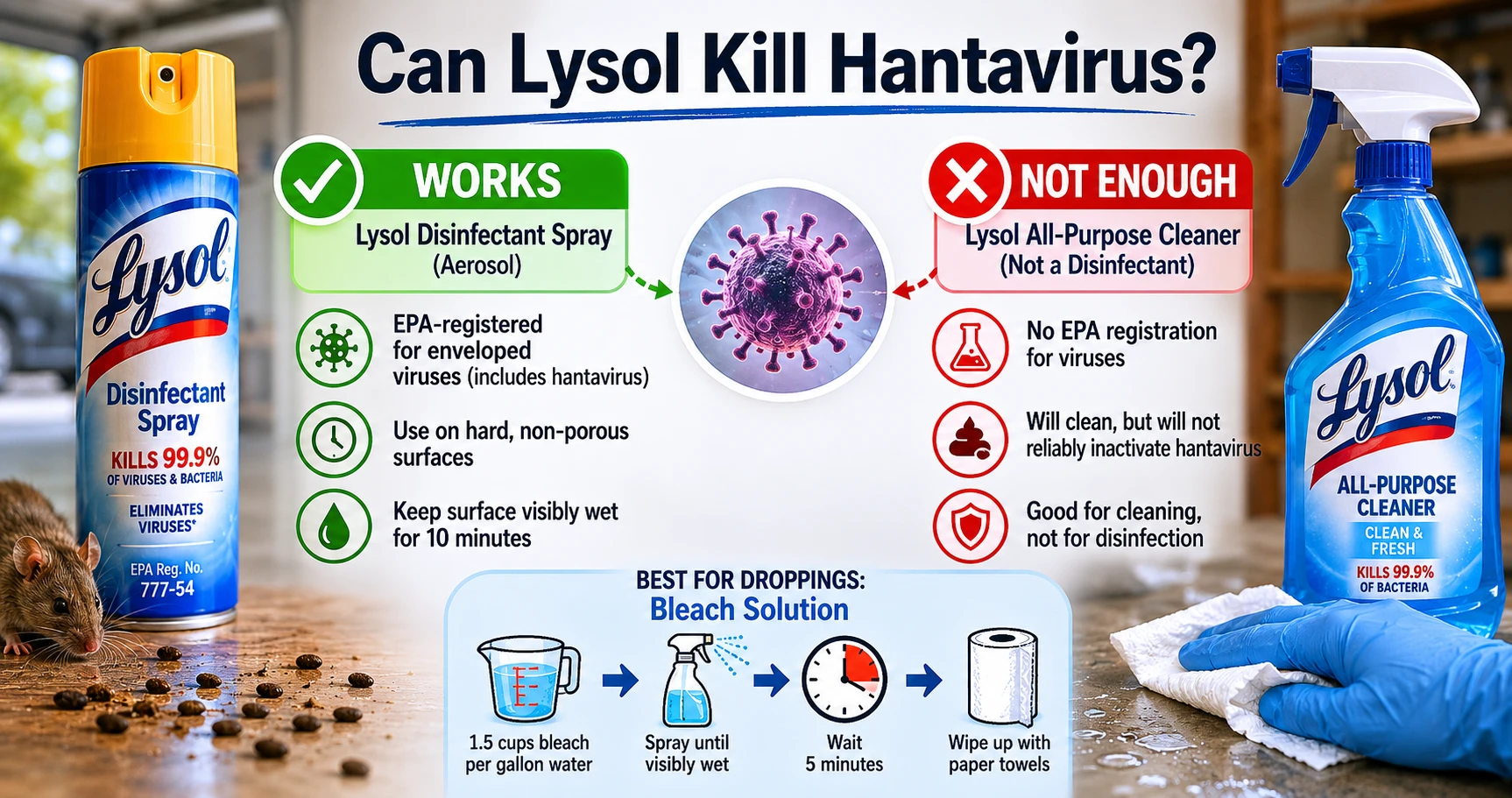
When I found mouse droppings in my garage, my first instinct was to grab whatever was under the sink. That happened to be a bottle of Lysol All-Purpose Cleaner — the blue one. It smelled like disinfectant. It said "kills 99.9% of bacteria" on the front.
I sprayed it on the droppings and wiped them up. Problem solved, I thought.
The issue is that "kills 99.9% of bacteria" and "inactivates hantavirus" are not the same claim. Bacteria and viruses are different things. And not all products with "Lysol" on the label are the same product.
The distinction that actually matters
Lysol makes dozens of products. The one most people picture — the aerosol spray in the brown-and-yellow can — is Lysol Disinfectant Spray. It contains a combination of ethanol and quaternary ammonium compounds. According to CDC's MMWR guidance on hantavirus risk reduction, disinfectants based on "phenols, quaternary ammonium compounds, and hypochlorite" are effective against hantavirus. Lysol Disinfectant Spray's active ingredients fall squarely in that category.
Hantavirus is an enveloped virus. Under the EPA's Emerging Viral Pathogens framework, products that demonstrate effectiveness against enveloped viruses can make claims against new enveloped viral pathogens — Lysol Disinfectant Spray qualifies. So used correctly on a hard surface, it can inactivate hantavirus.
But the bottle under most people's sinks isn't Lysol Disinfectant Spray. It's Lysol All-Purpose Cleaner, or Lysol Multi-Surface, or one of the other cleaning products that borrow the Lysol name. These don't carry the same EPA disinfectant claims. They'll remove visible grime. They won't reliably inactivate a virus.
To know which category a product falls into, look for the EPA registration number on the label. Legitimate disinfectants will have one. If you don't see it, the product is a cleaner — not a disinfectant.
Where Lysol Disinfectant Spray fits in a cleanup
Even if you have the right Lysol product, there's a limitation worth knowing: the spray is primarily alcohol, and alcohol doesn't penetrate organic material well.
Dried rodent droppings are a dense matrix of proteins and organic debris. When you spray alcohol on the surface, it evaporates before it reaches virus particles embedded inside the material. This is the same reason CDC's MMWR cleanup protocol leads with bleach rather than alcohol-based sprays — bleach soaks in, alcohol mostly doesn't.
Where Lysol Disinfectant Spray does make sense is as a secondary step: after you've removed the droppings using the bleach protocol, you can use it to wipe down surrounding hard surfaces — countertops, shelving, door handles — as a follow-up measure. For that purpose, it's a reasonable tool.
Contact time matters regardless of what you use. Lysol's disinfectant claims require the surface to remain visibly wet for a specific period — typically ten minutes. Spray and immediately wipe isn't disinfection.
The practical version
If you're about to clean up rodent droppings and wondering whether the Lysol in your cabinet is enough:
Check the label. Does it have an EPA registration number? Does it list efficacy against enveloped viruses or viral pathogens? If yes, it can work as a supplemental disinfectant for hard surfaces. If no, it's a cleaner — useful for cleaning, not for inactivating hantavirus.
For the droppings themselves, bleach is the more reliable choice. CDC's MMWR guidance specifies mixing 1½ cups of household bleach per gallon of water, spraying until the material is visibly wet, waiting five minutes, then wiping up with paper towels and double-bagging the waste. That protocol is built around penetrating the organic material that surrounds the virus — something alcohol-based sprays don't do reliably.
Lysol isn't wrong to reach for. The aerosol version, used on the right surfaces, genuinely works. It's just not a replacement for bleach when you're dealing with the droppings directly.
Sources & References
- CDC — Centers for Disease Control and Prevention
Hantavirus: Prevention, Symptoms & Control
- cdc.gov — Cleaning Up
https://www.cdc.gov/hantavirus/prevention/cleaning-up.html
- cdc.gov — Rr5109a1
https://www.cdc.gov/mmwr/preview/mmwrhtml/rr5109a1.htm
- EPA — Environmental Protection Agency
Registered Disinfectants for Emerging Viral Pathogens
All health claims on this page are verified against the primary sources listed above. View our Editorial Policy
Frequently Asked Questions
Medical Disclaimer
The information on this page is for educational purposes only and is not medical advice. If you believe you may have been exposed to hantavirus or are experiencing symptoms, contact a qualified healthcare professional or local health authority immediately.